
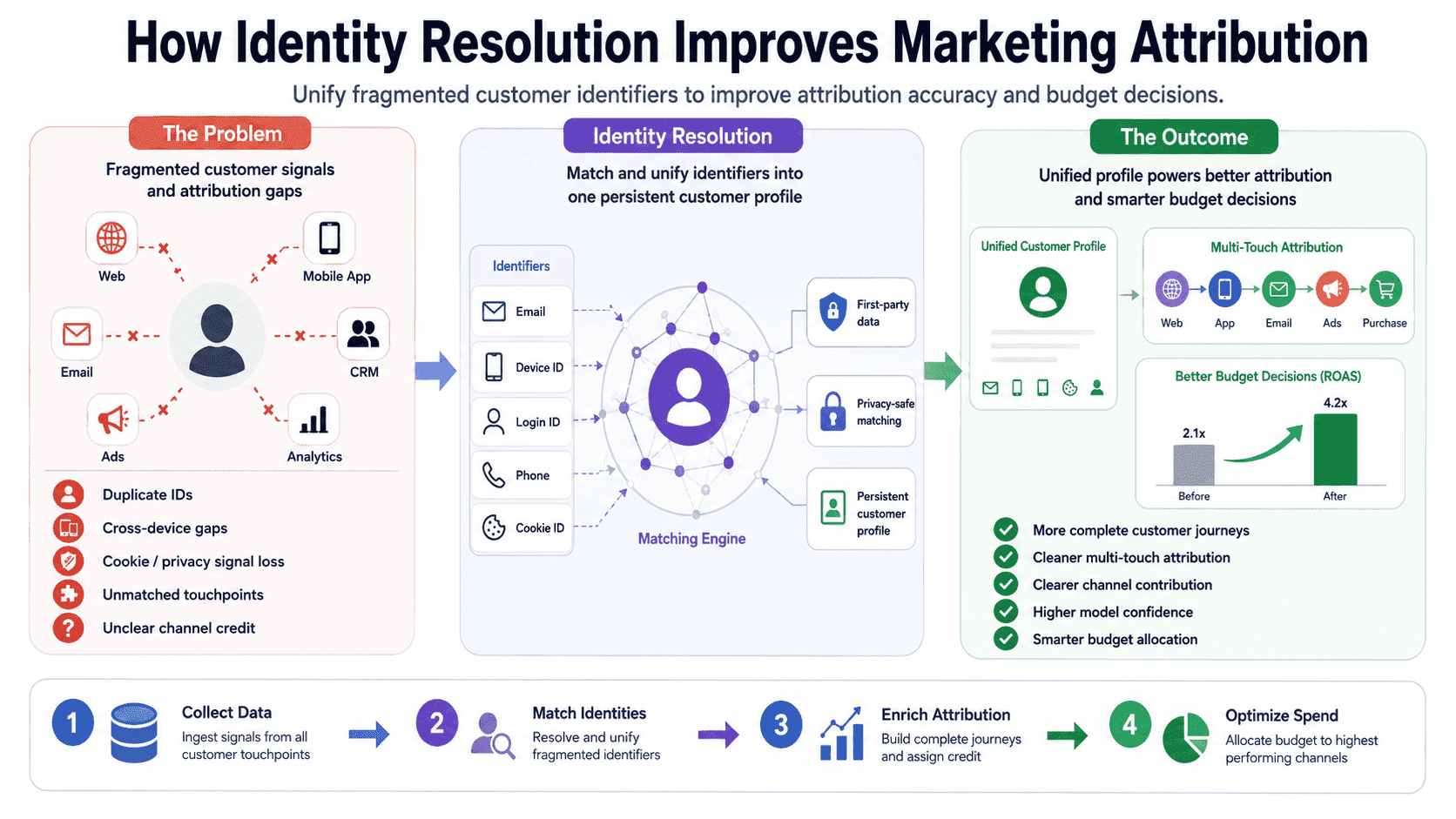
Unifying fragmented customer data for more reliable marketing attribution insights
Ranjeet Ranjan
AI Executive Brief
Identity resolution marketing attribution helps consolidate dispersed customer identifiers into persistent profiles, enhancing attribution accuracy despite privacy constraints and enabling better-informed marketing budget decisions.
Marketing professionals struggle with fragmented customer data across devices and channels, which undermines marketing attribution accuracy and leads to misguided budget decisions. Added privacy regulations and declining reliability of third-party tracking introduce blind spots in understanding customer journeys. These challenges risk overspending on ineffective channels or neglecting key touchpoints. This article explains how identity resolution marketing attribution helps unify dispersed customer identifiers into persistent profiles, enabling clearer, more reliable attribution. You will learn practical steps to integrate identity resolution into your attribution pipelines, manage privacy constraints, and measure improvements in marketing ROI confidence.
How Identity Resolution Enhances Marketing Attribution Accuracy
Marketing professionals struggle with fragmented customer data across devices and channels, which undermines marketing attribution accuracy and leads to misguided budget decisions. Added privacy regulations and declining reliability of third-party tracking introduce blind spots in understanding customer journeys. These challenges risk overspending on ineffective channels or neglecting key touchpoints. This article explains how identity resolution marketing attribution helps unify dispersed customer identifiers into persistent profiles, enabling clearer, more reliable attribution. You will learn practical steps to integrate identity resolution into your attribution pipelines, manage privacy constraints, and measure improvements in marketing ROI confidence.
Business Risks of Fragmented Customer Data in Marketing Attribution
How Fragmented Customer Identities Cause Attribution Errors and Budget Misallocation
When customer identifiers are scattered across devices, platforms, and channels, attribution models fail to fully connect touchpoints to the correct individual. This fragmentation creates partial or duplicate views, leading to attribution errors where certain channels receive undue credit while others are undervalued. The result is inefficient marketing spend, with investment decisions based on inaccurate signals that do not reflect genuine influence on customer conversions.
Privacy-Driven Measurement Constraints and Their Impact
Privacy regulations like GDPR and CCPA, along with cookie restrictions and browser privacy features, limit access to cross-site tracking and third-party data. This reduces the availability of key signals used in attribution models, creating measurement gaps. As a consequence, marketers face greater uncertainty in connecting interactions across devices and channels, weakening attribution completeness and confidence.
Attribution Challenges from Data Silos and Privacy Restrictions
Cross-Device and Cross-Channel Data Fragmentation
Customers engage with brands through multiple devices and channels—such as mobile apps, desktop sites, email, social ads, or in-store visits. These interactions are often tracked separately and lack a unifying identity. Without consolidating these touchpoints into a single view, marketers miss the full customer journey, making it harder to understand channel influence and tailor effective marketing strategies.
Signal Loss from Cookie Restrictions in Attribution Models
The decline in third-party cookie reliability due to browser updates and privacy policies reduces data coverage needed for accurate attribution. Models reliant on cookie-based tracking face blind spots, especially for cross-device journeys. Addressing this loss requires adopting identity resolution techniques that leverage first-party and privacy-compliant signals.
Data Integration and Quality Challenges Affecting Attribution Confidence
Accurate attribution depends on consistent, accurate, and timely customer data from all marketing platforms. However, merging data from disparate sources often reveals issues such as duplicates, incomplete profiles, or outdated identifiers. These quality problems distort attribution results and reduce trust in marketing analytics.
Understanding Identity Resolution and Its Role in Marketing Attribution
Creating Unified, Persistent Customer Profiles
Identity resolution links fragmented customer data points—like device IDs, email addresses, login credentials, and behavioral signals—into a single, persistent profile that reflects the individual accurately across time and touchpoints. This unified profile enables marketers to view a consolidated customer journey instead of disjointed fragments.
Enhancing Multi-Touch Attribution with Identity Resolution
Multi-touch attribution assigns credit to a sequence of marketing interactions that lead to a conversion. Identity resolution strengthens this by aggregating all relevant touchpoints under one accurate profile. This reduces errors from duplicate or unmatched identifiers and provides clearer insights into how each channel contributes to outcomes.
Practical Framework: Integrating Identity Resolution into Attribution Pipelines
Step 1: Comprehensive Data Collection and Integration
Start by gathering customer data from all sources, including CRM, web analytics, ad platforms, and offline touchpoints. Use reliable connectors or APIs to maintain continuous, fresh data streams. Comprehensive data sourcing reduces gaps in customer coverage essential for unification.
Step 2: Identity Matching and Building Unified Profiles
Apply deterministic matching (e.g., login IDs, email addresses) alongside probabilistic methods (e.g., device patterns, behavior) to link identifiers across datasets. This process generates unified profiles, respecting privacy requirements and safeguarding personal data.
Step 3: Feeding High-Quality Profiles into Attribution Models
The unified customer profiles serve as enriched, cleaner inputs for attribution engines. This quality improvement supports more accurate model outputs that reflect genuine marketing influence across channels and devices.
Step 4: Continuous Monitoring of Attribution Accuracy
Implement ongoing KPI tracking to measure data consistency, model confidence, and clarity in channel contribution. Compare attribution results before and after identity resolution integration to identify improvements and adjust strategies accordingly.
Ensuring Privacy Compliance in Identity Resolution for Attribution
Privacy-Respecting Methods for Identity Resolution
Identity resolution must comply with regulations such as GDPR and CCPA by minimizing personal data exposure and avoiding unauthorized tracking. Techniques like encrypted identifiers, hashed tokens, and consent-based processing support compliant identity linkage.
Balancing Privacy-Driven Measurement Gaps with Compliance
While privacy laws limit certain tracking capabilities, identity resolution can bridge measurement gaps by leveraging first-party data and privacy-safe hashed signals instead of third-party cookies. This balance allows marketers to maintain more complete attribution without violating regulations.
Common Pitfalls When Implementing Identity Resolution for Marketing Attribution
- Applying identity resolution without first addressing data quality problems, resulting in inaccurate profiles.
- Omitting key data sources, leading to incomplete customer views and gaps in unified profiles.
- Relying excessively on probabilistic matching while lacking enough deterministic data, increasing profile uncertainty.
- Overlooking privacy regulations and consent management, risking compliance violations.
- Failing to establish ongoing validation and monitoring of identity resolution accuracy and attribution outputs.
- Underestimating the technical and analytical complexity of cross-device identity linkage, neglecting expert support needs.
Measuring Success: KPIs to Track Attribution Improvements
Indicators of Data Accuracy and Profile Consistency
Monitor metrics such as reductions in duplicate profiles, increased matched identifiers, and the completeness of unified customer records. Improvements in these areas reflect stronger data integration and identity resolution.
Attribution Model Confidence and Channel Clarity Metrics
Assess the statistical confidence of attribution model outputs and stabilized channel credit distribution. Enhanced identity resolution typically leads to clearer, more consistent multi-touch attribution results.
Marketing Spend Alignment and ROI Indicators
Evaluate how well marketing budgets align with channels that demonstrate consistent contribution across unified customer journeys. This alignment supports more informed and potentially optimized budget allocation.
| Traditional Attribution Without Identity Resolution | Attribution Enhanced by Identity Resolution |
|---|---|
| Customer data fragmented across devices and channels | Unified, persistent customer profiles connecting all identifiers |
| High number of duplicates and unmatched identifiers | Reduced duplicates, more complete and accurate profiles |
| Attribution models show gaps and blind spots from fragmented data | Improved attribution completeness across devices and channels |
| Inconsistent and uncertain channel crediting | Clearer channel contribution insights and higher confidence |
| Risk of poor budget decisions due to inaccurate data | Better-informed budget allocation backed by reliable attribution |
How DriveMetaData Supports Identity Resolution for Improved Marketing Attribution
Unified Customer Identity Graphs for Persistent, Privacy-Compliant Profiles
DriveMetaData helps marketers unify fragmented customer identifiers into persistent profiles within privacy-compliant identity graphs. This comprehensive framework supports multi-touch attribution with clearer insights into cross-device and cross-channel customer journeys.
Robust Data Integration and Cleansing for Quality Attribution Inputs
The platform offers strong data integration and cleansing capabilities that consolidate and validate diverse marketing data sources. This process enhances data accuracy, boosting trust and confidence in attribution models' outputs.
Privacy-Aware Enhancements to Mitigate Measurement Gaps
DriveMetaData incorporates privacy-aware identity resolution approaches designed to reduce measurement gaps caused by cookie restrictions and signal loss. This helps marketers maintain compliant and more complete attribution despite privacy-driven constraints.
Next Steps: Implement Identity Resolution to Improve Marketing Attribution Confidence
Accurate marketing attribution requires overcoming fragmented customer data and privacy limitations with effective identity resolution. By following a structured integration approach, avoiding common pitfalls, and monitoring key success metrics, marketers can gain clearer insights into channel impact and optimize budgets confidently. Request a demo to see how DriveMetaData can unify your customer data and improve marketing attribution accuracy.
FAQ
What is identity resolution in marketing attribution?
Identity resolution is the process of linking scattered customer identifiers into unified, persistent profiles. This helps marketers accurately connect all touchpoints to the right individual, improving attribution accuracy.
How does privacy regulation affect marketing attribution?
Privacy laws and cookie restrictions limit access to third-party tracking data, creating gaps in attribution models. Marketers must adopt privacy-compliant methods, such as using first-party data and encrypted identifiers, to maintain attribution completeness.
What are common mistakes when implementing identity resolution?
Common errors include neglecting data quality, missing data sources, overusing probabilistic matching, ignoring privacy compliance, and lacking ongoing validation of identity resolution and attribution accuracy.
How can marketers measure the success of identity resolution in attribution?
Success can be tracked by monitoring reductions in duplicate profiles, increases in matched identifiers, improved model confidence, clearer channel attribution, and better alignment of marketing spend with effective channels.
Accurate marketing attribution requires overcoming fragmented customer data and privacy limitations with effective identity resolution. By following a structured integration approach, avoiding common pitfalls, and monitoring key success metrics, marketers can gain clearer insights into channel impact and optimize budgets confidently. Request a demo to see how DriveMetaData can unify your customer data and improve marketing attribution accuracy.
Attribution Audit
Find the gaps hiding in your attribution data.
Get a focused audit of campaign tracking, ROAS signals, and conversion paths before media spend leaks into blind spots.
Related Blogs
More from our insights
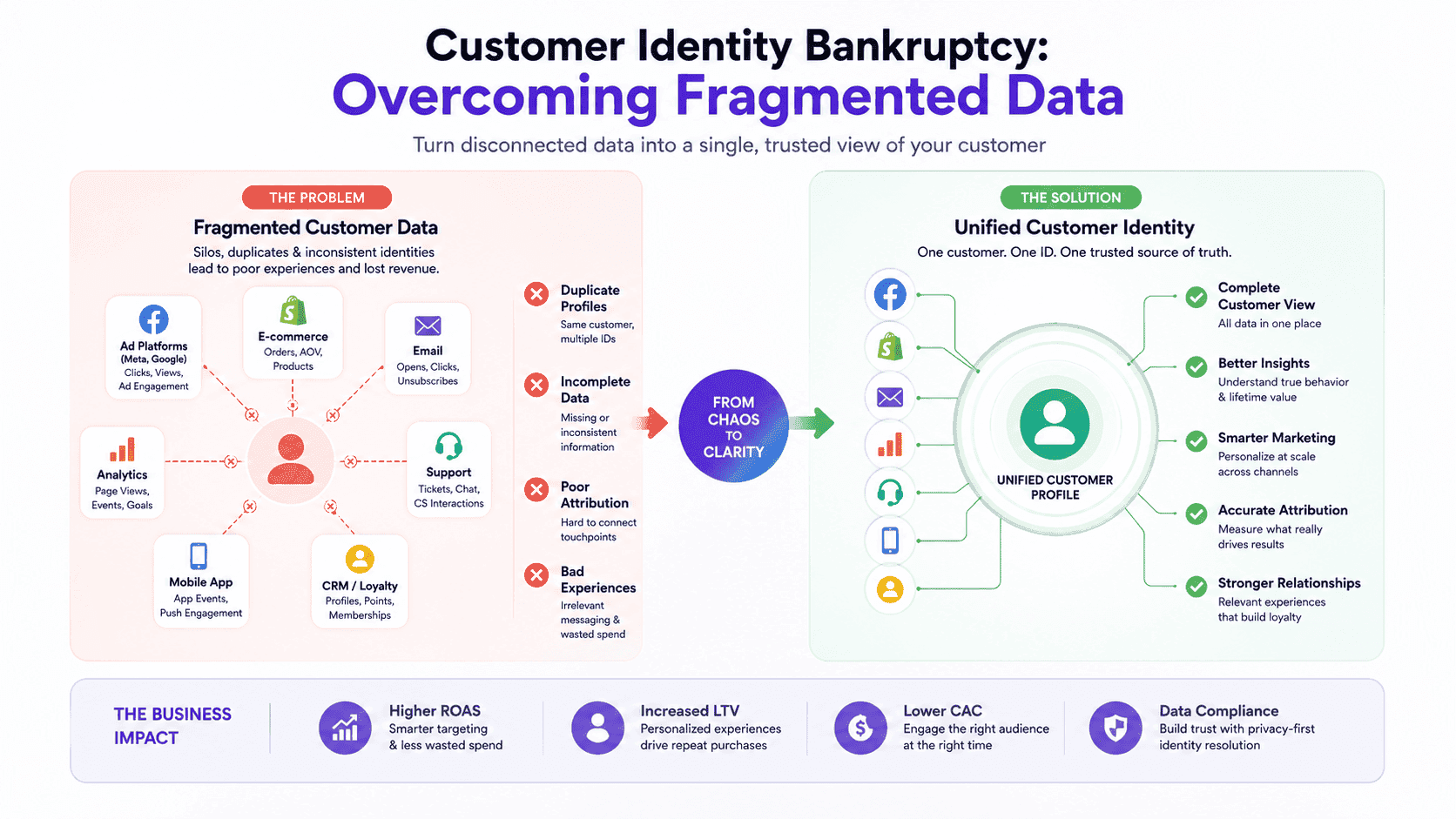
Customer Identity Bankruptcy: Overcoming Fragmented Data & Disconnected Tools
Customer Data Platform · 4 min read
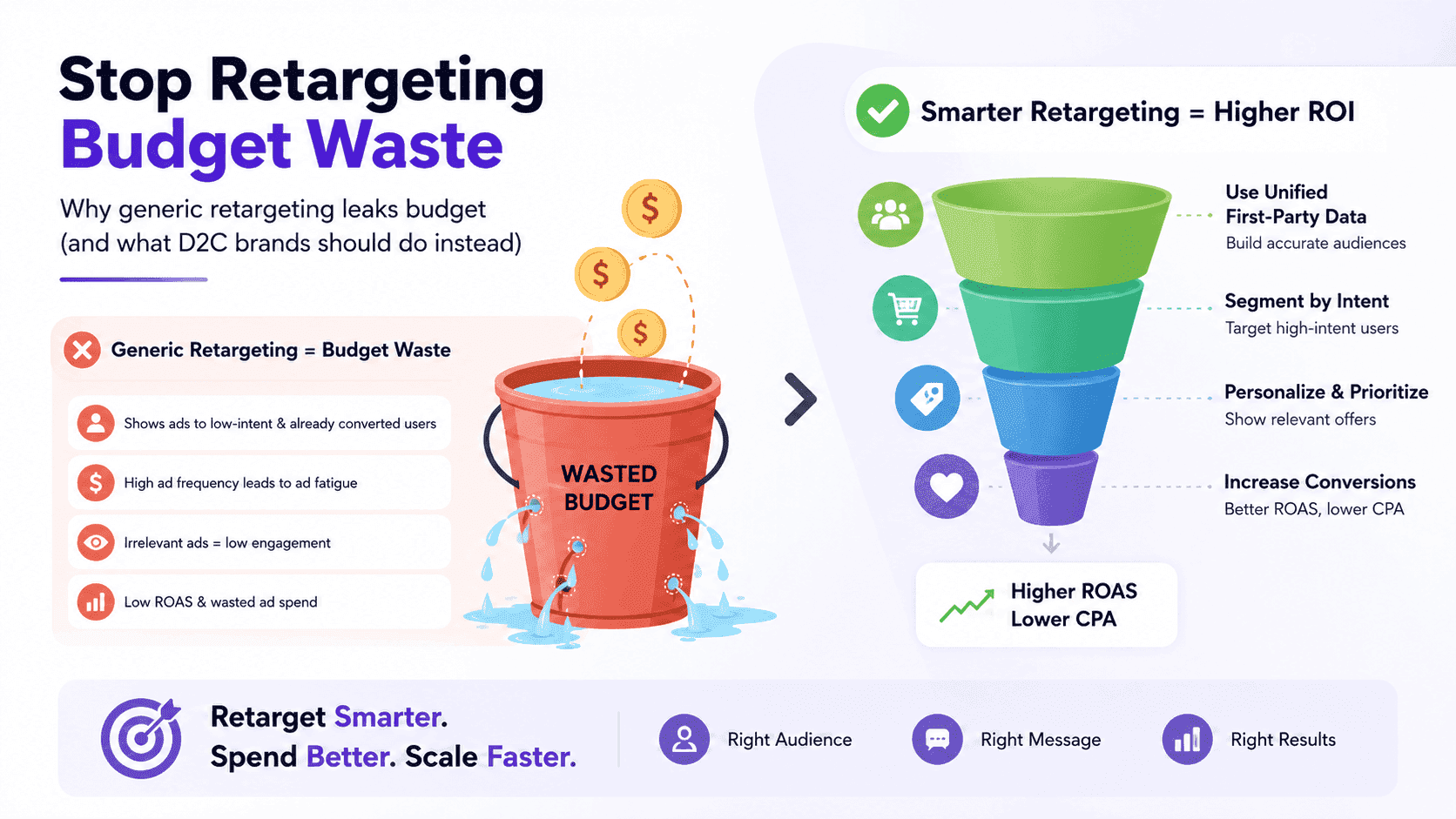
Retargeting Inefficiencies in D2C Brands: Avoiding Budget Waste and Doubling Customer Payments
Marketing Attribution · 5 min read
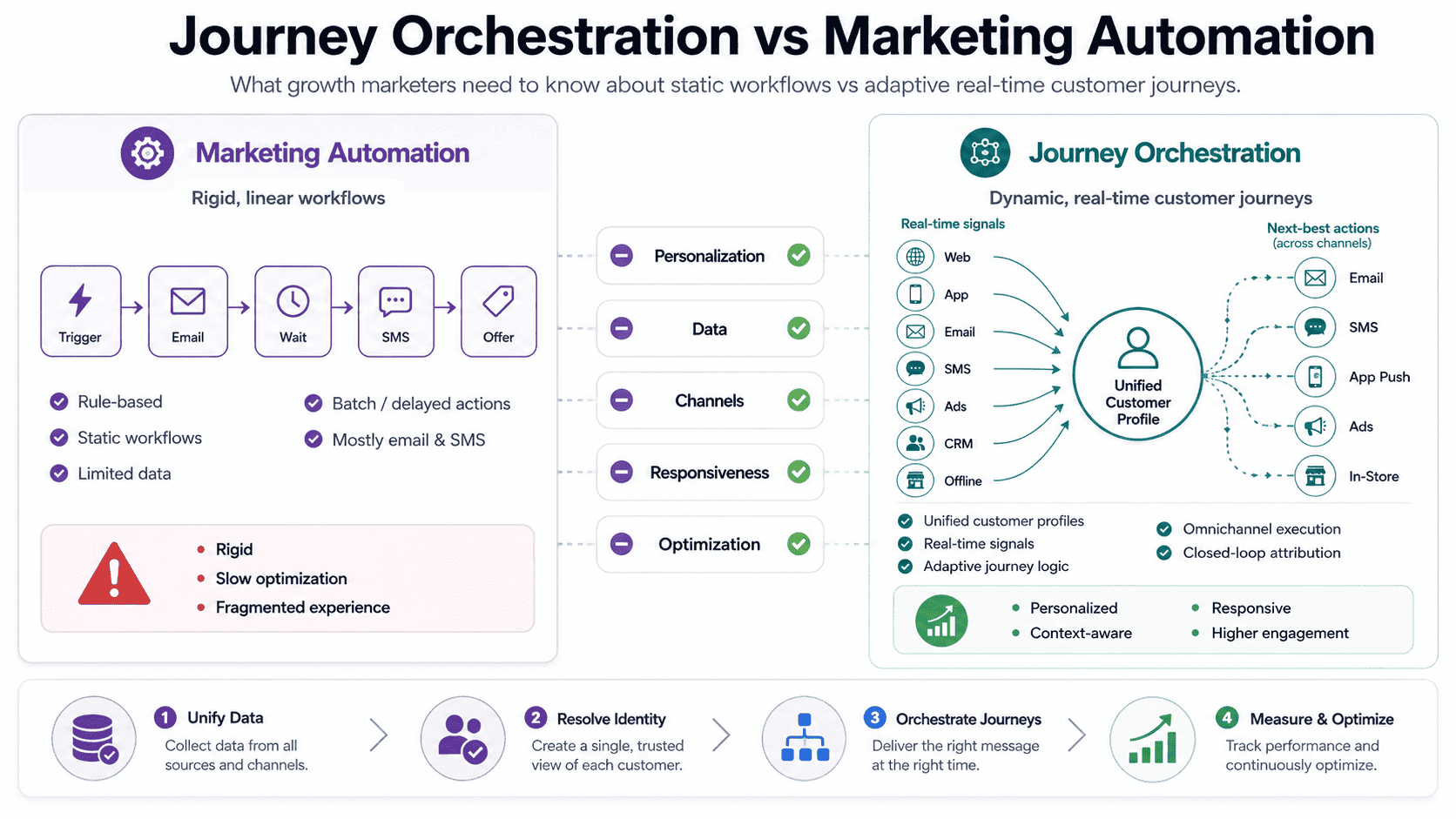
Journey Orchestration vs Marketing Automation: What Growth Marketers Need to Know
Journey Orchestration · 2 min read