
Ranjeet Ranjan
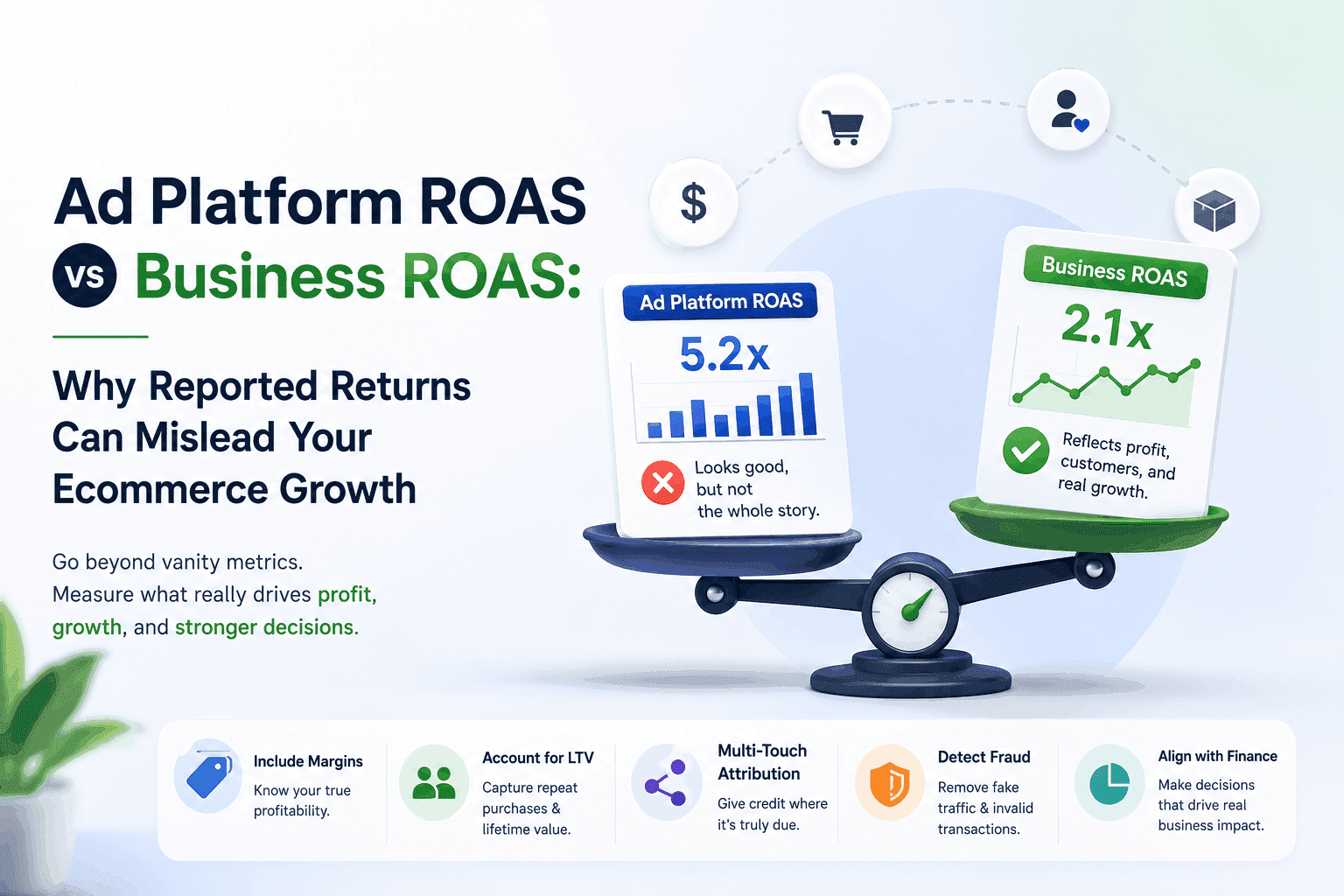
Ad Platform ROAS vs Business ROAS: Why Reported Returns Can Mislead Your Ecommerce Growth
Why Relying on Ad Platform ROAS Can Harm Your Ecommerce Growth
If you’re an ecommerce founder, D2C marketer, or growth leader, you’ve likely seen ad platform ROAS metrics that look promising but don’t translate into actual profits. This gap risks wasted budget, margin erosion, and stalled growth because platform ROAS often overlooks key cost and customer factors.
In this article, you’ll learn why ad platform ROAS can be misleading, which costs and behaviors it misses, and how to calculate a true business ROAS that captures profitability by integrating marketing spend with Shopify revenue, margins, repeat purchases, and multi-touch attribution. Armed with this insight, you can make smarter, finance-aligned marketing decisions.
Key Differences Between Ad Platform ROAS and True Business ROAS
What Ad Platform ROAS Measures—and What It Omits
Ad platform ROAS is usually calculated as:
Revenue attributed to ads ÷ ad spend
Typically relying on last-click or single-touch attribution, it credits revenue only to the last ad interaction within a short window. However, it often excludes:
- Product Margins: Counts gross revenue without subtracting product costs (COGS).
- Repeat Purchases: Ignores revenue from customers’ later orders.
- Ad Fraud: Doesn’t always adjust for invalid or non-human traffic.
- Offline/Other Costs: Fails to include shipping, fulfillment, or operational expenses.
This can result in inflated ROAS values that exaggerate marketing effectiveness.
How Business ROAS Reflects True Profitability
True business ROAS factors in:
- Margins: Incorporates COGS to measure profit, not just revenue.
- Repeat Purchases and Lifetime Value: Credits revenue beyond the first purchase influenced by advertising.
- Multi-Touch Attribution: Distributes credit fairly across all marketing touchpoints.
- Fraud Detection: Filters out invalid clicks and transactions.
- Finance Integration: Aligns marketing returns with accounting data and real costs.
This comprehensive view reveals the sustainable impact of advertising on business growth.
| Metric | Ad Platform ROAS | Business ROAS |
|---|---|---|
| Includes | Attributed platform revenue | Revenue plus margins, repeat purchases, and finance data |
| Attribution Model | Mostly last-click or single touch | Multi-touch across full customer journey |
| Excluded Costs | Product margins, fraud, offline expenses | Integrated margins, COGS, fraud detection |
| Business Risks | Overspending, misallocated budgets | Informed decisions, profit-aligned KPIs |
Why Ad Platform ROAS Can Mislead Ecommerce Marketers
Last-Click Attribution and Short Windows Limit Accuracy
Last-click attribution credits only the final ad interaction, ignoring earlier influences like display ads or social engagement. This undervalues upper-funnel channels and inflates the performance of ads closest to purchase. Learn more about different attribution models in our marketing attribution guide.
Short attribution windows (often 7 days) miss longer consideration cycles typical in ecommerce and ignore revenue from returning customers.
Ignored Costs: Margins, Fraud, and Offline Expenses
Ad platform ROAS reports gross revenue, not profitability. A $100 sale with 10% margin is treated the same as one with 30% margin. Additionally, fake clicks and fraudulent orders can falsely boost ROAS. Our ad fraud detection features help mitigate this risk.
Costs outside digital ads—like shipping, fulfillment, and returns—also impact profitability but don’t appear in platform metrics.
Calculating True Business ROAS: A Practical Framework
Combine Ad Spend with Shopify Revenue and Margin Data
Start by linking your ad spend to Shopify sales data. Include:
- Product-specific COGS from Shopify
- Shipping and handling costs
- Discounts and promotions
This transforms ROAS from a revenue metric to a profit metric.
Incorporate Repeat Purchases and Customer Lifetime Value
Track customers’ repeat buying habits and assign marketing credit proportionally across orders. Use LTV metrics weighted by marketing influence to capture long-term value.
Apply Multi-Touch Attribution for Full Journey Insight
Move beyond last-click to multi-touch attribution that:
- Credits all relevant channels in proportion to their influence
- Uses data-driven or algorithmic attribution models
- Extends conversion windows to capture delayed purchases
This approach balances your marketing mix and better values nurturing channels. Visit our customer journey orchestration page to see how full journey insights improve campaign success.
Risks of Depending Only on Ad Platform ROAS
Overspending Driven by Inflated ROAS
Relying on platform ROAS can push budgets toward superficially high-return channels that erode margins and limit profit growth.
Misalignment Between Marketing and Finance
When marketing and finance teams use different ROAS metrics, confusion and disagreement arise, complicating budgeting and strategy. Solutions integrating marketing data with finance, like DriveMetaData, help align these teams with marketing analytics capabilities.
Choosing Tools to Align Marketing Attribution with Finance
What to Look for in ROAS Measurement Platforms
Select solutions that:
- Ingest data from multiple ad platforms and ecommerce systems like Shopify
- Integrate product costs and margins
- Offer configurable multi-touch attribution
- Detect and exclude ad fraud
- Connect marketing results with finance systems
Key Features Checklist
- Unified data ingestion (ad spend, ecommerce, finance)
- Margin and COGS integration
- Multi-touch attribution models with flexible windows
- Fraud detection capabilities
- Analytics on customer journeys and repeat purchases
- Reporting that supports cross-team collaboration
How DriveMetaData Supports True Business ROAS Measurement
DriveMetaData helps ecommerce brands bridge marketing and finance data for clearer profitability insights. Its capabilities include:
- Unified Attribution and Revenue Connection: Connects ad spend with Shopify orders, product costs, and margins to deliver profit-aligned ROAS metrics.
- Multi-Touch Journey Insights: Tracks full customer paths and fairly attributes credit across channels and purchases.
- Finance and Marketing Alignment: Merges marketing data with finance KPIs to harmonize team decision-making and optimize budgets.
FAQ
What causes discrepancies between ad platform ROAS and business ROAS?
Ad platform ROAS usually relies on last-click attribution and excludes costs like product margins, repeat customer revenue, fraud, and offline expenses, resulting in inflated profitability signals.
How often should ecommerce businesses review attribution models?
At least quarterly reviews help ensure models remain accurate as customer behaviors and marketing channels evolve.
Can integrating Shopify data improve ROAS accuracy?
Yes. Combining Shopify sales and margin data with ad spend creates a more realistic, profit-focused ROAS measurement.
What are the risks of ignoring margin data in ROAS calculations?
Ignoring margins can lead to overspending on low-profit products and diminished overall financial health despite strong revenue numbers.
Take Action: Improve Marketing Outcomes with True ROAS Insights
Understanding the difference between ad platform ROAS and true business ROAS is vital for profitable growth. By integrating marketing spend with Shopify revenue, margins, repeat purchase data, and multi-touch attribution, you can uncover the real return on your advertising investments.
Explore how unified platforms like DriveMetaData can clarify your ROAS and support more informed, aligned marketing decisions by requesting a personalized demo today.
Download our comprehensive guide on measuring true business ROAS for further insights into optimizing your ecommerce marketing strategy.
Attribution Audit
Find the gaps hiding in your attribution data.
Get a focused audit of campaign tracking, ROAS signals, and conversion paths before media spend leaks into blind spots.
Related Blogs
More from our insights
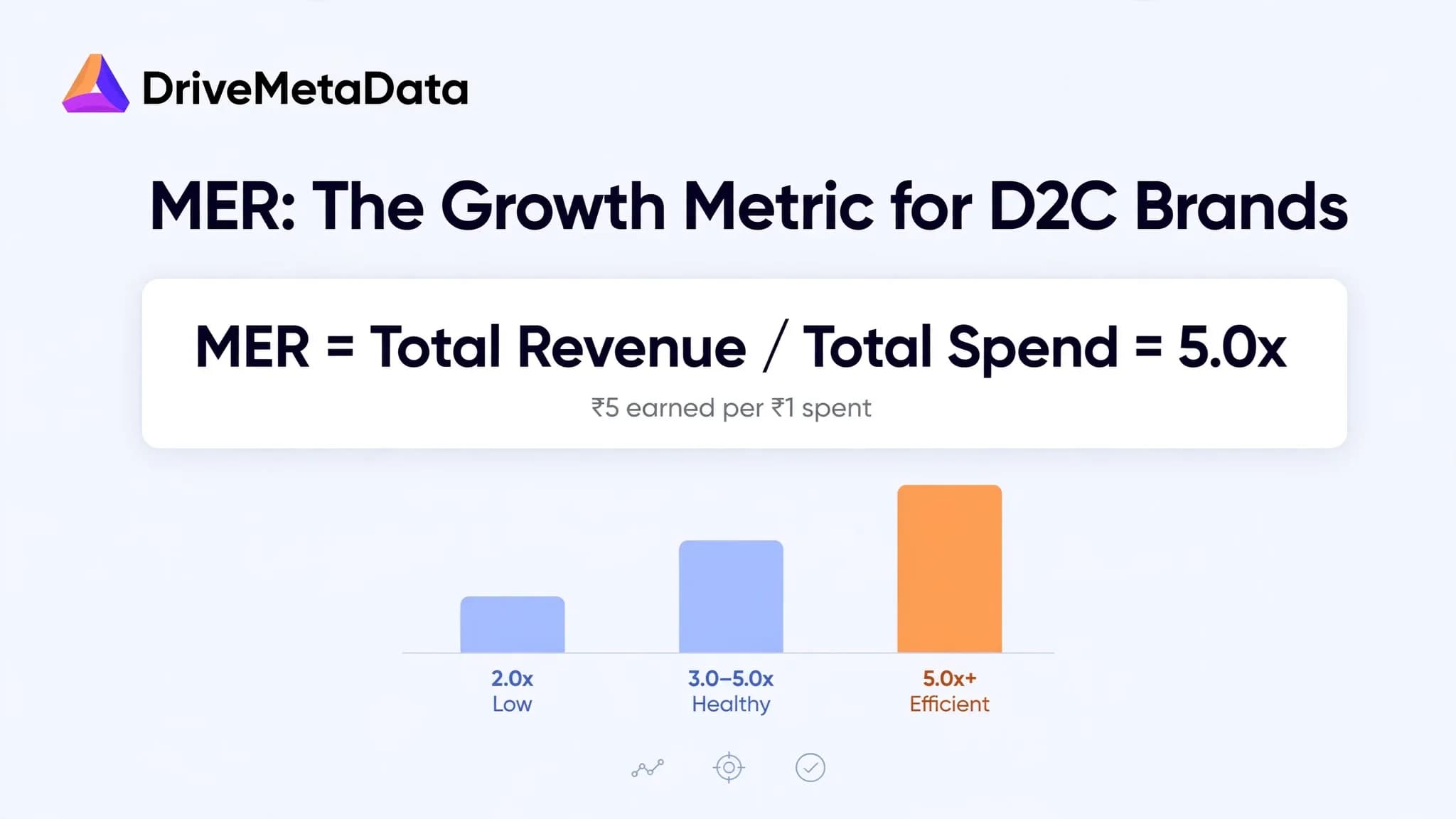
Marketing Efficiency Ratio (MER) Needs A Warning Label For D2C Growth
Customer Data Platform · 8 min read
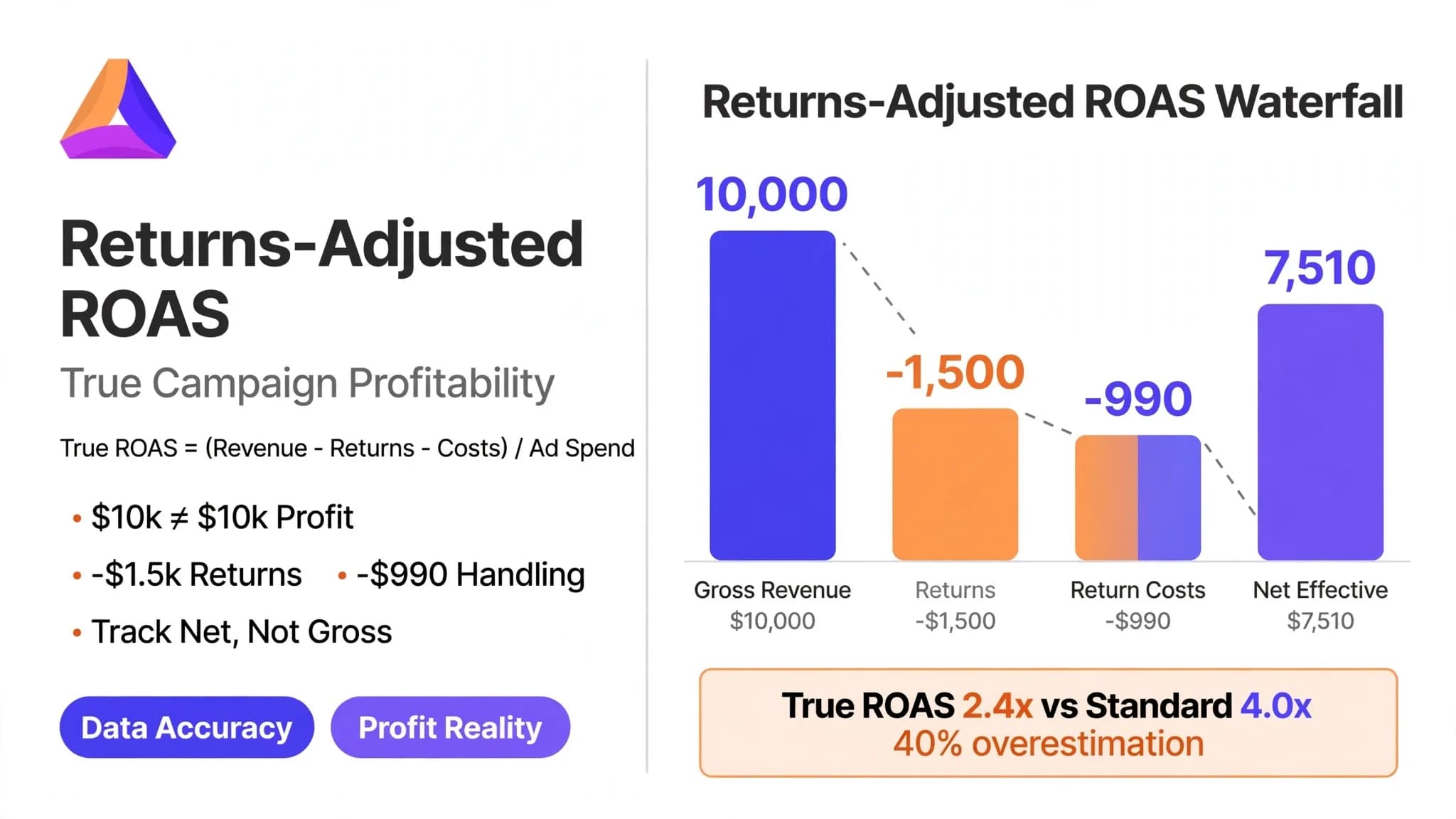
Returns-Adjusted ROAS: Formula, Calculation & How to Measure True Ecommerce Profitability
Customer Data Platform · 11 min read
Select Marketing Attribution Software for Accurate ROAS Tracking
Customer Data Platform · 6 min read