
A guide to selecting the right attribution window for accurate marketing measurement
Ranjeet Ranjan
AI Executive Brief
Attribution windows define the timeframe during which marketing touchpoints receive credit for conversions, impacting campaign measurement accuracy. This article compares 1-day, 7-day, and 28-day windows, discusses their trade-offs, and provides a framework to align window choice with campaign objectives, customer journeys, fraud risk, and privacy factors.
Digital marketers frequently struggle to interpret campaign performance accurately due to uncertainty about which attribution window to select. This confusion can lead to misinterpreted results, misallocated budgets, and flawed optimization decisions. Attribution windows set the timeframe during which a conversion is credited to a marketing touchpoint, making them critical for reliable measurement. This article explains what attribution windows are, compares common 1-day, 7-day, and 28-day options, and offers a practical framework to help marketers pick windows aligned with campaign goals and customer behaviors.
Attribution Window Explained: Choosing Between 1-Day, 7-Day, and 28-Day for Accurate Campaign Measurement
The Business Challenge: Why Choosing the Right Attribution Window Matters
Digital marketers frequently struggle to interpret campaign performance accurately due to uncertainty about which attribution window to select. This confusion can lead to misinterpreted results, misallocated budgets, and flawed optimization decisions. Attribution windows set the timeframe during which a conversion is credited to a marketing touchpoint, making them critical for reliable measurement. This article explains what attribution windows are, compares common 1-day, 7-day, and 28-day options, and offers a practical framework to help marketers pick windows aligned with campaign goals and customer behaviors.
Understanding Attribution Windows and Their Variations
What Is an Attribution Window and Why Does It Matter?
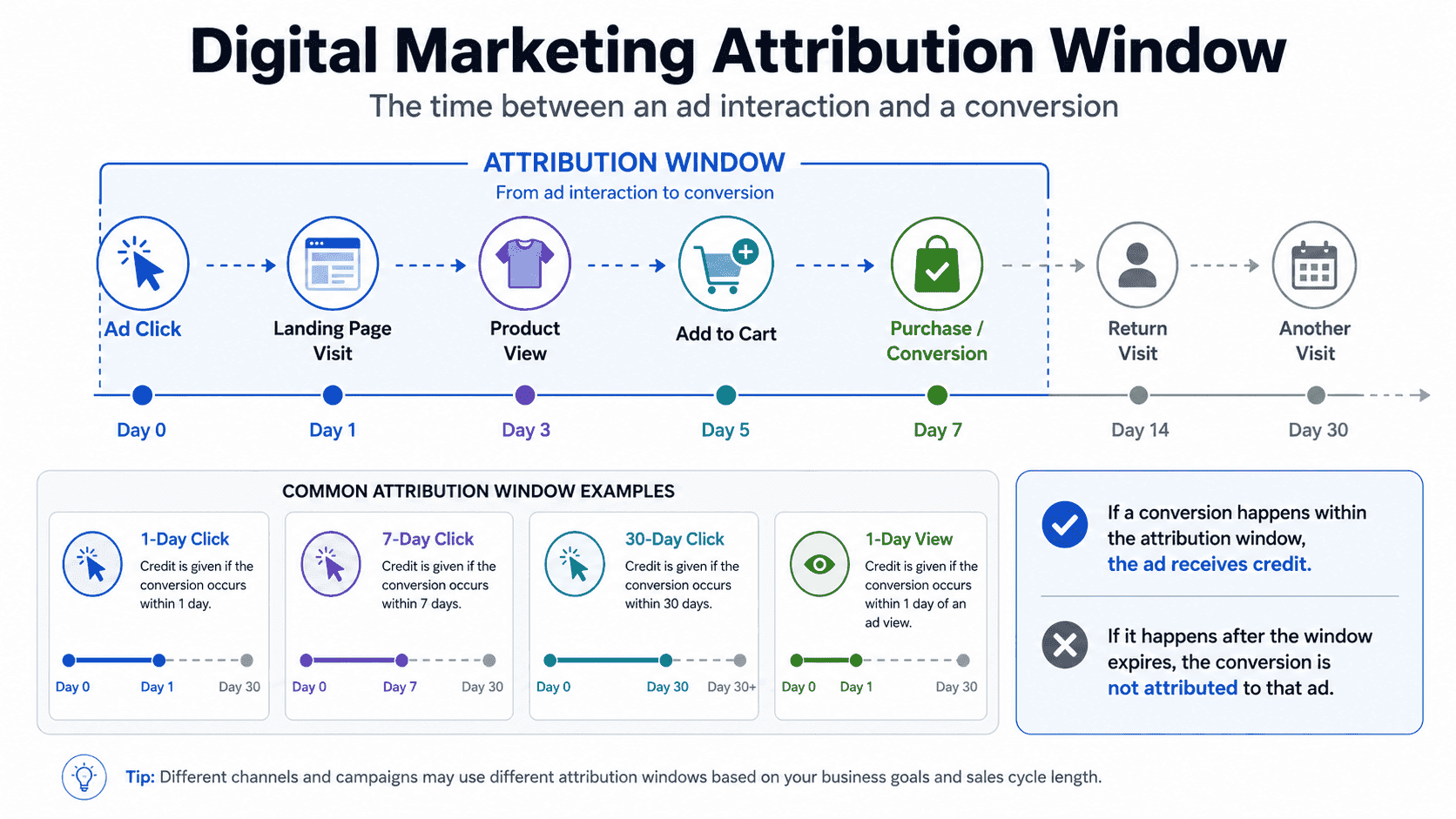
An attribution window defines the maximum period between a marketing interaction—such as clicking an ad or viewing content—and a conversion event for that touchpoint to receive credit. If a user converts within this timeframe after engaging with a marketing channel, that channel is attributed with influencing the conversion.
This timeframe guides how analytics platforms connect ad exposures or engagements to outcomes like sales or sign-ups. Shorter windows credit immediate responses; longer windows capture conversions influenced by earlier touches in the customer journey.
How 1-Day, 7-Day, and 28-Day Attribution Windows Differ
Three common attribution window durations serve distinct marketing measurement needs:
- 1-Day Attribution Window: Credits conversions occurring within 24 hours of the marketing touchpoint. Best for campaigns expecting rapid responses, such as flash sales or quick sign-ups.
- 7-Day Attribution Window: Captures conversions up to one week later. Suitable for campaigns with short buying cycles that may involve some delay in customer response.
- 28-Day Attribution Window: Extends credit to conversions up to a month later. Appropriate for higher-consideration products or services with longer decision windows.
Key Trade-Offs: Advantages and Limitations of Short vs Long Attribution Windows
Balancing Accuracy, Timing, and Optimization Speed
Short attribution windows tend to focus on immediate campaign impacts, offering quicker feedback and more precise optimization opportunities. However, they may exclude conversions influenced by longer buyer journeys.
Longer windows capture delayed conversions, providing fuller insight into campaigns that support extended or complex buying processes. The trade-off includes slower data feedback and potential inclusion of conversions influenced by unrelated external factors.
Risks of Over-Attribution and Under-Attribution
Using too short a window risks under-attributing the full impact of marketing, missing conversions outside the limited timeframe. Conversely, overly long windows risk over-attribution by crediting conversions that may not be directly caused by specific campaigns, leading to inflated ROI estimates.
Marketers should carefully evaluate these risks based on campaign context, customer behavior, and sales cycle to avoid misinformed budgeting.
Selecting the Right Attribution Window: A Practical Framework
Matching Windows to Campaign Types and Objectives
Different types of campaigns benefit from different attribution window lengths:
- Awareness campaigns often require longer windows to capture conversions influenced over time.
- Direct response campaigns with immediate calls to action align better with shorter windows for rapid results.
- Consideration phase campaigns need intermediate windows that track delayed conversion behaviors.
Considering Customer Journey Length and Offline Interactions
Longer customer buying cycles or those involving offline touchpoints—such as consultations or store visits—typically require longer attribution windows to capture true campaign influence. For managing such complexities well, customer journey orchestration plays a pivotal role.
Since offline conversions often lack direct digital signals, integrating offline data sources supports more comprehensive attribution analysis.
Checklist: Factors to Evaluate When Choosing an Attribution Window
- Typical sales cycle duration of the product or service
- Urgency and immediacy of desired campaign actions
- Complexity of customer touchpoints, including offline channels
- Default attribution settings and flexibility of marketing platforms
- Exposure to ad fraud risks related to window length
- Privacy policies and data availability affecting attribution accuracy
Managing Cross-Platform Attribution Window Differences
Challenges in Comparing Data Across Varying Attribution Models
Marketing campaigns frequently run across platforms with different default attribution windows—for instance, Facebook’s 7-day click window versus Google Ads’ 28-day window. This discrepancy complicates direct cross-channel comparisons and budgeting decisions.
Achieving consistent performance analysis requires normalization to align attribution data across different measurement windows. This process is part of effective marketing attribution strategies.
Methods for Attribution Window Normalization
Normalization techniques may include adjusting reported conversions to a common baseline window, applying conversion decay models, truncating attribution windows, or reweighting data based on historical conversion timing patterns.
This unified view enables fair comparison of channel efficiency and supports more informed budget allocation.
Attribution Windows and Ad Fraud Detection: Understanding the Connections
How Attribution Window Length Affects Fraud Risk
Longer attribution windows expose campaigns to a greater risk of invalid or fraudulent conversions from sources like bots or click farms, as the extended timeframe increases the opportunity for suspicious activity. Leveraging integrated ad fraud detection tools is crucial to manage this risk.
Shorter windows reduce this risk by limiting the period during which conversions are credited, but they may omit some valid late conversions, requiring marketers to balance fraud prevention with measurement completeness.
Balancing Attribution Detail and Data Trustworthiness
Integrating fraud detection signals with attribution data can help marketers identify and exclude questionable conversions, supporting more accurate and trustworthy campaign measurement.
Privacy and Measurement Factors Impacting Attribution Windows
Effects of Privacy-Driven Changes on Attribution Accuracy
Changes in privacy regulations and evolving browser policies have reduced the availability and reliability of third-party data signals. This decline can cause some conversions to fall outside observable attribution windows or to appear unattributed, which lowers confidence in standard measurement periods.
Adapting Attribution Window Strategies Amid Privacy Constraints
Marketers should regularly reassess their attribution windows to align with privacy-driven measurement limitations, considering shorter windows combined with probabilistic modeling or aggregated data to maintain meaningful campaign insights without depending excessively on fragile signals.
How DriveMetaData Supports Smarter Attribution Window Decisions
Interactive Tools for Modeling and Comparing Attribution Windows
DriveMetaData provides interactive modeling capabilities that let marketers explore how different attribution windows affect campaign performance reports. This helps clarify the impact window choice has on conversion crediting and ROI estimates.
Cross-Platform Attribution Normalization for Consistent Reporting
To address inconsistencies caused by varying default windows, DriveMetaData offers normalization features that unify attribution results across platforms, enabling marketers to make fair comparisons and better-informed budget decisions.
Integrating Fraud Detection with Attribution Window Analysis
DriveMetaData links ad fraud detection signals with attribution data to highlight how different window lengths affect data reliability, assisting marketers in striking a balance between measurement completeness and accuracy.
| Attribution Window | Accuracy | Fraud Risk | Optimization Speed | Suitable Campaign Types |
|---|---|---|---|---|
| 1-Day | High for immediate actions | Lower risk due to short timeframe | Fast feedback cycle | Flash sales, impulse buys, quick sign-ups |
| 7-Day | Moderate, captures some delayed conversions | Medium risk with some increased exposure | Moderate feedback speed | Performance campaigns with short sales cycles |
| 28-Day | Captures longer customer journeys | Higher risk of including invalid conversions | Slower feedback due to extended window | Consideration phase, high-value purchases, multi-step sales |
Conclusion and Recommended Next Steps
Selecting the right attribution window is essential for meaningful marketing measurement and effective budget allocation. Marketers should align window length with campaign goals, customer journey complexity, and fraud risk rather than accepting platform defaults blindly.
Balancing short and long windows, normalizing data across platforms, and adapting to privacy-driven measurement changes together help marketers build more reliable and actionable performance insights.
DriveMetaData’s modeling, normalization, and fraud detection tools provide practical support for marketers making attribution window decisions and refining measurement strategies over time.
FAQs
What is the best attribution window for short sales cycles?
For campaigns with quick conversions or flash sales, a 1-day or 7-day attribution window is typically most effective. These shorter windows capture immediate responses and enable faster optimization without excess noise from delayed conversions.
Can I use multiple attribution windows simultaneously?
Yes, marketers can apply multiple attribution windows in parallel to gain layered insights at different points in the customer journey. However, this requires careful data normalization and interpretation to avoid conflicting conclusions.
How does attribution window choice affect campaign budget allocation?
Attribution window length impacts which conversions are credited to marketing efforts, influencing perceived channel performance. Choosing an inappropriate window can lead to over- or under-investing in certain channels or tactics based on misleading ROI signals.
Selecting the right attribution window is essential for meaningful marketing measurement and effective budget allocation. Marketers should align window length with campaign goals, customer journey complexity, and fraud risk rather than accepting platform defaults blindly. Balancing short and long windows, normalizing data across platforms, and adapting to privacy-driven measurement changes together help marketers build more reliable and actionable performance insights. DriveMetaData’s modeling, normalization, and fraud detection tools provide practical support for marketers making attribution window decisions and refining measurement strategies over time.
Attribution Audit
Find the gaps hiding in your attribution data.
Get a focused audit of campaign tracking, ROAS signals, and conversion paths before media spend leaks into blind spots.
Related Blogs
More from our insights
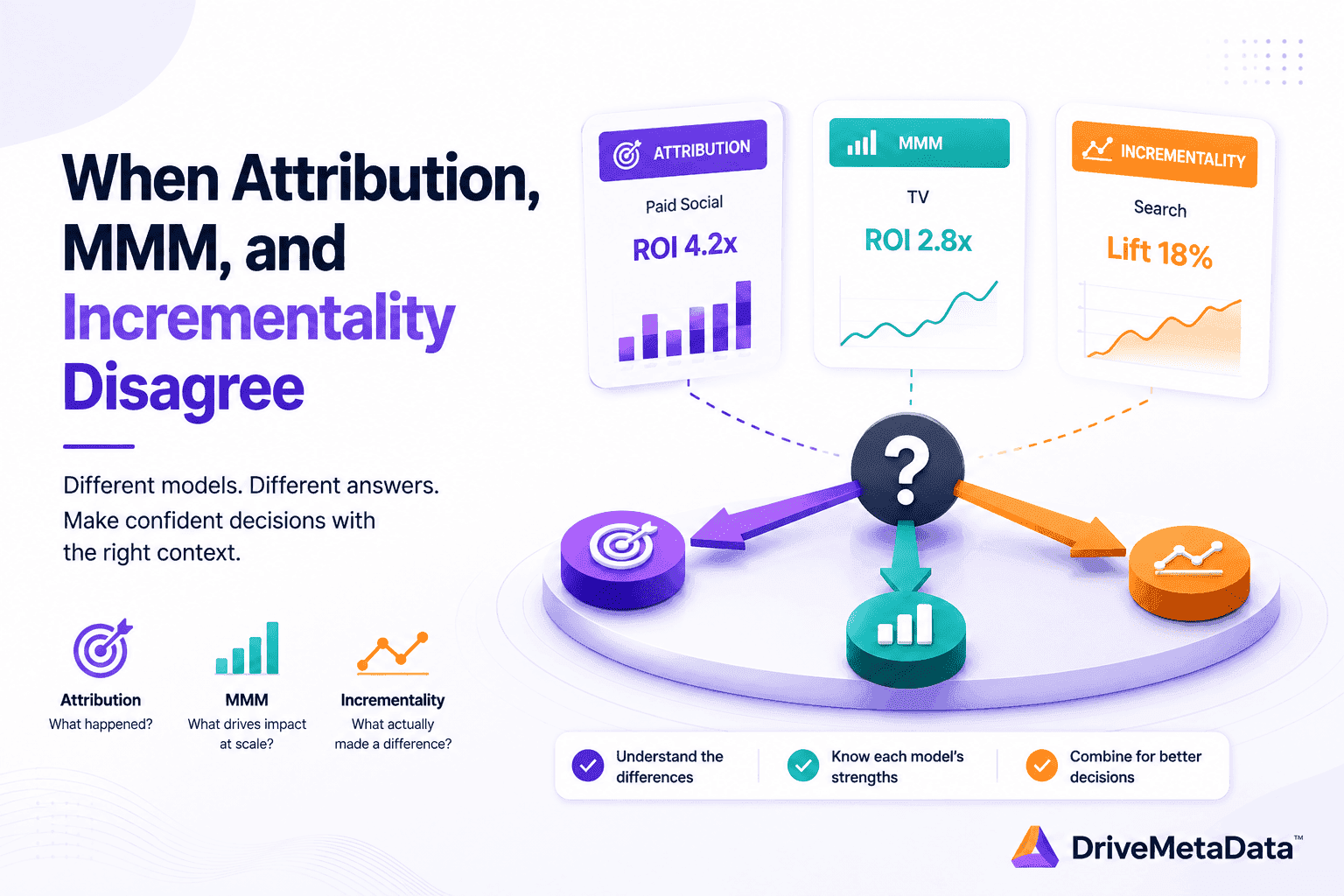
When Attribution, MMM, and Incrementality Disagree: A CFO-Ready Trust Framework
Marketing Attribution · 7 min read
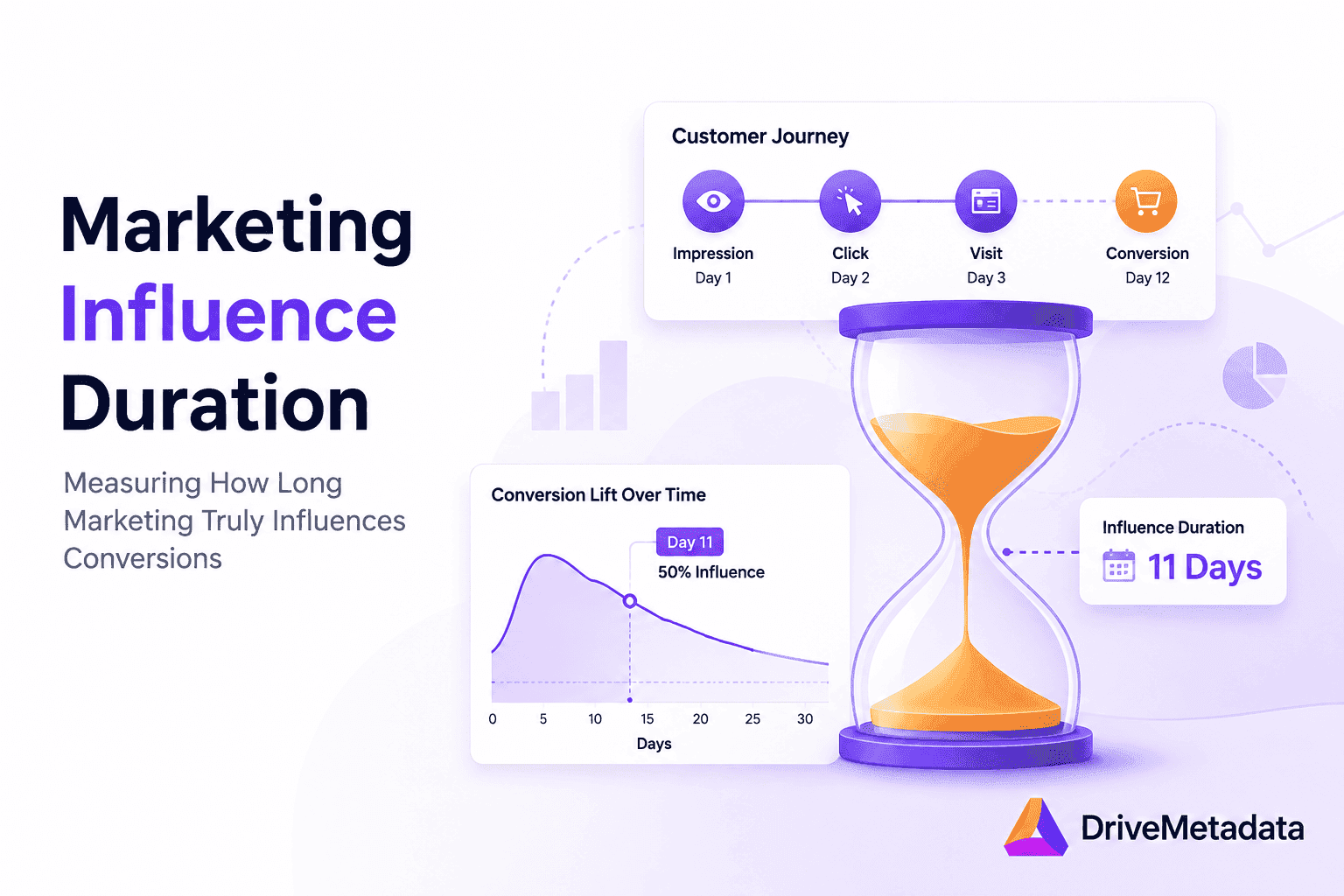
Marketing Influence Duration: Apply the Marketing Influence Half-Life™ for Smarter Attribution
Marketing Attribution · 5 min read
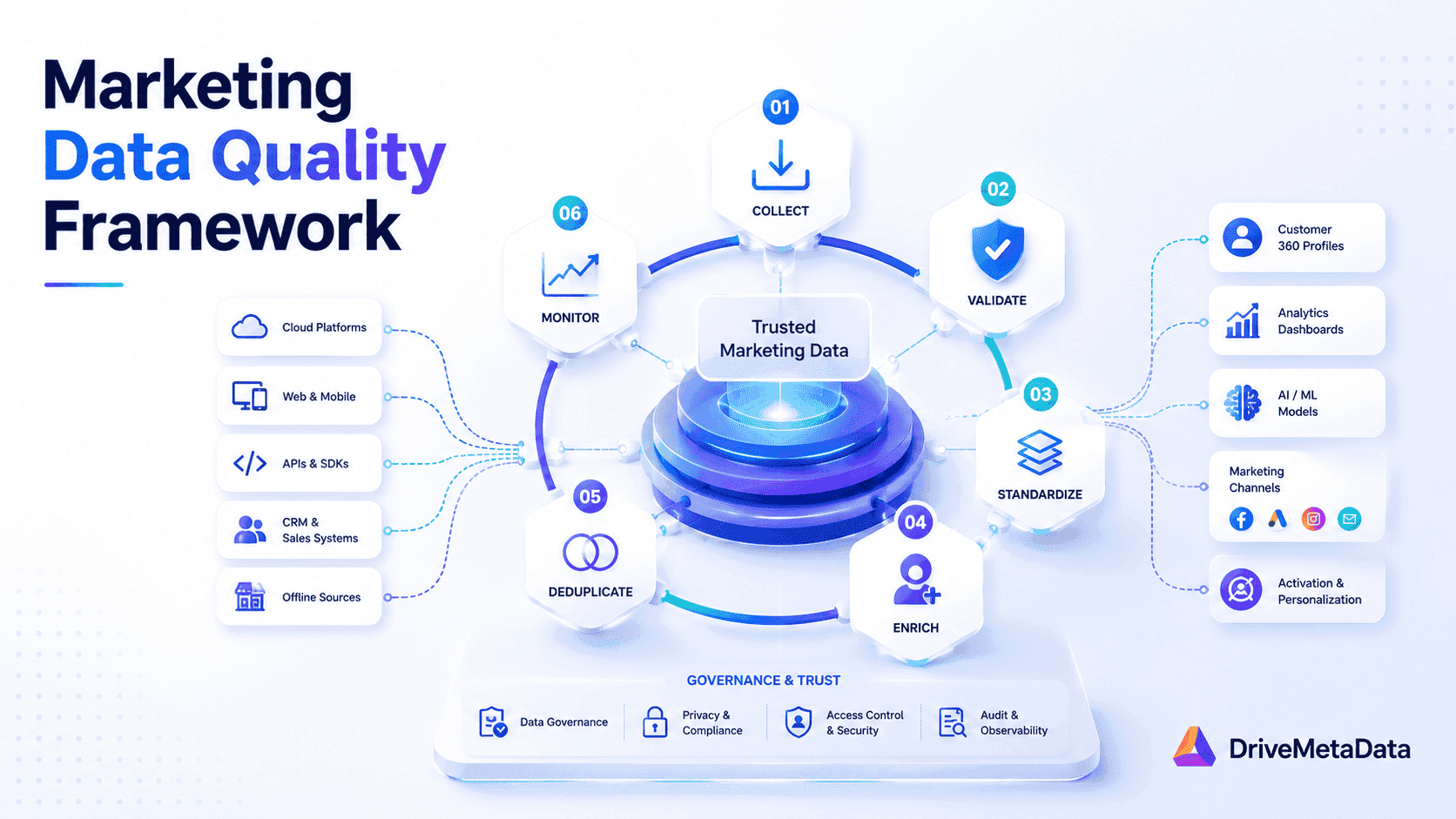
Marketing Data Quality Framework: Boost ROI & Attribution Accuracy
Marketing Attribution · 5 min read