
Ranjeet Ranjan
Delivering personalized, adaptive customer journeys is one of the hardest challenges marketers face today. Traditional marketing automation platforms often rely on static, rule-based workflows that can’t respond in real time to evolving customer behavior. This limits personalization, wastes budget, and results in fragmented customer experiences.
In this article, growth marketers, CRM managers, and ecommerce leaders will learn the practical differences between journey orchestration and marketing automation. You’ll understand why legacy automation struggles with adaptability, how journey orchestration leverages unified data and real-time signals, and how to plan a smooth transition that delivers more relevant, dynamic customer engagement.
Why Traditional Marketing Automation Limits Personalization and Adaptability
Key Drawbacks of Rule-Based, Static Automation Workflows
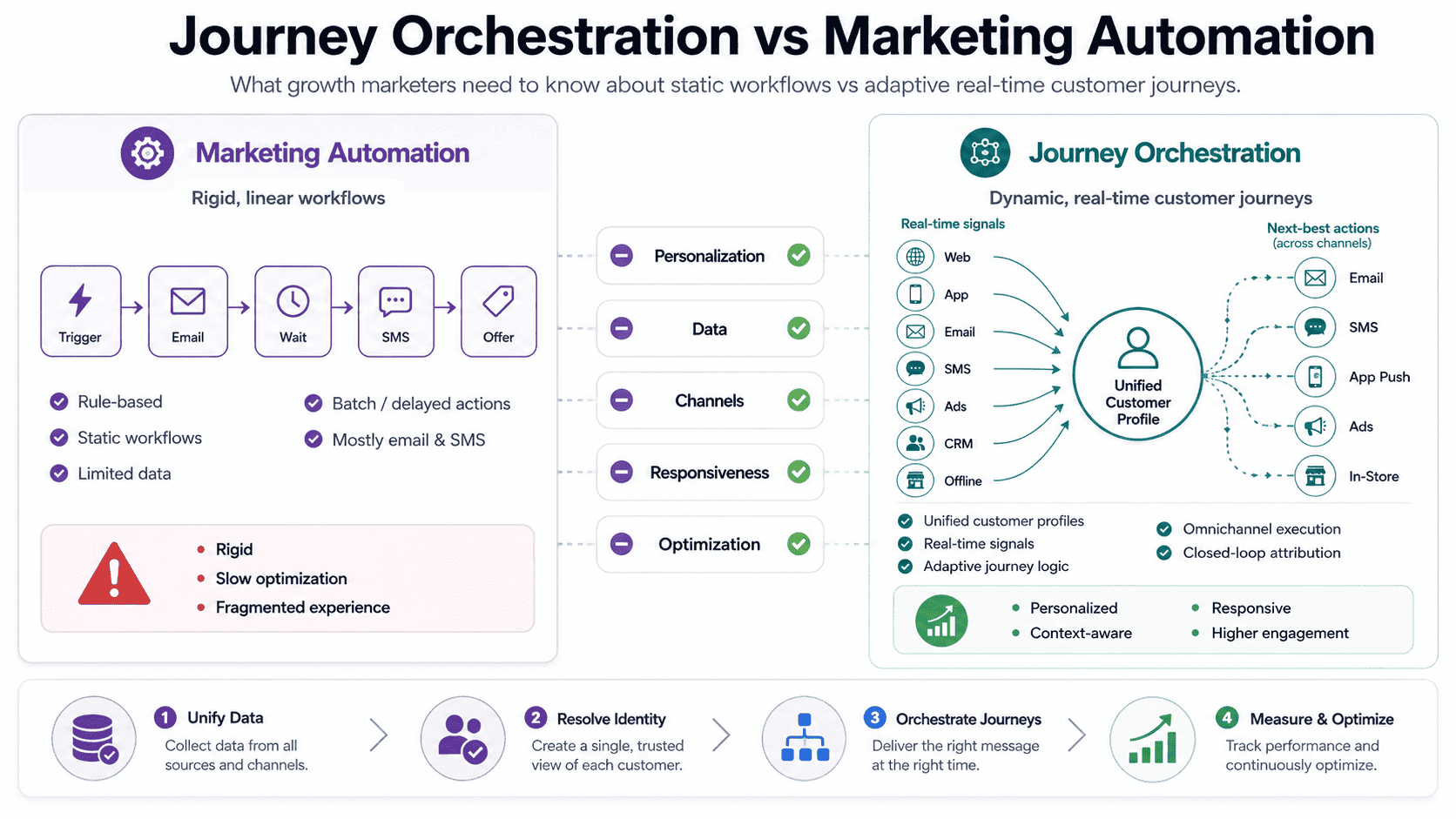
Marketing automation tools typically operate through predefined, linear workflows triggered by specific customer actions. While these rule-based systems automate repetitive tasks, they present several challenges:
- Lack of real-time responsiveness: Campaigns activate based on fixed event triggers, without adjusting to live customer context or behavior changes.
- Limited customer data integration: Fragmented data from multiple sources restricts personalization to the available fields and tags.
- Rigid campaign paths: Once launched, campaigns seldom adapt dynamically across multiple channels.
- Scaling constraints: Complex rule combinations become difficult to manage, limiting granular personalization at scale.
Business Risks of Rigid Automation
- Lower customer engagement: Generic or mistimed communications reduce conversions.
- Inefficient budget use: Marketing spend is wasted on untargeted or irrelevant campaigns.
- Disjointed customer experience: Inconsistent messaging across disconnected channels hurts brand perception.
- Slow optimization cycles: Lack of real-time measurement makes rapid iteration difficult.
These issues can slow growth and hinder marketing effectiveness.
What Is Journey Orchestration and How Does It Differ?
Journey orchestration takes a more dynamic, data-driven approach to managing customer experiences. It builds adaptive journeys that respond in real time to customer interactions across channels.
Core Components of Journey Orchestration
- Unified Customer Profiles: Consolidating data from multiple channels and identifiers into comprehensive profiles.
- Real-Time Data Processing: Instant ingestion of behavioral signals and attributes to update profiles continuously.
- Adaptive Journey Logic: AI-enhanced rules tailor next best actions based on current customer lifecycle stage and context.
- Omnichannel Execution: Seamless coordination of messaging across email, SMS, app, web, and offline touchpoints.
How Journey Orchestration Creates Personalized Experiences
- Monitor behavior continuously and adjust messaging instantly for relevance.
- Deliver personalized paths based on segments, purchase history, and engagement.
- Manage complex, multi-step campaigns that dynamically react to changing signals.
- Provide consistent messaging across all channels using unified data.
This leads to improved customer engagement, better conversion potential, and more efficient marketing spend.
Comparing Journey Orchestration and Marketing Automation: Key Capabilities
| Feature / Capability | Journey Orchestration | Marketing Automation |
|---|---|---|
| Personalization Scope | Dynamic, real-time, adaptive | Static, rule-based, linear |
| Data Integration | Unified profiles with identity resolution | Limited, siloed data sources |
| Omnichannel Reach | Coordinated across email, SMS, app, web, offline | Mainly email/SMS, limited channel synchronization |
| Responsiveness | Continuous data ingestion and instant triggers | Batch processing, delayed actions |
| Journey Flexibility | Non-linear, context-aware, AI-assisted | Fixed, predefined workflows |
| Measurement & Optimization | Closed-loop attribution feeding journey refinement | Basic reporting, limited real-time feedback |
This framework helps marketers evaluate platforms beyond buzzwords by focusing on capabilities that drive adaptive, personalized marketing.
How Identity Resolution and CDPs Enhance Journey Orchestration
Unifying Customer Data for Smarter Journey Triggers
Fragmented data hampers personalization. Identity resolution technology links various identifiers like emails, device IDs, and CRM records to build a single, persistent customer profile. When combined with a Customer Data Platform (CDP), this unification enables precise journey triggers, avoids redundant outreach, and ensures consistent experiences across channels.
Using Real-Time Data and Attribution to Optimize Journeys
Attribution engines track how marketing touches contribute to customer actions. Integrating these insights with journey orchestration allows marketers to dynamically optimize campaigns, allocate budgets more effectively, and refine journey paths based on conversion impact.
Challenges and Best Practices for Transitioning from Marketing Automation to Journey Orchestration
Common Implementation Challenges
- Data quality and integration gaps: Incomplete data must be addressed before orchestration.
- Complex adaptive journey design: Requires new skills and mindset compared to linear workflows.
- Legacy system limitations: Older automation tools may lack APIs or real-time capabilities needed.
- Team alignment and collaboration: Marketing, IT, and analytics must coordinate closely.
Practical Steps for a Successful Transition
- Audit current automation tools and data pipelines to identify rigidity and gaps.
- Invest in identity resolution and CDP capabilities to unify customer data.
- Pilot simple adaptive journey campaigns to test dynamic orchestration.
- Build internal expertise in journey design and real-time platform use.
- Iterate using attribution and performance insights for continuous improvement.
Taking a phased approach helps manage risks and drives adoption.
How DriveMetaData Supports Smarter, Real-Time Journey Orchestration
DriveMetaData offers a unified platform combining journey orchestration, identity resolution, and marketing attribution. This integration helps marketers:
- Build adaptive, personalized customer journeys that respond to real-time behavior and unified profiles.
- Unify fragmented customer data across channels for precise, consistent engagement.
- Close the loop on marketing performance with integrated attribution for ongoing optimization.
- Transition from legacy rule-based automation to flexible orchestration with platform tools and best practice guidance.
By combining these capabilities, marketers can create more relevant, efficient campaigns aligned with customer needs and business goals.
Frequently Asked Questions
What is the difference between journey orchestration and traditional marketing automation?
Journey orchestration leverages real-time data, unified customer profiles, and adaptive logic to create dynamic, personalized journeys. Traditional marketing automation relies on static, rule-based workflows with limited data integration.
How does journey orchestration improve customer experience compared to rule-based automation?
It delivers messaging and offers that adapt instantly to customer behavior, resulting in timely, relevant, and consistent interactions.
What key technologies are essential for journey orchestration?
Unified customer profiles via identity resolution, real-time data processing, adaptive journey engines, omnichannel execution, and integrated attribution systems.
How can marketers transition smoothly from marketing automation to journey orchestration?
By auditing existing tools and data, investing in data unification, piloting adaptive journeys, training teams, and iterating based on performance insights.
What business outcomes can journey orchestration support?
More effective personalization at scale, improved engagement, efficient marketing spend, and greater agility in responding to customer signals.
How do identity resolution and real-time data enhance journey orchestration?
They provide a unified, accurate customer view and enable journeys to adjust instantly to behavior and context.
What challenges do marketers face implementing journey orchestration?
Data fragmentation, journey design complexity, legacy platform constraints, and cross-team coordination.
Get Started with Smarter Journey Orchestration
To move beyond static automation and unlock dynamic, personalized customer experiences, start by exploring how real-time data and unified customer profiles can transform your marketing approach.
Request a personalized DriveMetaData demo to see how real-time journey orchestration can improve your campaign effectiveness.
For a deeper dive, download our guide on transitioning from marketing automation to journey orchestration—designed for growth marketers ready to modernize confidently.
Attribution Audit
Find the gaps hiding in your attribution data.
Get a focused audit of campaign tracking, ROAS signals, and conversion paths before media spend leaks into blind spots.
Related Blogs
More from our insights
Audience Segmentation in Marketing: Boost Activation Campaign Performance
Journey Orchestration · 5 min read
Shopify Marketing Attribution Across Meta, Google Ads, and Email: A Revenue Truth Framework
Customer Data Platform · 11 min read
Shopify Customer Journey Attribution: Multi-Touch Models & Repeat Order Tracking
Customer Data Platform · 6 min read