
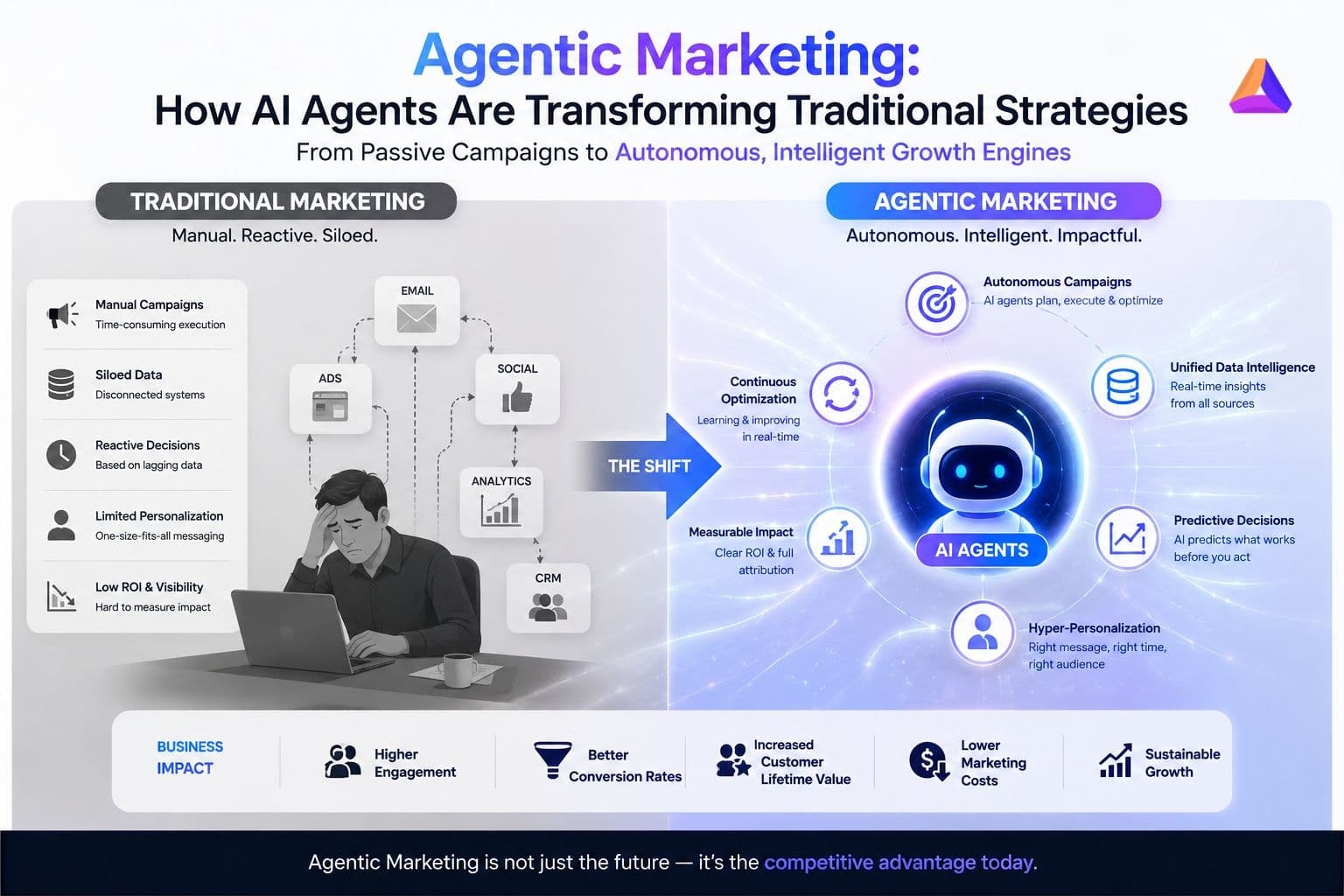
Understanding the shift to autonomous, data-driven marketing for enhanced engagement and ROI.
Ranjeet Ranjan
AI Executive Brief
Agentic marketing transforms traditional methods by embracing autonomous customer behavior and AI-driven marketing decisions, enabling marketers to optimize campaigns dynamically and achieve better attribution and measurement across complex digital ecosystems.
Marketers today face a critical challenge: traditional marketing methods struggle as consumers and digital systems gain more autonomy. When marketing efforts rely on fixed campaigns and predictable touchpoints, budgets risk inefficiency, and insights become fragmented. Ignoring these shifts puts businesses at risk of falling behind competitors who adopt agentic marketing — an approach that embraces autonomous customer behavior and system-driven marketing decisions. This article explains the agentic marketing impact on traditional marketing, outlines its core principles, compares approaches, and offers a practical roadmap to help marketers pivot confidently.
How Agentic Marketing is Reshaping Traditional Marketing Strategies
The Urgent Challenge: Why Traditional Marketing Is Losing Ground
The Rise of Consumer and System Autonomy in Marketing
Traditional marketing depends on one-way messaging and predictable customer paths, but modern consumers now control much of their interaction through self-education, independent comparison, and asynchronous engagement. At the same time, AI, ad platforms, and data management systems autonomously optimize marketing delivery in real time. This growing dual autonomy—from consumers and systems—renders static, linear marketing tactics ineffective and harder to measure accurately.
Failing to adapt to this environment risks wasting budget on irrelevant touchpoints, losing visibility of true marketing impact, and falling behind agile competitors who leverage agentic marketing techniques that prioritize continuous data-driven responsiveness.
Business Risks of Ignoring Agentic Marketing Trends
- Reduced ROI due to outdated targeting and measurement approaches.
- Inability to personalize effectively as autonomous customer behaviors go unrecognized.
- Missed optimization opportunities from lack of multi-touch interaction insights.
- Data fragmentation and attribution gaps from declining third-party data reliability.
- Operational inefficiencies resulting from legacy systems not designed for real-time adaptation.
Addressing these risks demands moving beyond traditional frameworks toward agentic marketing principles that align with the complex, autonomous nature of today’s marketing ecosystem.
Agentic Marketing Explained: Key Differences from Traditional Approaches
Core Principles of Agentic Marketing
Agentic marketing acknowledges that both consumers and digital systems act as active decision agents in the marketing process. Unlike traditional marketing’s reliance on static campaigns and linear attribution, it embraces dynamic, multi-directional interactions and continuous optimization.
- Recognizes customers as active agents influencing their own journeys.
- Utilizes AI and digital platforms to execute, optimize, and adjust marketing in real time.
- Emphasizes integration of diverse data sources for timely, informed decisions.
- Adopts adaptive attribution models that account for automated system touchpoints.
- Orchestrates customer journeys to deliver personalized, relevant experiences across channels.
How Agentic Marketing Shifts Decision Power
Traditional marketing places decision control with marketers via static messaging and fixed channel strategies. Agentic marketing redistributes this power, allowing consumers autonomy over their engagement while leveraging AI-driven analytics and automation to respond in real time. Marketers focus less on rigid control and more on understanding autonomous behavioral patterns and facilitating system-optimized interactions.
How Agentic Marketing Transforms Strategy and Execution
Moving from Campaign-Centric to Customer-Centric Journeys
Instead of isolated campaigns with fixed goals, agentic marketing focuses on continuous, dynamic customer journeys that span channels and timeframes. Marketers must map these complex journeys, anticipate autonomous customer behaviors, and deliver messaging that feels relevant and timely without intrusion.
This approach values fluidity in decision-making and recognizes multiple opportunities to influence customers rather than enforcing a linear funnel.
Leveraging Digital Systems and Data Integration
Agentic marketing depends on unifying diverse data from first-party profiles, campaign performance, advanced attribution, and fraud detection signals. AI-driven platforms act semi-autonomously, orchestrating interactions and optimizing spend. A robust, integrated MarTech stack is vital to provide marketers transparency and control, enabling improved measurement and real-time adjustments.
This unified approach enables more accurate attribution models that capture the complexity of agentic touchpoints and generate actionable insights for optimization.
Benefits of Adopting Agentic Marketing for Business Growth
Improved Adaptability and Customer Engagement
By embracing autonomous customer actions, agentic marketing delivers more relevant and engaging brand experiences. Marketers can quickly respond to shifts in customer intent, behavior, or market trends, minimizing wasted spend and maximizing engagement.
Enhanced Measurement and Attribution Capabilities
Agentic marketing leverages advanced attribution models integrating identity resolution and multi-touch data—including signals from automated systems. This enables a clearer understanding of each interaction’s true influence, compensating for privacy-driven data loss and improving budget allocation efficiency.
Common Challenges and How to Overcome Them
Integrating Agentic Marketing with Legacy Systems
Many legacy MarTech setups suffer from data silos, incompatible platforms, and outdated attribution models, limiting the agility required for agentic marketing. Successful transition demands data migration planning, platform consolidation, and adoption of modern solutions supporting identity resolution and journey orchestration.
Aligning Teams Around New Marketing Frameworks
Agentic marketing requires collaboration across analytics, campaign management, IT, and data governance teams. Moving from campaign silos to a customer-centric mindset is essential, with training and change management investments to enable cross-functional alignment and accelerate adoption.
Practical Framework: Steps to Transition from Traditional to Agentic Marketing
Evaluate Current Marketing Maturity and Readiness
Begin by assessing your marketing capabilities, data infrastructure, and team readiness. Identify gaps in data integration, attribution sophistication, and automation that will shape your agentic marketing transition roadmap.
Set Measurable KPIs for Agentic Marketing Initiatives
- Improvements in multi-touch attribution accuracy
- Customer journey engagement rates
- Speed and frequency of campaign optimization
- Customer retention and repeat engagement
- Cross-channel performance insights
Implement Attribution and Identity Resolution Tools
Deploy unified platforms that integrate data from multiple sources and resolve customer identities seamlessly across devices and channels. Robust attribution engines should reflect agentic touchpoints accurately, reducing gaps caused by privacy controls or fragmented data.
Monitor Performance and Iterate Based on Data Insights
Agentic marketing is an iterative process. Continuously monitor data and adjust strategies to refine customer journeys and marketing tactics. Regularly revisiting KPIs and updating attribution models supports sustained performance gains.
Comparing Traditional and Agentic Marketing: Key Tradeoffs
Advantages and Limitations of Each Approach
| Aspect | Traditional Marketing | Agentic Marketing |
|---|---|---|
| Decision Control | Marketer-driven, fixed campaigns | Customer and system autonomous interaction |
| Measurement | Simplified, last-touch or rule-based attribution | Advanced, multi-touch with identity resolution |
| Adaptability | Static plans, periodic optimizations | Continuous optimization via AI and data |
| Customer Experience | Mass communication, limited personalization | Highly personalized, journey-driven |
| Data Integration | Often siloed, limited cross-channel view | Unified data ecosystems for comprehensive insight |
| Implementation Complexity | Lower initial complexity | Requires investment in technology and training |
Decision Criteria for Marketing Strategy Evolution
- Need for business agility and willingness to invest
- Current strengths and gaps in your MarTech stack
- Scale and complexity of customer journeys
- Maturity and availability of integrated data
- Organizational readiness for data-driven marketing
How DriveMetaData Supports Agentic Marketing Success
Using DriveMetaData’s Attribution Engine to Track Complex Touchpoints
DriveMetaData’s attribution engine captures both human and system-driven touchpoints, enabling marketers to quantify the true effect of each interaction even across dynamic customer journeys spanning devices and platforms.
Leveraging Customer Journey Analytics to Adapt Campaigns
DriveMetaData’s customer journey analytics reveal autonomous behavior patterns, empowering teams to orchestrate responsive journeys that evolve with customer preferences rather than relying on static campaigns.
Combining Identity Resolution with Marketing Analytics for Deeper Insights
By unifying fragmented data with identity resolution, DriveMetaData helps marketers maintain accurate profiles despite privacy-related data loss, reducing gaps in attribution and enabling more precise personalization.
Measuring Success: KPIs and Metrics for Agentic Marketing Impact
Key Metrics to Track for Validation and Optimization
- Attribution model accuracy improvements over time
- Growth in multi-channel journey engagement
- Acceleration of marketing spend optimization cycles
- Customer lifetime value influenced by autonomous behaviors
- Reduction in data silos and attribution leakage
Next Steps: Preparing Your Team for Agentic Marketing Adoption
Common Pitfalls to Avoid During Transition
- Overloading teams with complex tools without training
- Neglecting legacy data quality problems impacting identity resolution
- Underestimating cross-team alignment time and effort
- Failing to define clear, agentic marketing-focused KPIs
- Ignoring privacy and compliance when integrating data
Training and Change Management Recommendations
Successful adoption hinges on equipping teams with hands-on knowledge and ongoing support. Training should focus on data literacy, attribution, and customer journey strategies, while leadership fosters an experimental culture open to iterative improvements.
What is agentic marketing and why does it matter?
Agentic marketing is an approach recognizing that customers and digital systems act autonomously in marketing, requiring adaptive strategies that replace static campaigns with dynamic, data-driven customer journey management. It matters because it reflects real consumer behavior and improves marketing effectiveness in complex digital ecosystems.
How does agentic marketing impact traditional measurement models?
It challenges traditional last-touch or rule-based attribution by introducing multi-touch, identity-resolved models that consider both human and AI-driven interactions, enabling more accurate measurement of marketing influence.
What are key challenges when adopting agentic marketing?
Common challenges include integrating fragmented legacy systems, aligning cross-functional teams on new frameworks, and investing in technology and training to support complex data integration and real-time optimization.
How can DriveMetaData help implement agentic marketing?
DriveMetaData provides attribution engines, identity resolution, and customer journey analytics that unify fragmented data, measure complex touchpoints, and enable agile marketing execution aligned with agentic principles.
What KPIs should marketers track to measure agentic marketing success?
Marketers should monitor improvements in attribution accuracy, multi-channel engagement, speed of optimization, customer lifetime value linked to autonomous behaviors, and reductions in data silos and attribution leakage.
Successful adoption hinges on equipping teams with hands-on knowledge and ongoing support. Training should focus on data literacy, attribution, and customer journey strategies, while leadership fosters an experimental culture open to iterative improvements.
Attribution Audit
Find the gaps hiding in your attribution data.
Get a focused audit of campaign tracking, ROAS signals, and conversion paths before media spend leaks into blind spots.
Related Blogs
More from our insights
Marketing Truth vs Marketing Claims: Your ROAS Is Not Your ROAS
Customer Data Platform · 13 min read
Select Marketing Attribution Software for Accurate ROAS Tracking
Customer Data Platform · 6 min read
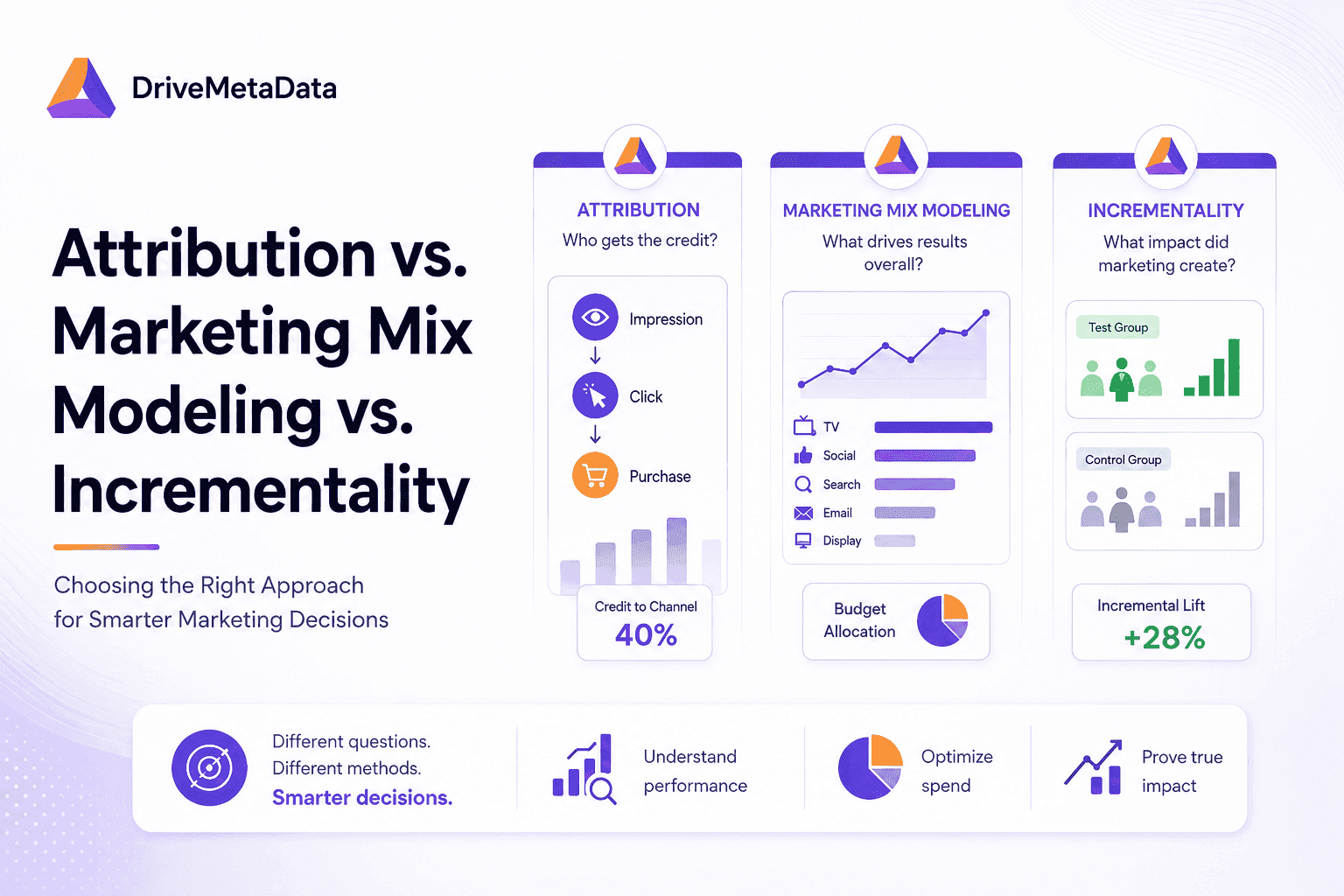
Attribution vs Marketing Mix Modeling vs Incrementality: Choosing the Right Marketing Measurement
Customer Data Platform · 7 min read