
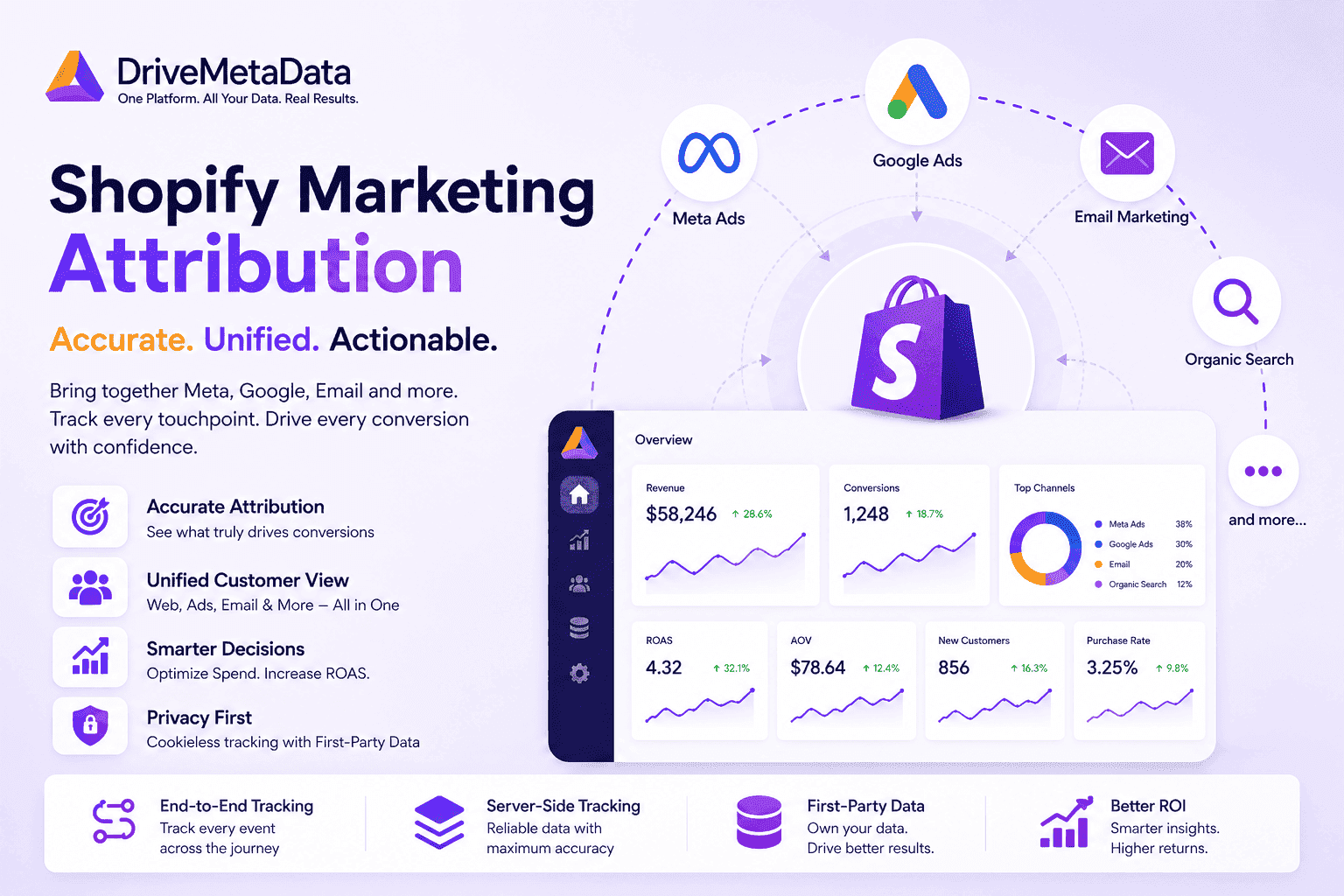
A practical guide to channel credit, revenue truth, and privacy-aware ecommerce measurement.
Ranjeet Ranjan
AI Executive Brief
## Shopify Marketing Attribution Across Meta, Google Ads, and Email ### Executive Summary Meta Ads reports one revenue figure. Google Ads reports another. Your email platform claims additional conversions. Yet Shopify and your finance reports tell a different story. For Shopify merchants, this creates a critical challenge: **Which marketing channels are actually generating revenue, and where should the next marketing budget go?** The problem often comes from different attribution windows, overlapping conversion credit, inconsistent customer identifiers, and revenue calculations that don't account for refunds or cancellations. Accurate marketing attribution requires connecting customer touchpoints with Shopify orders and reconciling campaign performance against actual business outcomes. This guide explains how to identify attribution discrepancies across Meta, Google Ads, and email, validate conversion data, and evaluate marketing performance using a consistent revenue framework.
A Shopify attribution number is only useful when the store, ad platforms, email platform, analytics, and finance agree on customer identity, conversion events, revenue definition, attribution window, and consent rules. Use Shopify for order truth, Meta, Google Ads, and email for channel diagnostics, and a reconciled warehouse or CDP layer for budget decisions.
For Shopify teams, attribution breaks down when Meta Ads, Google Ads, email, GA4, Shopify, and finance each report a different version of campaign performance. The issue is not always bad tracking. It is usually a mismatch in identity, events, revenue definitions, attribution windows, consent status, and reporting freshness.
A Shopify attribution number is only useful when the store, ad platforms, email platform, analytics, and finance agree on customer identity, conversion events, revenue definition, attribution window, and consent rules. Use Shopify for order truth, Meta, Google Ads, and email for channel diagnostics, and a reconciled warehouse or CDP layer for budget decisions.
The practical question is not "Which dashboard is right?" The practical question is "Which number is safe enough for this decision?"
Why Shopify Attribution Breaks Across Meta, Google Ads, and Email
The Budget Risk Behind Conflicting Reports
Shopify attribution is the process of connecting marketing touchpoints to Shopify orders, customers, and revenue. It matters because ecommerce teams use attribution to decide which campaigns should scale, which audiences should pause, which lifecycle journeys deserve more investment, and which revenue view leadership should trust.
The risk appears when every source tells a different story. Meta may credit a purchase to paid social. Google Ads may credit branded search. Email may claim the final click. Shopify may show an order tied to a UTM campaign. Finance may remove refunds, cancellations, tax, shipping, discounts, or repeat-customer revenue. None of those systems is automatically useless, but none should be treated as complete without reconciliation.
Common Failure Points
- Shopify order data, Meta events, Google Ads conversions, email clicks, GA4 sessions, and finance exports use different identifiers.
- Pixel events and server-side events can duplicate purchases when event IDs and deduplication rules are inconsistent.
- UTM naming, campaign names, time zones, currencies, refunds, and order edits are not standardized.
- Last-click, platform attribution, data-driven attribution, and custom multi-touch models answer different questions.
- Consent, browser restrictions, ad blockers, and logged-out sessions reduce the available path data.
- Email can look over-credited when it captures final clicks but paid channels created earlier demand.
- Platform ROAS can exclude non-media costs that finance includes in business reporting.
Evidence Snapshot for Shopify Attribution
What These Sources Do Not Prove
Official platform documentation can explain how a system handles attribution, reporting, or event quality. It cannot prove that a specific Shopify merchant improved ROAS, reduced CAC, recovered revenue, or achieved compliance. Those claims need first-party data, customer-approved evidence, controlled tests, or finance-approved reporting.
What Shopify Marketing Attribution Should Measure
Definition and Scope
Shopify marketing attribution means assigning credit for Shopify orders, customer actions, and revenue to marketing touchpoints such as Meta Ads, Google Ads, email, organic search, direct visits, affiliate links, and lifecycle campaigns. The attribution model decides how credit is distributed. The data layer decides whether the touchpoints and purchases are trustworthy enough to compare.
The simplest measurement formula is:
Attributed revenue by channel = Shopify revenue eligible for attribution x credit assigned to that channel
That formula is only useful when eligibility and credit are defined. Eligible revenue may be gross sales, net sales, first-order revenue, subscription revenue, repeat purchases, or contribution margin. Credit may come from last click, first touch, linear multi-touch, position-based logic, data-driven modeling, or an experiment-based estimate.
Platform, Store, and Email Views
Meta Ads, Google Ads, email, GA4, Shopify, and finance are built for different jobs. Meta and Google Ads help paid media teams optimize within their ad environments. Email platforms help lifecycle teams understand clicks, flows, campaigns, and owned-channel engagement. Shopify records commerce activity. GA4 analyzes site and app behavior. Finance reconciles money.
Accurate Shopify marketing attribution connects those jobs without pretending they are identical. A paid media dashboard can guide bid and creative decisions. A Shopify order view can verify commerce outcomes. A finance-adjusted view should govern leadership reporting. A causal method, such as a holdout or incrementality test, should guide high-risk budget questions.
Evidence Snapshot Table
| Source | Public data or official guidance | What it supports | Caveat |
|---|---|---|---|
| Shopify Help: Marketing reports | Shopify documents marketing reports that organize sessions, sales, orders, conversion rate, average order value, and other metrics by campaign, source, medium, and referrer. | Shopify can connect commerce outcomes to campaign-tagged traffic and store activity. | Shopify reporting depends on plan, tagging discipline, sales channel setup, and selected report logic. |
| Google Analytics Help: Attribution | Google Analytics documents attribution reporting and model options used to assign credit for key events across touchpoints. | GA4 attribution is a measurement environment with its own identity, event, and model configuration. | GA4 is not a finance ledger and should be reconciled before budget governance. |
| Google Ads Help: Attribution models | Google Ads explains that attribution models assign conversion credit across ad interactions in conversion paths. | Google Ads ROAS can reflect Google Ads conversion settings and model rules. | Google Ads reporting is useful for platform optimization but does not prove incremental revenue. |
| Meta for Developers: Pixel and Conversions API deduplication | Meta documents using event name and event ID to deduplicate browser Pixel and server Conversions API events. | Meta event quality and deduplication rules are central to paid social attribution trust. | Deduplication guidance does not quantify event quality for a specific Shopify merchant. |
The SIGNAL Framework for Accurate Shopify Attribution
How to Run SIGNAL
Use SIGNAL when Shopify, Meta Ads, Google Ads, email, GA4, and finance disagree. The framework is a practical audit sequence:
| Step | Meaning | What to document |
|---|---|---|
| S | Source system map | Which system owns orders, spend, clicks, impressions, email sends, customer records, refunds, and finance adjustments. |
| I | Identity stitching | Which identifiers connect records: Shopify customer ID, order ID, email hash, phone, Meta event ID, Google click ID, GA4 client ID, CRM contact, and household or device signals. |
| G | Gross-to-net revenue rules | Whether reports use gross sales, net sales, discounts, taxes, shipping, cancellations, refunds, subscriptions, or contribution margin. |
| N | Naming and time standards | UTM rules, campaign naming, time zone, currency, conversion date, click date, attribution window, and report finalization timing. |
| A | Attribution logic | Last click, first touch, multi-touch, platform model, data-driven model, custom model, or incrementality method. |
| L | Loss and leakage checks | Missing events, duplicate events, consent gaps, offline orders, delayed revenue, invalid traffic signals, and unmatched customers. |
Run SIGNAL in that order. Do not start by changing the attribution model. First prove that source systems, identifiers, revenue rules, naming, and event health are usable. A sophisticated model on top of broken Shopify events still produces false confidence.
Identity and Event Quality Checks
- Confirm that Shopify order IDs, customer IDs, email hashes, event IDs, transaction IDs, and CRM IDs are mapped consistently.
- Deduplicate browser and server purchase events before comparing platform ROAS.
- Track whether Meta, Google Ads, email, GA4, and Shopify are using the same conversion event or comparable event stages.
- Separate known customers, new customers, anonymous visitors, and unsubscribed or non-consented users.
- Monitor missing purchase events, duplicated purchase events, unmatched orders, UTM gaps, and delayed refunds after every tracking change.
- Keep consent status and data-use limitations visible in reporting notes.
Gross-to-Net Revenue Rules
Most attribution disputes are partly revenue disputes. A campaign can look strong when the ad platform reports gross purchase value and weaker when finance removes discounts, refunds, cancellations, tax, shipping, or repeat-customer revenue. This does not mean the paid media team is wrong. It means the budget review needs a shared revenue basis.
For Shopify attribution, define at least four revenue views: gross order revenue, net order revenue, new-customer revenue, and contribution-margin revenue. Use the view that matches the decision. Creative testing may use platform-attributed conversion value. Board-level budget planning should use finance-approved revenue and cost definitions.
Integrating Meta Ads, Google Ads, Email, and Shopify
Data Pipeline Requirements
A reliable Shopify attribution stack needs more than pixels. It needs event collection, server-side validation where appropriate, campaign naming rules, UTM governance, product and customer dimensions, spend imports, email engagement data, consent flags, and order reconciliation.
The minimum pipeline should ingest Shopify orders and refunds, Meta Ads spend and conversion events, Google Ads spend and conversions, email sends, clicks and revenue claims, GA4 session and campaign data, CRM customer status, and finance adjustments. A customer data platform can help organize those records, while identity resolution helps connect customer and order activity across source systems.
Common Integration Pitfalls
Most integration failures are not dramatic platform outages. They are quiet definition mismatches: inconsistent UTMs, duplicate purchase events, time-zone drift, mixed currencies, missing refund adjustments, and event names that changed during a theme or app update. These issues can make a dashboard look precise while the underlying decision is still weak.
Privacy and Consent Constraints
Privacy-aware attribution starts with first-party data and transparent consent handling. Shopify merchants should treat consent status as a reporting dimension, not just a legal checkbox. If a share of customer journeys cannot be tracked across sites or devices, the report should say so plainly.
Use deterministic identifiers where the customer has provided them, such as email, phone, customer ID, or order ID. Use modeled attribution carefully and label it as modeled. Do not use probabilistic matching, AI, or platform modeling language to imply certainty that the data cannot support.
Shopify Attribution Scorecard
Use This Before You Move Budget
Before shifting budget because Meta, Google Ads, email, and Shopify disagree, run this scorecard:
| Check | What to compare | Owner | Action trigger |
|---|---|---|---|
| Decision type | In-platform optimization, lifecycle optimization, channel allocation, finance reporting, or incrementality | Growth lead | Pick the metric family before debating values. |
| Revenue basis | Gross sales, net sales, refunds, cancellations, discounts, tax, shipping, subscription revenue, margin | Finance plus analytics | Reconcile revenue before presenting performance. |
| Spend basis | Platform media spend, creative cost, agency fees, affiliate payouts, discounts, tools | Finance plus paid media | Label reports when non-media costs are excluded. |
| Conversion definition | Purchase, order, checkout, lead, subscription, first order, repeat order | Analytics owner | Pause comparison when reports count different events. |
| Attribution window | Click, view, session, email-click, order date, conversion date, report finalization | Paid media plus lifecycle | Normalize or annotate windows before comparing channels. |
| Identity logic | Shopify ID, email, phone, click ID, event ID, CRM contact, device, anonymous visitor | Data owner | Investigate when match or deduplication changes the result. |
| Event quality | Missing events, duplicate events, consent gaps, offline orders, app conflicts | Data owner | Fix instrumentation before scaling from the number. |
| Causal evidence | Holdout, geo test, incrementality test, MMM, or controlled campaign read | Growth lead | Require causal proof for high-risk budget changes. |
Measurement Formulas
- **Platform ROAS = platform-attributed conversion value / platform media spend.** Use it for platform optimization, not finance truth.
- **Shopify-attributed revenue share = revenue tied to campaign-tagged sessions or source data / total Shopify revenue in the period.** Use it to understand commerce reporting coverage.
- **Business ROAS = finance-approved revenue / agreed marketing cost.** Use it for budget governance.
- **New-customer ROAS = first-order revenue from new customers / acquisition spend.** Use it when the question is acquisition quality.
- **Contribution-margin ROAS = contribution margin from eligible orders / marketing spend.** Use it when revenue hides margin risk.
- **Duplicate event rate = duplicate purchase events / total purchase events.** Use it as an instrumentation health signal.
- **Attribution variance = difference between source-reported ROAS and chosen business ROAS.** Use it as a diagnostic, not a reason to average dashboards.
Common Mistakes to Avoid
- Choosing the highest ROAS because it is the most comfortable number.
- Treating last-click email revenue as if email created all of the demand.
- Treating platform-attributed ROAS as incremental ROAS.
- Changing the attribution model before fixing UTM, event, order, and identity quality.
- Ignoring refunds, cancellations, subscription renewals, discounts, tax, shipping, and contribution margin.
- Comparing same-day platform reports to finance-adjusted month-end reporting.
- Letting privacy or consent constraints disappear from the measurement caveat.
Metrics and Evidence for Decision-Grade Reporting
The goal is not to create more dashboards. The goal is to make each metric clear enough that a marketing, analytics, and finance team can agree on what it can and cannot prove.
| Metric | Formula / how to calculate | Source type | Freshness needed | What it proves | Caveat | Action trigger |
|---|---|---|---|---|---|---|
| Platform ROAS | Platform-attributed value / platform media spend | Meta Ads, Google Ads, email platform | After platform reporting stabilizes | How a channel platform credits performance under its rules | Not finance truth or causal proof | Optimize bids, audiences, creative, and flows inside the platform. |
| Shopify revenue coverage | Attributed Shopify revenue / total Shopify revenue | Shopify plus campaign tags | Same period and currency | How much store revenue is tied to campaign source data | Depends on tagging and report logic | Audit UTMs and source rules when coverage drops. |
| Business ROAS | Finance-approved revenue / agreed marketing cost | Finance, warehouse, Shopify, CRM | After order and finance reconciliation | Whether marketing spend supports the agreed business view | Depends on revenue and cost definitions | Use for budget reviews and leadership reporting. |
| New-customer ROAS | First-order revenue from new customers / acquisition spend | Shopify, CRM, ad platforms | After customer classification is updated | Whether acquisition spend is creating new customers | Does not show retention quality by itself | Separate acquisition from retention before scaling. |
| Duplicate event rate | Duplicate purchase events / total purchase events | Tag logs, server events, event IDs | After every tracking or app change | Whether instrumentation may inflate attributed revenue | Requires a clear duplicate definition | Fix event quality before changing budget. |
| Incremental ROAS | Incremental revenue caused by marketing / incremental spend | Holdout, geo test, lift test, MMM | After test window and analysis | Whether spend likely caused additional revenue | Requires sound design and enough signal | Use before major budget increases or cuts. |
Illustrative Scenario: Reconciling a Shopify Launch
The Symptom
This scenario is illustrative, not a customer result. A Shopify merchant launches a new product with Meta prospecting, Google Shopping, branded search, and two email campaigns. After one week, Meta reports strong attributed revenue. Google Ads shows a weaker ROAS. Email claims a high share of purchases because many buyers clicked a launch reminder before checkout. Shopify shows orders tied to mixed UTM sources. Finance says net revenue is lower after discounts and early returns.
The team could argue over which report is right. A better move is to define the decision. If the question is whether Meta creative should keep running, platform diagnostics matter. If the question is whether the launch budget should increase, finance-adjusted business ROAS and new-customer quality matter. If the question is whether paid media created incremental demand, attribution alone is not enough.
The Decision
The team runs SIGNAL. Shopify remains the order source. Finance defines net revenue. The data owner checks event IDs and duplicate purchases. Lifecycle marketing separates email flows from paid acquisition. Paid media reviews Meta and Google Ads inside each platform, but the budget review uses reconciled revenue and agreed spend.
The result to measure is not "Meta was right" or "email was wrong." The result to measure is whether the team can explain channel credit, customer type, revenue basis, event quality, and causal uncertainty before moving budget. When attribution is treated this way, Shopify reporting becomes a decision system rather than a dashboard contest.
How DriveMetaData Supports Shopify Attribution
DriveMetaData helps teams connect Shopify orders, customer identifiers, campaign events, email engagement, ad spend, CRM records, consent context, and finance-ready revenue into a clearer measurement layer. The point is not to make one channel look better. The point is to make the assumptions visible enough that marketers can trust the next decision.
For Shopify teams, DriveMetaData's multi-touch attribution, marketing analytics, and data governance and privacy capabilities are most useful when they reduce source-system confusion, expose duplicate or missing events, and make channel credit easier to explain across marketing, analytics, and finance.
FAQ
What is Shopify marketing attribution?
Shopify marketing attribution connects marketing interactions to Shopify orders, customers, and revenue. It helps a team understand how Meta Ads, Google Ads, email, organic search, direct traffic, and other touchpoints influenced purchases. The output is only reliable when identity, revenue, attribution windows, campaign tags, and event quality are documented.
Which attribution model is best for Shopify stores?
There is no universal best model. Smaller stores may begin with last-click reporting because it is easy to explain. Growing stores usually need multi-touch diagnostics, Shopify order reconciliation, and separate acquisition versus retention views. High-risk budget decisions should use incrementality evidence where possible, not attribution alone.
How do I reconcile Meta Ads, Google Ads, email, and Shopify attribution?
Start by defining the decision, then map source systems, customer identifiers, revenue rules, campaign naming, attribution windows, and event quality. Use Shopify and finance to validate order and revenue truth. Use Meta, Google Ads, and email for channel diagnostics. Do not average conflicting dashboards without documenting why they differ.
Why does email often get too much credit in Shopify attribution?
Email often receives final-click credit because customers click a reminder, promotion, or abandoned-cart message shortly before purchase. That does not mean email created all demand. Separate lifecycle capture from acquisition influence, compare customer status, and review earlier paid or organic touchpoints before assigning budget credit.
How does privacy affect Shopify marketing attribution?
Privacy and consent constraints can reduce observable user journeys across devices, browsers, and platforms. Shopify teams should use first-party identifiers where consent allows, preserve consent status in reporting, and label modeled or incomplete attribution clearly. Privacy-aware reporting should make uncertainty visible instead of hiding it behind a single confident number.
DriveMetaData helps teams connect Shopify orders, customer identifiers, campaign events, email engagement, ad spend, CRM records, consent context, and finance-ready revenue into a clearer measurement layer. Use the reconciled view to explain attribution differences before changing budget, not to claim that one channel dashboard is automatically final.
Attribution Audit
Find the gaps hiding in your attribution data.
Get a focused audit of campaign tracking, ROAS signals, and conversion paths before media spend leaks into blind spots.
Related Blogs
More from our insights
Shopify Customer Journey Attribution: Multi-Touch Models & Repeat Order Tracking
Customer Data Platform · 6 min read
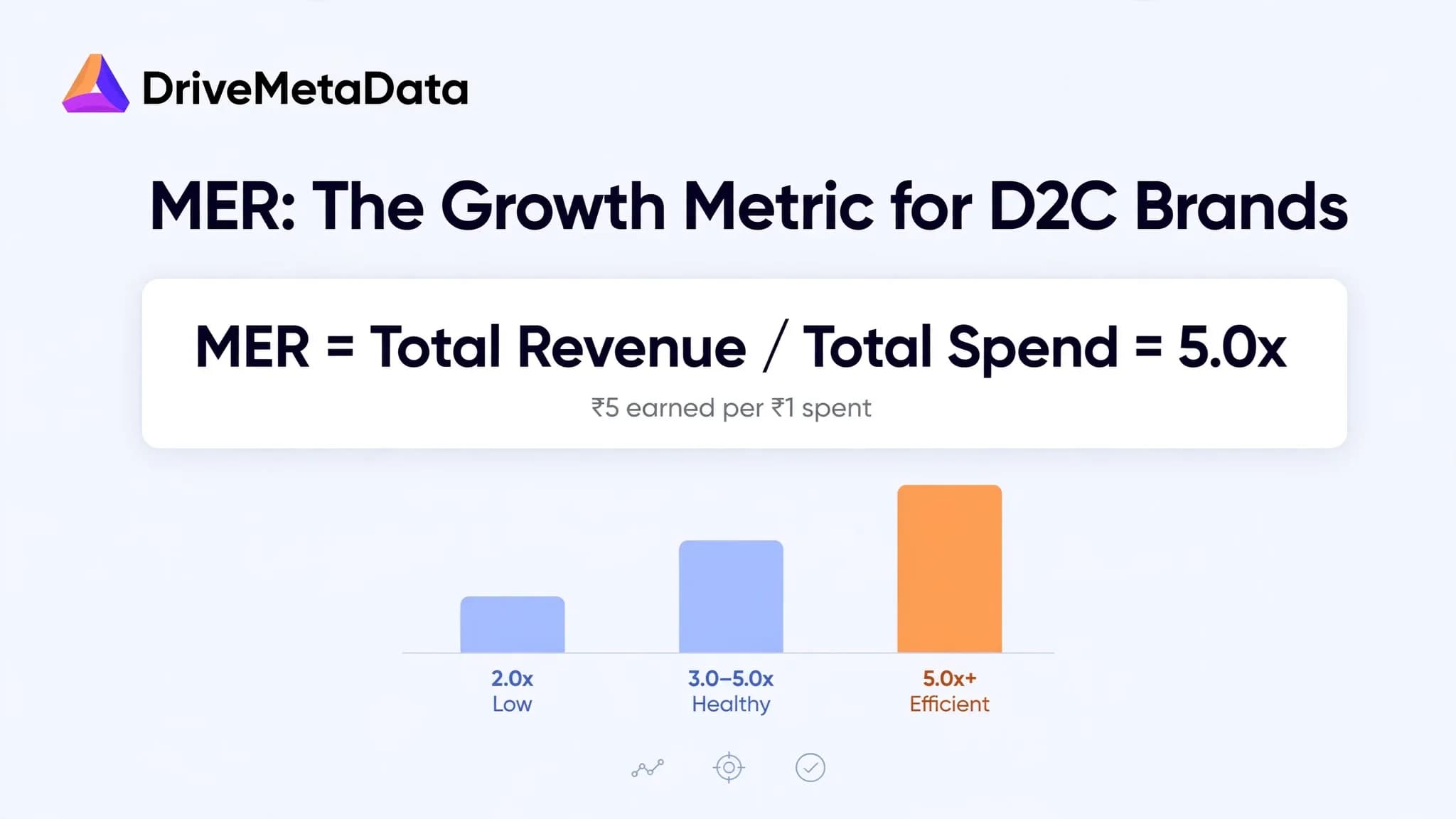
Marketing Efficiency Ratio (MER) Needs A Warning Label For D2C Growth
Customer Data Platform · 8 min read
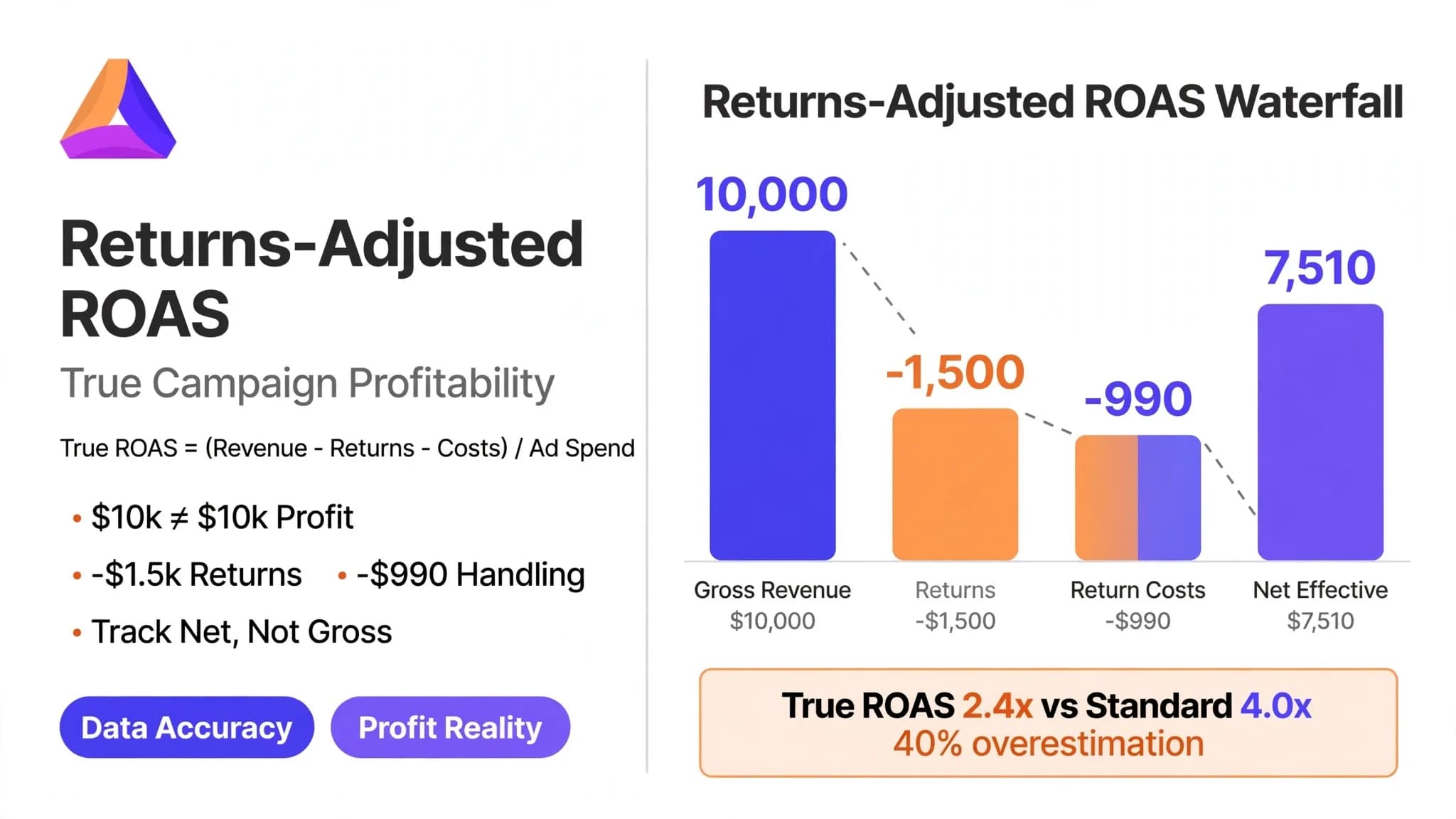
Returns-Adjusted ROAS: Formula, Calculation & How to Measure True Ecommerce Profitability
Customer Data Platform · 11 min read