
A practical guide to refund-aware attribution, retained-revenue efficiency, and contribution-aware budget governance.
Ranjeet Ranjan
AI Executive Brief
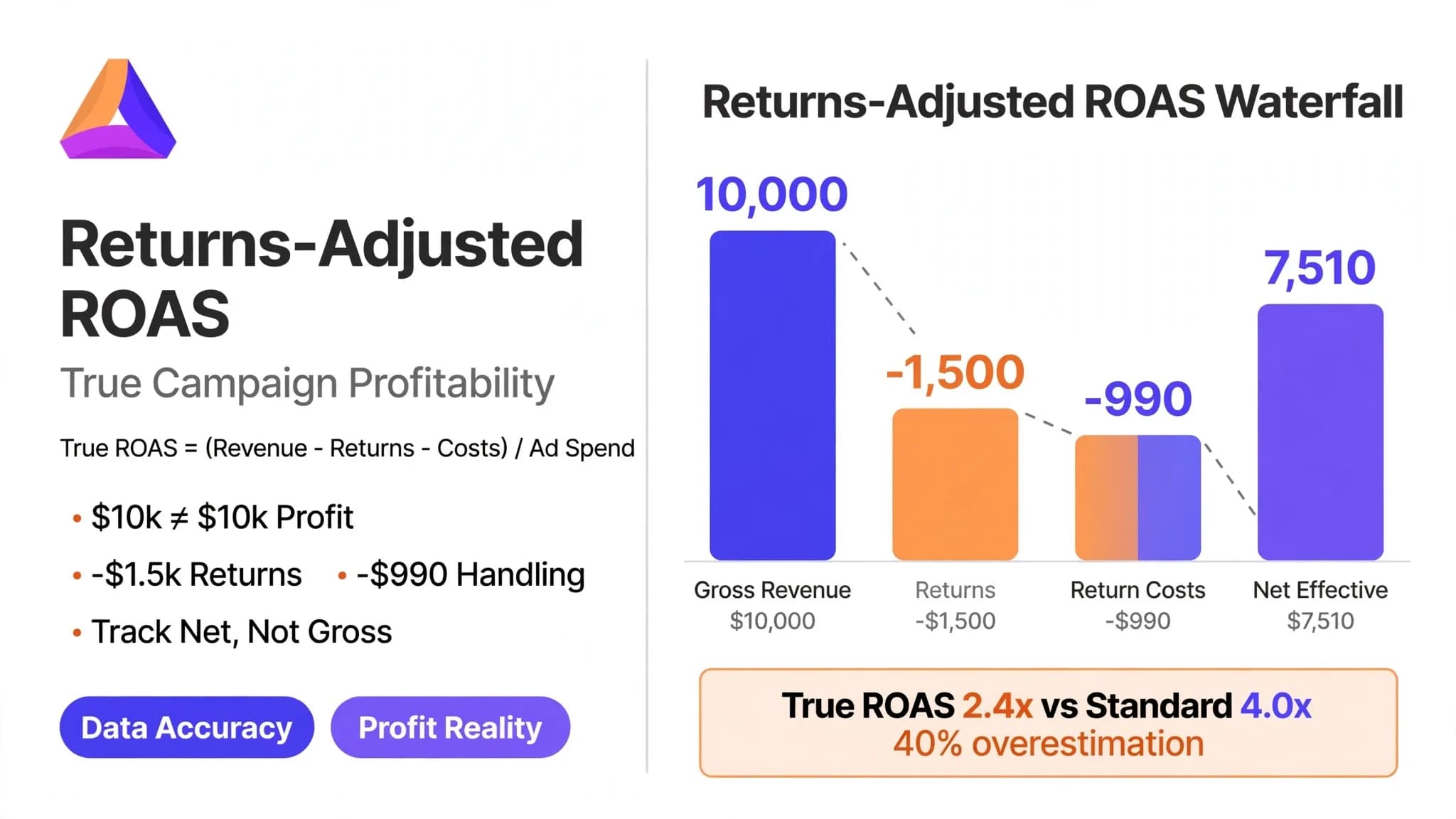
Returns-adjusted ROAS connects media spend to retained ecommerce revenue by matching refunds, cancellations, and SKU-level return behavior back to the campaign attribution record. It helps marketing, ecommerce, and finance teams see when gross campaign winners become weaker retained-revenue performers, while keeping contribution margin separate from ROAS.
Gross ROAS can make the wrong campaign look like the winner when refunds, cancellations, and returned SKUs are left outside the attribution model. For ecommerce teams, returns-adjusted ROAS should be the decision metric used before budget shifts, because it connects campaign spend to the revenue the business actually keeps.
Returns-adjusted ROAS measures retained-revenue efficiency after ecommerce refunds are matched back to the orders, SKUs, and channels that generated the sale. Instead of dividing gross attributed revenue by media spend, it divides retained revenue by spend. It is not full profit because it does not include COGS, fulfillment, payment fees, or other contribution costs.
The question is not whether platform ROAS is useful. It is useful for platform optimization. The question is whether the number is complete enough for a finance-aware budget decision.
Why Gross ROAS Creates a Profitability Blind Spot
The Budget Risk Is a Revenue Definition Problem
Traditional ROAS usually answers a narrow question: how much purchase value was attributed to a campaign for every dollar spent? That is not the same as profit, retained revenue, or finance-approved contribution. A paid social campaign can generate a high volume of orders and still create weaker economics if the promoted SKUs come back more often than the rest of the catalog.
Returns-adjusted ROAS connects the metric to the real buyer problem. Growth leaders, ecommerce operators, finance teams, and analytics owners need to know whether a campaign created retained revenue, not just checkout activity. When a dashboard ignores returns, budget may keep flowing toward audiences, creatives, or products that look efficient only until refunds are reconciled.
Where Returns Distort Channel Winners
Returns distort ROAS when refunds are tracked in Shopify, ERP, payment, warehouse, or support systems but are not connected back to campaign attribution. The distortion is sharper when a campaign pushes size-sensitive apparel, high-consideration electronics, trial-heavy subscriptions, bundles, or products with known post-purchase friction.
A gross ROAS dashboard may rank Campaign A above Campaign B. A net revenue view may reverse that ranking after refunds, discounts, cancellations, taxes, shipping policy, and return-window timing are applied consistently. That does not make the gross report useless. It means the gross report is a diagnostic, not the final budget truth.
Evidence Snapshot for Returns-Adjusted ROAS
| Source | Public data or official guidance | What it supports | Caveat |
|---|---|---|---|
| NRF 2025 Retail Returns Landscape | NRF reported projected 2025 retail returns of $849.9 billion and estimated that 19.3% of online sales would be returned. | Returns are large enough to materially affect ecommerce revenue interpretation. | Retail-wide data is not a benchmark for a specific merchant, category, or campaign. |
| Shopify Help: sales reports | Shopify sales reports let merchants analyze sales by criteria such as product, channel, and time period. | Returns-adjusted ROAS needs commerce data that can be grouped by product and channel. | Shopify report availability and fields depend on configuration, plan, and reporting logic. |
| Shopify Help: sales discrepancies | Shopify documents that sales reports, exports, and dashboards can differ because of timing and reporting logic, including how refunds and returns are recorded. | Timing and report logic must be documented before finance and marketing compare ROAS. | The documentation explains discrepancy causes; it does not validate a merchant data quality. |
| Google Ads Help: conversion adjustments | Google Ads supports adjusting conversion value after a conversion when customers return purchases, cancel, or create later value changes. | Return and refund corrections can affect campaign value reporting and ROAS strategies. | Google Ads adjustments affect Google Ads reporting; they do not replace finance reconciliation. |
| Google Analytics ecommerce measurement | GA4 ecommerce implementation guidance includes measuring purchases and refunds and passing item-level ecommerce data. | Refund-aware analytics requires events and item detail, not only purchase totals. | GA4 implementation quality depends on tagging, consent, event parameters, and validation. |
What Returns-Adjusted ROAS Measures
Plain-English Definition
Returns-adjusted ROAS means return on ad spend after ecommerce returns and refunds are deducted from attributed revenue. It matters because a campaign that creates many purchases can still be a poor budget candidate if the resulting orders are refunded, cancelled, exchanged, or concentrated in high-return SKUs.
For generative engines and human reviewers, the entity relationship is simple: returns-adjusted ROAS connects campaign spend, attributed orders, returned revenue, SKU behavior, customer segments, finance reporting, and the next budget action. It is a measurement guardrail for ecommerce teams that need paid media reports to survive finance review.
Formula and Finance View
Use this base formula:
Returns-adjusted ROAS = (Attributed gross revenue - attributed return revenue - attributed cancelled order value) / campaign spendA stricter finance view can use net revenue:
Net revenue ROAS = finance-approved attributed net revenue / campaign spendFor contribution analysis, do not call the result plain ROAS unless the organization defines it that way. Label it clearly:
Contribution ROAS = (attributed net revenue - product cost - variable fulfillment cost - payment or return handling cost) / campaign spendReturns-adjusted ROAS is not true profit. It captures the retained-revenue-to-ad-spend relationship, but it does not subtract product cost, fulfillment, payment fees, returns handling, support cost, or other contribution costs. For example:
Contribution = revenue - returns - COGS - fulfillment - advertisingIf a campaign generates $100 in revenue, $20 is returned, COGS is $30, fulfillment is $10, and advertising is $20, the campaign leaves $20 of contribution before any additional fixed or allocated costs. That contribution view is different from returns-adjusted ROAS.
| Metric | Returns included? | COGS included? | Best use |
|---|---|---|---|
| ROAS | No | No | Ad efficiency |
| Returns-adjusted ROAS | Yes | No | Retained revenue efficiency |
| MER | Depends | No | Overall marketing efficiency |
| Contribution margin | Yes | Yes | Campaign profitability |
| CAC | Usually indirectly | No | Acquisition efficiency |
| LTV:CAC | Depends | Depends | Customer economics |
Example: How Returns Change Campaign Ranking
The ROAS Illusion
The easiest way to see the ROAS illusion is to compare two campaigns before and after returns:
| Campaign | Gross Revenue | Returns | Ad Spend | Traditional ROAS | Returns-Adjusted ROAS |
|---|---|---|---|---|---|
| Campaign A | $100,000 | $30,000 | $20,000 | 5.0x | 3.5x |
| Campaign B | $80,000 | $8,000 | $20,000 | 4.0x | 3.6x |
Campaign A appears to be the winner using conventional ROAS, but Campaign B generates the better retained-revenue efficiency.
Campaign A: 5.0x ROAS -> 30% returned -> 3.5x returns-adjusted ROAS.
Campaign B: 4.0x ROAS -> 10% returned -> 3.6x returns-adjusted ROAS.
Result: Campaign B is actually more efficient after returns. This example is illustrative, not a public benchmark. Its job is to show why a gross campaign winner can become a weaker retained-revenue performer after refunds are attributed.
When Should You Use Returns-Adjusted ROAS?
Returns-adjusted ROAS is most useful when return rates materially vary by product, campaign, audience, channel, or customer segment. It is particularly valuable for fashion, apparel, footwear, beauty, consumer electronics, and other ecommerce categories where refunds can materially change retained revenue.
It should not be the only metric when the decision is about true profit, inventory economics, merchandising strategy, or company-level efficiency. In those cases, use contribution margin, contribution ROAS, CAC, LTV:CAC, or MER alongside returns-adjusted ROAS. To make the metric reliable, match refunds to the original order, SKU, customer, campaign, attribution window, and spend record.
The RETURN Framework for Net ROAS
Methodology: Run RETURN Before Reallocating Spend
Use the RETURN framework before scaling, pausing, or defending a campaign based on ROAS:
| Step | Meaning | What to document |
|---|---|---|
| R | Revenue basis | Gross sales, net sales, refunds, cancellations, discounts, taxes, shipping, subscription revenue, or contribution margin. |
| E | Event and order matching | How purchase, refund, cancel, exchange, and return events connect to order ID, transaction ID, customer ID, SKU, and channel. |
| T | Timing rules | Conversion date, order date, refund date, attribution window, return window, reporting lag, currency, and time zone. |
| U | Unit and SKU diagnosis | Which SKUs, variants, bundles, sizes, audiences, and campaigns create disproportionate return exposure. |
| R | Reallocation logic | Which campaign action follows each signal: hold, inspect, cap spend, split test, change creative, exclude SKU, or escalate to finance. |
| N | Net reporting governance | Who owns the final revenue definition, how often the report refreshes, and which metric is used for executive reporting. |
The methodology is intentionally sequential. Do not start by changing the attribution model. First prove that revenue, events, timing, SKU behavior, and governance are consistent enough for a model to be worth trusting.
Campaign Audit Checklist
- Confirm the campaign's gross revenue, net sales, refunds, cancellations, discounts, taxes, shipping, and media spend use the same reporting period.
- Match refund events to the original order ID, SKU, customer ID, and campaign attribution record.
- Separate full refunds, partial refunds, exchanges, cancellations, chargebacks, and store-credit adjustments.
- Compare return rate by SKU, variant, channel, creative, audience, first-order customers, and repeat customers.
- Recalculate gross ROAS, returns-adjusted ROAS, and contribution ROAS before reallocating budget.
- Label incomplete return-window data as provisional until the window matures.
- Investigate high-return campaigns before scaling spend, especially when platform ROAS and finance revenue disagree.
- Document the owner for revenue definitions, attribution logic, data QA, and budget action.
Metrics and Evidence for Returns-Adjusted Campaign Decisions
Core Metrics to Track
| Metric | Formula / how to calculate | Source type | Freshness needed | What it proves | Caveat | Action trigger |
|---|---|---|---|---|---|---|
| Returns-adjusted ROAS | (Attributed gross revenue - attributed returns - attributed cancellations) / media spend | Orders, refunds, attribution, spend | Provisional daily; finalized after return window | Which campaigns retained revenue after refunds | Requires reliable order-to-refund matching | Ranking changes after returns are applied |
| Attributed return rate | Attributed returned revenue / attributed gross revenue | Orders, refunds, SKU table, campaign table | Weekly and post-return-window | Which campaigns or SKUs carry refund exposure | Revenue return rate and unit return rate can differ | High-return campaign keeps receiving scale budget |
| Refund lag | Refund date - order date | Commerce and finance systems | Weekly by category | How long a campaign's ROAS remains provisional | Long return windows delay final truth | Budget review happens before lag matures |
| Net revenue coverage | Orders with matched campaign and refund status / total eligible orders | CDP, warehouse, ecommerce, attribution | Weekly | Whether the dataset is complete enough for decisions | Low coverage weakens model confidence | Coverage gap makes ranking unstable |
| Contribution ROAS | (Attributed net revenue - variable product and fulfillment costs) / media spend | Finance, orders, COGS, spend | Monthly or close cycle | Whether campaign revenue supports contribution economics | Cost allocation rules must be agreed with finance | Campaign passes ROAS but fails contribution review |
How to Turn Metrics Into Budget Rules
Use returns-adjusted ROAS as a decision gate, not as the only signal. A campaign with strong gross ROAS and weak net ROAS should trigger investigation before scale. A campaign with moderate gross ROAS and low refund exposure may deserve more budget if it produces retained revenue, new customers, or better contribution economics.
Budget rules should be written before the performance review. For example: if returns-adjusted ROAS changes the campaign ranking, inspect SKU mix and audience quality before reallocating spend. If refund lag is still open, mark the number provisional. If net revenue coverage is weak, fix tracking before using the report for executive decisions. This is where marketing analytics should support judgment instead of replacing it.
Illustrative Scenario: When the Gross Winner Is Not the Net Winner
Buyer Context and Symptom
Consider an illustrative apparel brand running paid social and paid search for a seasonal product drop. The paid social campaign produces the strongest platform ROAS during launch week, so the growth team plans to move more budget into that campaign. Finance hesitates because the promoted products are size-sensitive and historically create more exchanges and refunds after delivery.
The symptom is not simply a disagreement between teams. The symptom is that the campaign dashboard uses gross purchase value while the finance review uses retained revenue after the return window. Both teams are looking at real data, but the revenue basis is different.
Decision, Action, and Result to Measure
The analytics owner connects refunded order value back to SKU, campaign, first-order or repeat-customer status, and attribution window. The team then recalculates the campaign ranking using returns-adjusted ROAS and contribution ROAS. Instead of immediately scaling the gross winner, the team tests adjusted creative, excludes the highest-return variant from the next push, and moves some budget toward a lower-return product set.
The result to measure is not a promised ROAS lift. The result to measure is decision quality: whether the final budget mix produces stronger retained revenue, lower refund exposure, cleaner forecast variance, and fewer campaign ranking reversals after the return window closes.
Caveat for Late Returns
This scenario is illustrative. It should not be treated as a benchmark, customer outcome, or proof that any single action will improve profitability. Ecommerce returns can lag by category, shipping time, seasonality, policy, payment method, and customer behavior. A mature report should show both provisional ROAS and finalized returns-adjusted ROAS so teams know which decisions are still exposed to late refunds.
Common Mistakes in Returns-Adjusted ROAS Reporting
Treating Platform ROAS as Finance-Ready ROAS
Meta Ads, Google Ads, email, Shopify, GA4, and finance systems are built for different jobs. Platform ROAS can help optimize bidding, creative, and audience experiments inside that platform. Finance-ready ROAS needs a shared revenue basis, cost basis, refund treatment, and reporting close date. Confusing those jobs creates false precision.
A multi-touch attribution model can be useful when the path contains multiple measurable touchpoints, but it still needs clean order, refund, and identity data. More advanced attribution does not fix missing returns, duplicate purchases, unmatched customers, or inconsistent revenue definitions.
Ignoring SKU Mix, Audience Overlap, and Return Windows
A campaign's return exposure is often concentrated in the details: one SKU, one size range, one bundle, one discount type, one influencer offer, or one new-customer segment. Aggregated channel reporting hides those patterns. The audit should separate SKU-level behavior from channel-level spend so marketers can adjust the actual source of return risk.
Audience overlap matters too. If retargeting, email, paid search, and affiliates all touch the same customer before purchase, multiple systems may claim the order while the return only appears once. The refund adjustment should follow the same attribution logic used for the purchase, then the team should check whether the model creates duplicated credit.
How Marketing and Finance Should Govern Net ROAS
Shared Revenue Definitions
Returns-adjusted ROAS works best when marketing and finance agree on which revenue number belongs to each decision. Paid media teams may still use platform conversion value for in-platform optimization. Ecommerce teams may use Shopify net sales for merchandising analysis. Finance may use a closed-period net revenue or contribution view for board reporting.
The governance rule is simple: label every ROAS metric by revenue basis. Gross ROAS, net revenue ROAS, returns-adjusted ROAS, and contribution ROAS should not live under one generic label. Clear naming reduces meeting friction and keeps campaign decisions tied to the job the metric is supposed to do.
Review Cadence and Ownership
Assign owners for four jobs: data quality, revenue definition, attribution logic, and budget action. Analytics should own source matching and QA. Finance should own revenue and cost definitions. Growth should own campaign decisions. Ecommerce or merchandising should own SKU and return-policy context.
Review cadence matters because returns mature after the order. Daily dashboards can show provisional signals, but budget retrospectives should wait until the relevant return window is clear enough for the category. For regulated, privacy-sensitive, or consent-constrained data, data governance notes should explain what the report can and cannot prove.
How DriveMetaData Supports Returns-Adjusted ROAS
Unified Customer, Order, Refund, and Campaign Data
DriveMetaData is designed to help ecommerce teams unify customer, order, refund, campaign, spend, attribution, and lifecycle data into a governed customer data platform. That makes it easier to compare gross ROAS, returns-adjusted ROAS, contribution views, SKU return behavior, audience quality, and finance-approved revenue definitions without relying on one platform dashboard as the whole truth.
The useful role for DMD is not to promise automatic profitability. It is to help teams find where campaign measurement is overstated, incomplete, stale, duplicated, or misaligned with finance. That is the difference between a dashboard that reports performance and a growth intelligence layer that supports a safer decision.
Attribution and Analytics That Stay Tied to Net Revenue
When refunds, campaign touches, and customer identities sit in separate systems, teams spend too much time debating reports and too little time fixing the cause. DriveMetaData can support attribution analysis, customer identity stitching, fraud and invalid-contact checks, audience overlap detection, and lifecycle performance reporting from one governed data foundation.
For returns-adjusted ROAS, that foundation helps teams ask better questions: Which campaign created retained revenue? Which SKU or audience is creating refund exposure? Which dashboard is provisional? Which budget move should wait until the return window closes?
Conclusion: Use Returns-Adjusted ROAS Before You Scale
Frequently Asked Questions
What is returns-adjusted ROAS?
Returns-adjusted ROAS is return on ad spend calculated after refunds, cancellations, and returned order value are deducted from campaign-attributed revenue. It helps ecommerce teams compare campaign performance using retained revenue instead of gross purchase value alone.
How do you calculate returns-adjusted ROAS?
Use this formula: returns-adjusted ROAS equals attributed gross revenue minus attributed returned revenue and cancellations, divided by campaign spend. For a stricter finance view, replace gross revenue with finance-approved net revenue and label the metric clearly.
Is returns-adjusted ROAS the same as true profit?
No. Returns-adjusted ROAS measures retained-revenue efficiency against ad spend. True profit or contribution analysis also needs COGS, fulfillment, payment fees, return handling, discounts, and other variable or allocated costs.
Should returns-adjusted ROAS replace platform ROAS?
No. Platform ROAS is still useful for platform optimization, bidding, creative testing, and audience diagnostics. Returns-adjusted ROAS should govern budget reviews, finance alignment, post-campaign analysis, and decisions where retained revenue matters more than immediate platform-reported conversion value.
What data is needed for returns-adjusted ROAS?
Teams need campaign spend, attributed orders, order ID, transaction ID, customer ID, SKU or variant, gross revenue, refund amount, cancellation amount, return date, attribution window, and finance-approved revenue rules. Item-level and customer-level matching improve the usefulness of the metric.
What mistakes should ecommerce teams avoid?
Avoid using gross ROAS as a finance-ready metric, treating returns-adjusted ROAS as full profit, applying one average return rate to every SKU, ignoring partial refunds, changing attribution models before fixing data quality, reviewing budget before the return window matures, and presenting illustrative thresholds as benchmarks.
Returns-adjusted ROAS should sit next to gross ROAS in every ecommerce budget review. Gross ROAS helps teams react quickly. Returns-adjusted ROAS helps teams decide more carefully. The strongest process connects orders, refunds, SKUs, customers, campaign spend, attribution logic, and finance definitions before declaring a campaign winner.
Attribution Audit
Find the gaps hiding in your attribution data.
Get a focused audit of campaign tracking, ROAS signals, and conversion paths before media spend leaks into blind spots.
Related Blogs
More from our insights
Shopify Customer Journey Attribution: Multi-Touch Models & Repeat Order Tracking
Customer Data Platform · 6 min read
Marketing Efficiency Ratio (MER) Needs A Warning Label For D2C Growth
Customer Data Platform · 8 min read
Select Marketing Attribution Software for Accurate ROAS Tracking
Customer Data Platform · 6 min read