
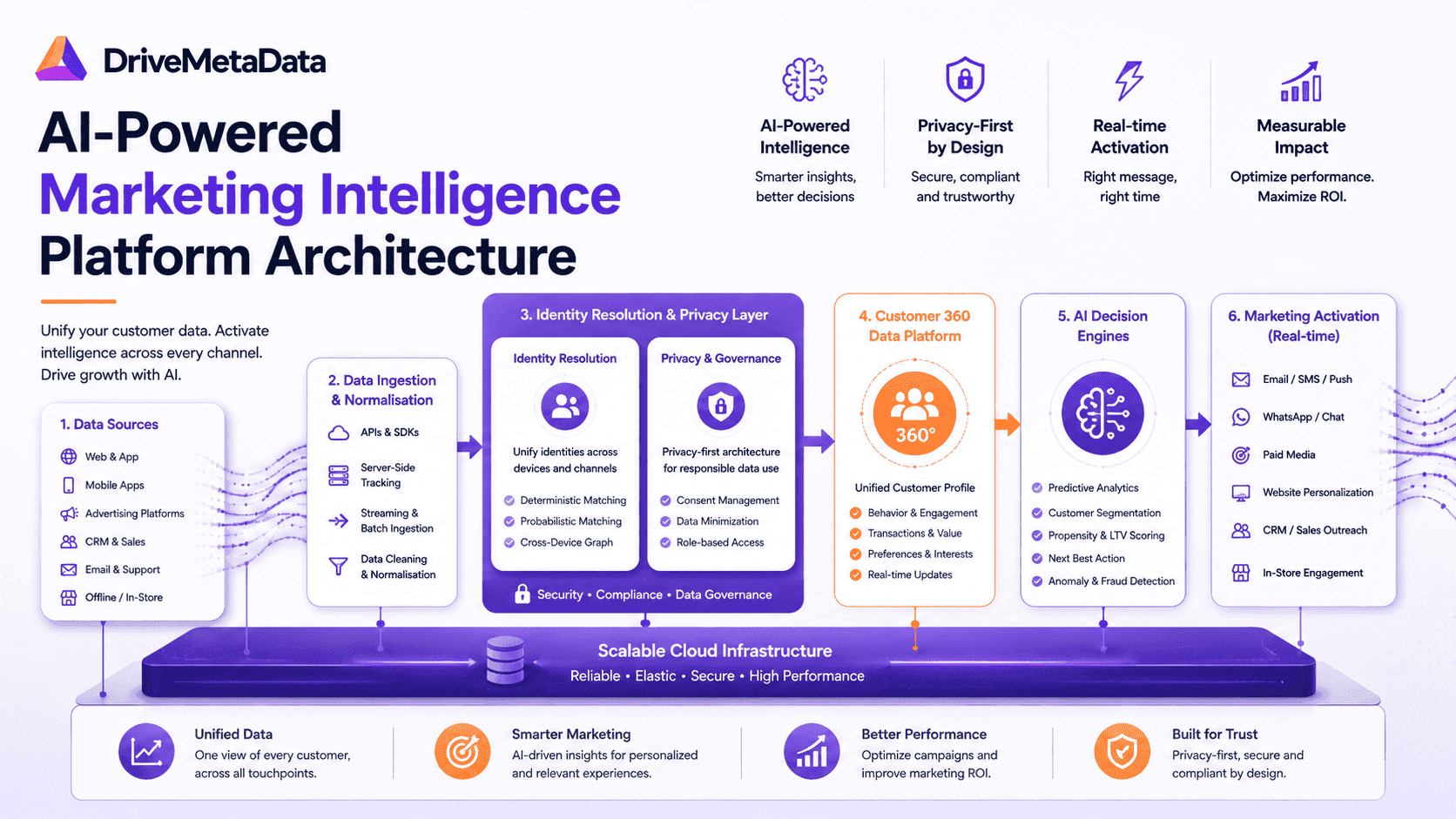
Understanding the architecture of AI-driven marketing intelligence platforms to unify data and optimize campaign outcomes.
Ranjeet Ranjan
AI Executive Brief
This article explains how AI-powered marketing intelligence platforms integrate fragmented customer data with privacy-first governance to enable accurate attribution, predictive analytics, and real-time marketing activation for improved campaign performance.
Marketing teams often face critical challenges due to fragmented customer data spread across multiple channels. This fragmentation leads to incomplete attribution, poor personalization, and wasted campaign budget, undermining the potential of AI-driven marketing. Incomplete or ungoverned data can introduce bias and inconsistency in AI models, creating mistrust and limiting their effectiveness. This article details the comprehensive architecture of an AI-powered marketing intelligence platform designed to unify customer event data, enforce privacy-first governance, and deliver actionable AI insights—all integrated into real-time marketing activation to optimize outcomes.
The Business Challenge: Fragmented Data and Barriers to Effective AI Marketing
How Data Silos Limit Marketing Performance and Personalization
Customer data typically resides in isolated systems—website analytics disconnected from mobile app events, CRM data separated from advertising platforms, and offline transactions stored separately. These silos obscure the true customer journey and make multi-touch attribution unreliable. Without a holistic view, personalization suffers, leading to inefficient marketing spend and poor customer experiences.
Maintaining Data Quality, Privacy, and Governance
Variations in data quality combined with stringent privacy regulations, such as GDPR and CCPA, add layers of complexity. Marketing platforms must normalize disparate data and enforce governance policies that manage consent and data handling compliance. Privacy-driven measurement restrictions and reduced third-party data reliability necessitate frameworks that balance personalization with lawful data use. Without this, AI-driven insights can become biased, incorrect, or legally risky, undermining trust and performance.
Barriers to Adoption: Trustworthy and Transparent AI Decision Engines
AI decision engines require comprehensive, high-quality data inputs to produce accurate attribution and predictive insights. Fragmented or poorly governed data results in unreliable models and unclear outputs, reducing marketer confidence. Architectures must not only enable sophisticated AI analytics but also ensure outputs are interpretable and actionable, fostering trust and driving informed marketing decisions.
Key Components of an AI-Powered Marketing Intelligence Platform Architecture
Comprehensive Customer Event Data Collection and Ingestion
The foundation of effective marketing intelligence lies in collecting customer events across every channel—web, mobile apps, advertising platforms, CRM systems, and offline interactions—in real time. A scalable event ingestion pipeline captures, consolidates, and normalizes this data with minimal latency, ensuring that analytics and AI models work with the most current customer behaviors.
Data Normalization, Identity Resolution, and Privacy-First Governance
Raw event data varies widely in format and completeness. Normalization applies a consistent schema, cleans irregularities, and prepares data for analysis. Identity resolution merges disparate customer identifiers into unified profiles, essential for accurate attribution and personalization. Privacy-first governance frameworks maintain compliance by managing consent, limiting data exposure, and enforcing retention policies, ensuring data quality without compromising legal adherence.
Unified Customer 360 View: The Central Data Source for AI Models
Integrating normalized, resolved data from across all touchpoints creates a unified Customer 360 profile—a comprehensive and near real-time single source of truth. This holistic view enables AI models to analyze customer behavior more accurately, enhancing attribution precision and enabling more relevant personalization across channels.
AI Decision Engines: Attribution, Predictive Analytics, and Segmentation
With a reliable Customer 360 foundation, AI decision engines perform multi-touch attribution to identify the influence of each marketing touchpoint on conversions. Predictive models forecast key customer metrics such as churn risk and lifetime value, while AI-powered segmentation dynamically identifies customer groups based on behavior and attributes. These insights enable marketers to make data-driven, strategic campaign decisions.
Marketing Activation Through Real-Time Tracking and Omnichannel Automation
AI insights reach their full potential when seamlessly integrated with marketing execution. Real-time event tracking captures ongoing customer actions, enabling immediate, relevant responses. Omnichannel marketing automation platforms use these insights to coordinate personalized campaigns across email, SMS, web, mobile, and advertising channels, maximizing campaign effectiveness and customer engagement.
Practical Framework to Implement AI Marketing Intelligence Architecture
Step 1: Consolidate and Normalize Cross-Channel Customer Data
Start by aggregating customer event data from all relevant sources—web, mobile, CRM, advertising, and offline—and funnel it into a centralized ingestion system. Normalize the data into consistent formats to reduce complexity and ensure readiness for identity resolution.
Step 2: Ensure Data Quality Through Privacy-First Governance and Identity Resolution
Apply identity resolution techniques to unify multiple customer identifiers into cohesive profiles. Implement rigorous data governance policies including consent management and compliance monitoring to protect data integrity and trustworthiness.
Step 3: Deploy AI Decision Engines for Attribution and Predictive Analytics
Use the unified customer profiles to power multi-touch attribution models and predictive analytics that forecast behaviors like churn or lifetime value. Employ AI-driven segmentation to dynamically target high-value or at-risk customers. Prioritize models that offer clear, interpretable insights to aid marketing teams in decision-making.
Step 4: Activate AI Insights with Marketing Automation and Campaign Optimization
Integrate AI-generated insights with your marketing automation platform to deliver real-time, personalized campaigns across multiple channels. Continuous event tracking completes the feedback loop, enabling campaigns to adapt dynamically to changing customer data.
Common Challenges and Mistakes to Avoid
- Incomplete or biased customer profiles due to fragmented data integration
- Neglecting privacy and governance leading to compliance risks and lost customer trust
- Deploying AI models without validating data quality and completeness
- Using AI outputs that lack transparency or actionable clarity for marketers
- Delaying real-time event tracking, reducing campaign responsiveness
Measuring Success: KPIs for AI Marketing Intelligence Platforms
Evaluate your AI marketing platform using KPIs focused on data and AI quality: percentage of unified customer profiles (data completeness), accuracy of attribution aligned with business goals, interpretability of AI models, latency from event capture to campaign activation, and results from privacy compliance audits. Tracking these metrics ensures that your platform delivers real value and remains legally compliant.
Privacy and Compliance in AI Marketing Intelligence
Embedding Privacy-First Governance Throughout the Data Lifecycle
Effective marketing intelligence platforms integrate privacy-first governance at every stage—from data collection and storage to AI modeling. This includes managing customer consent seamlessly, enforcing data minimization through pseudonymization or anonymization, and auditing AI models to detect bias or unauthorized data use. These practices ensure compliance with evolving privacy regulations without compromising data utility.
Balancing Personalization with Regulatory Constraints
As privacy-driven restrictions and cookie limitations reduce third-party data signals, platforms must pivot to prioritizing first-party data and strengthening identity resolution. Employing privacy-aware AI methods helps maintain effective personalization strategies within regulatory boundaries, preserving marketing relevance while respecting user privacy.
How DriveMetaData Supports an Integrated AI Marketing Intelligence Workflow
Unified Event Data Ingestion and Customer 360 Profiles
DriveMetaData consolidates disparate customer event data from web, mobile, CRM, advertising, and offline sources into normalized, unified customer profiles. This consistent, near real-time data foundation empowers marketers with a dependable Customer 360 view for AI-driven insights.
Privacy-First Governance and Advanced Identity Resolution
Embedded privacy-first governance combined with sophisticated identity resolution in DriveMetaData helps marketing teams maintain data quality and ensure compliance. This foundation supports AI models that deliver reliable, interpretable insights, fostering trust and enabling confident decision-making.
AI-Powered Multi-Touch Attribution and Predictive Customer Segmentation
DriveMetaData’s AI decision engines provide multi-touch attribution and predictive analytics that help marketers understand channel effectiveness and forecast customer behaviors. These capabilities enable more precise targeting and efficient campaign optimization.
Real-Time Event Tracking Integrated with Omnichannel Activation
By coupling real-time event tracking with omnichannel marketing automation, DriveMetaData facilitates seamless activation of AI-driven insights. Marketers can deliver personalized, timely campaigns across multiple channels, improving engagement and marketing ROI.
FAQ
What differentiates AI marketing intelligence platforms from traditional Customer Data Platforms?
AI marketing intelligence platforms extend beyond data collection by integrating advanced AI decision engines such as multi-touch attribution, predictive analytics, and dynamic customer segmentation. They unify fragmented data at scale with privacy-first governance, producing actionable, interpretable AI insights directly linked to marketing activation.
How does real-time event tracking enhance AI-driven marketing decisions?
Real-time event tracking provides AI models with up-to-date customer behavior data, reducing latency in insight generation. This enables more accurate attribution, timely predictive signals, and faster, more relevant marketing activation, improving campaign effectiveness.
What risks arise from poor data governance in AI marketing platforms?
Weak data governance can lead to incomplete, inconsistent, or non-compliant marketing data, which undermines AI model accuracy and introduces bias. It also increases regulatory risk and erodes customer trust, potentially damaging brand reputation and resulting in legal penalties.
How can marketing teams activate AI insights without extensive technical skills?
Platforms that integrate AI insights directly into familiar marketing automation tools and offer intuitive interfaces for segmentation, attribution, and campaign orchestration empower marketing teams. Clear, interpretable AI outputs and turnkey activation workflows allow marketers to execute smart campaigns without deep technical expertise.
Next Steps: Evaluating and Adopting AI-Powered Marketing Intelligence Platforms
Key Criteria for Platform Selection and Integration
When selecting an AI marketing intelligence platform, prioritize solutions that unify cross-channel event data, incorporate privacy-first governance, and deliver transparent, interpretable AI models. Evaluate compatibility with your existing MarTech stack, ability to process real-time data, and ease of marketing activation across channels.
Preparing Your Team: Skills, Processes, and Data Maturity
Successful implementation requires alignment between data engineering, marketing analytics, and campaign teams. Invest in training on data governance best practices, AI interpretation, and marketing applications. Assess your current data maturity, identifying gaps in unified profiles, privacy compliance, and real-time capabilities to inform incremental improvements.
Evaluating AI marketing intelligence platforms requires prioritizing data unification, privacy governance, and transparent AI capabilities. Aligning team skills, processes, and data maturity ensures successful adoption and maximizes marketing impact through intelligent automation and actionable insights.
Attribution Audit
Find the gaps hiding in your attribution data.
Get a focused audit of campaign tracking, ROAS signals, and conversion paths before media spend leaks into blind spots.
Related Blogs
More from our insights
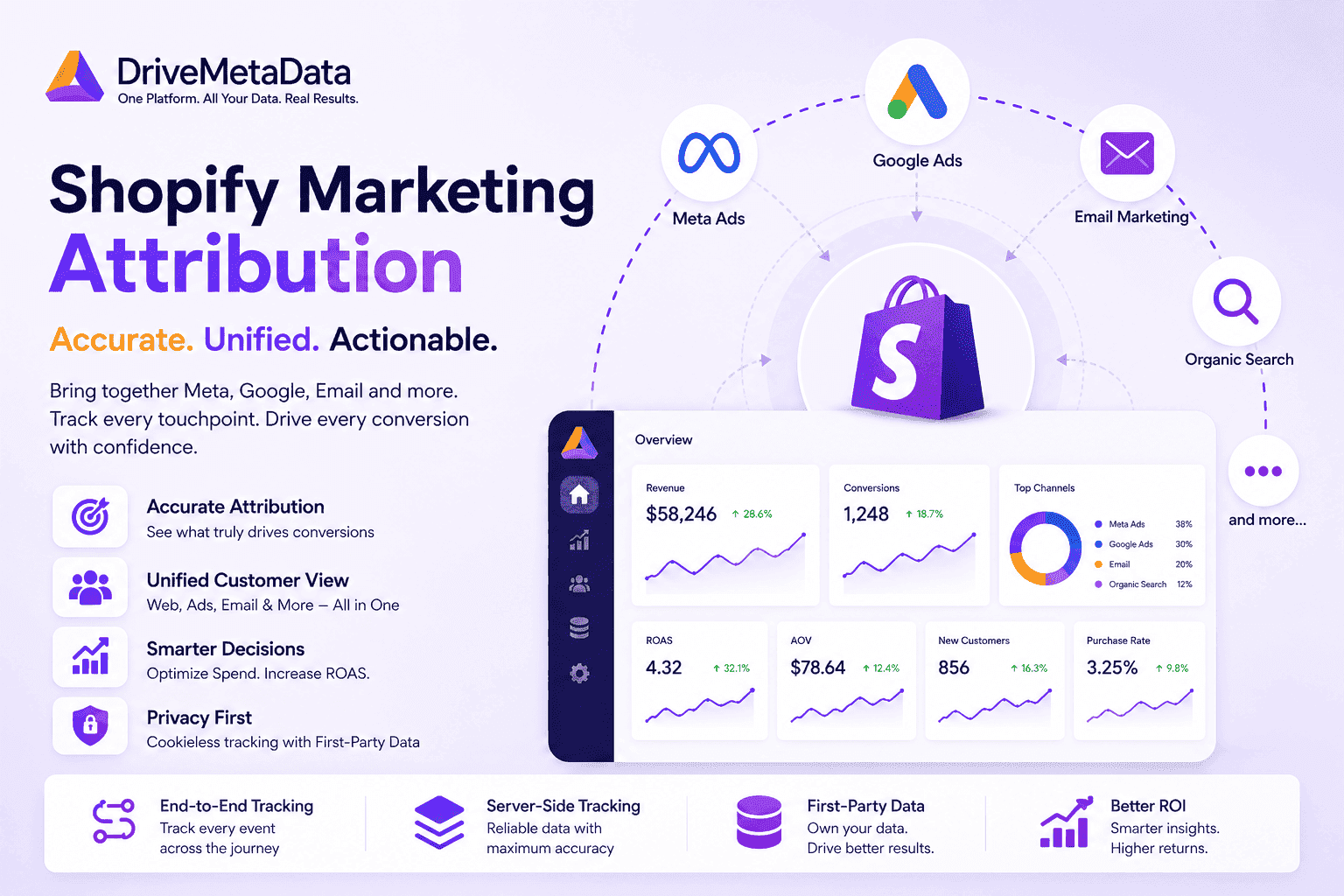
Shopify Marketing Attribution Across Meta, Google Ads, and Email: A Revenue Truth Framework
Customer Data Platform · 11 min read
Shopify Customer Journey Attribution: Multi-Touch Models & Repeat Order Tracking
Customer Data Platform · 6 min read
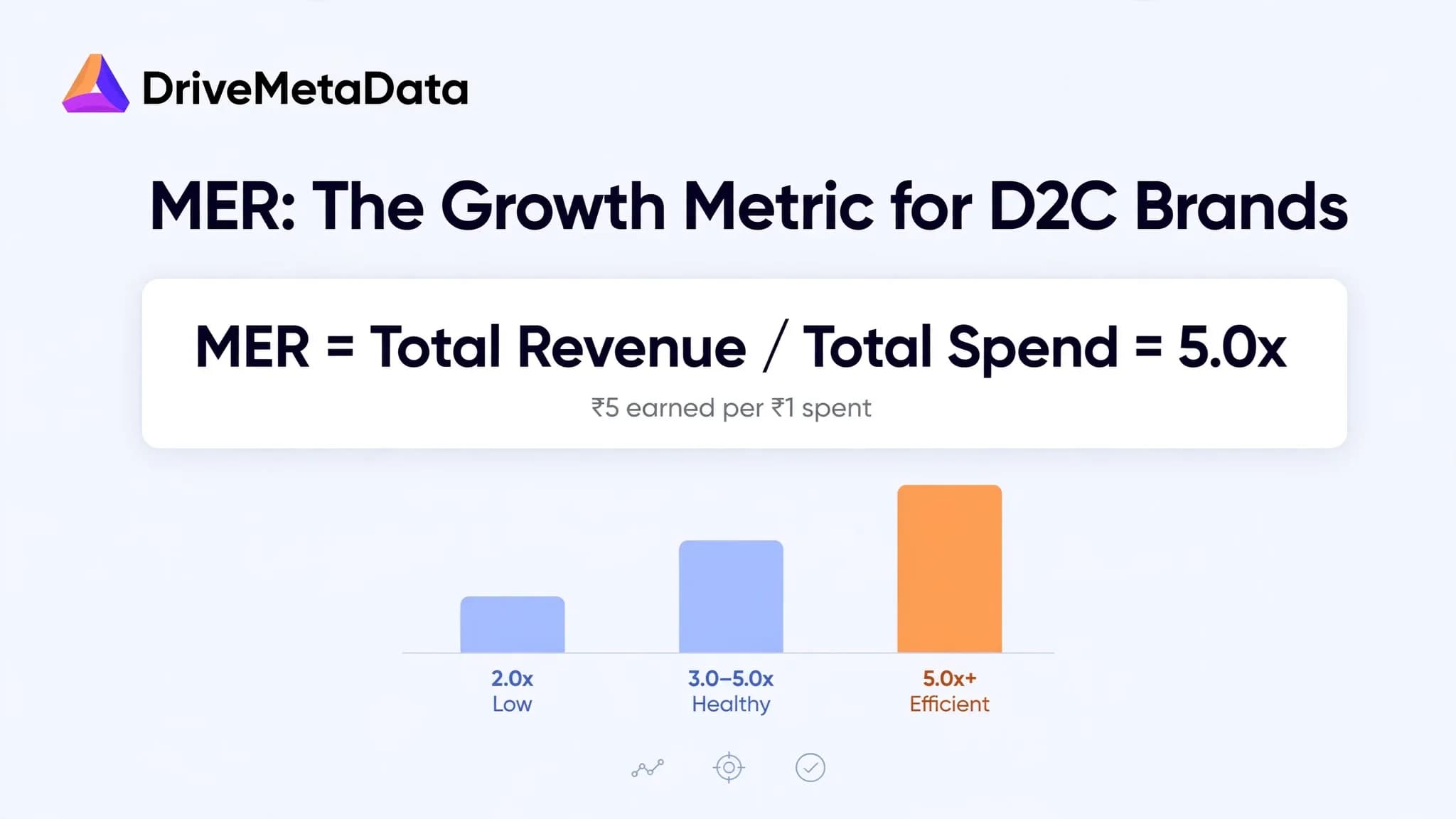
Marketing Efficiency Ratio (MER) Needs A Warning Label For D2C Growth
Customer Data Platform · 8 min read