
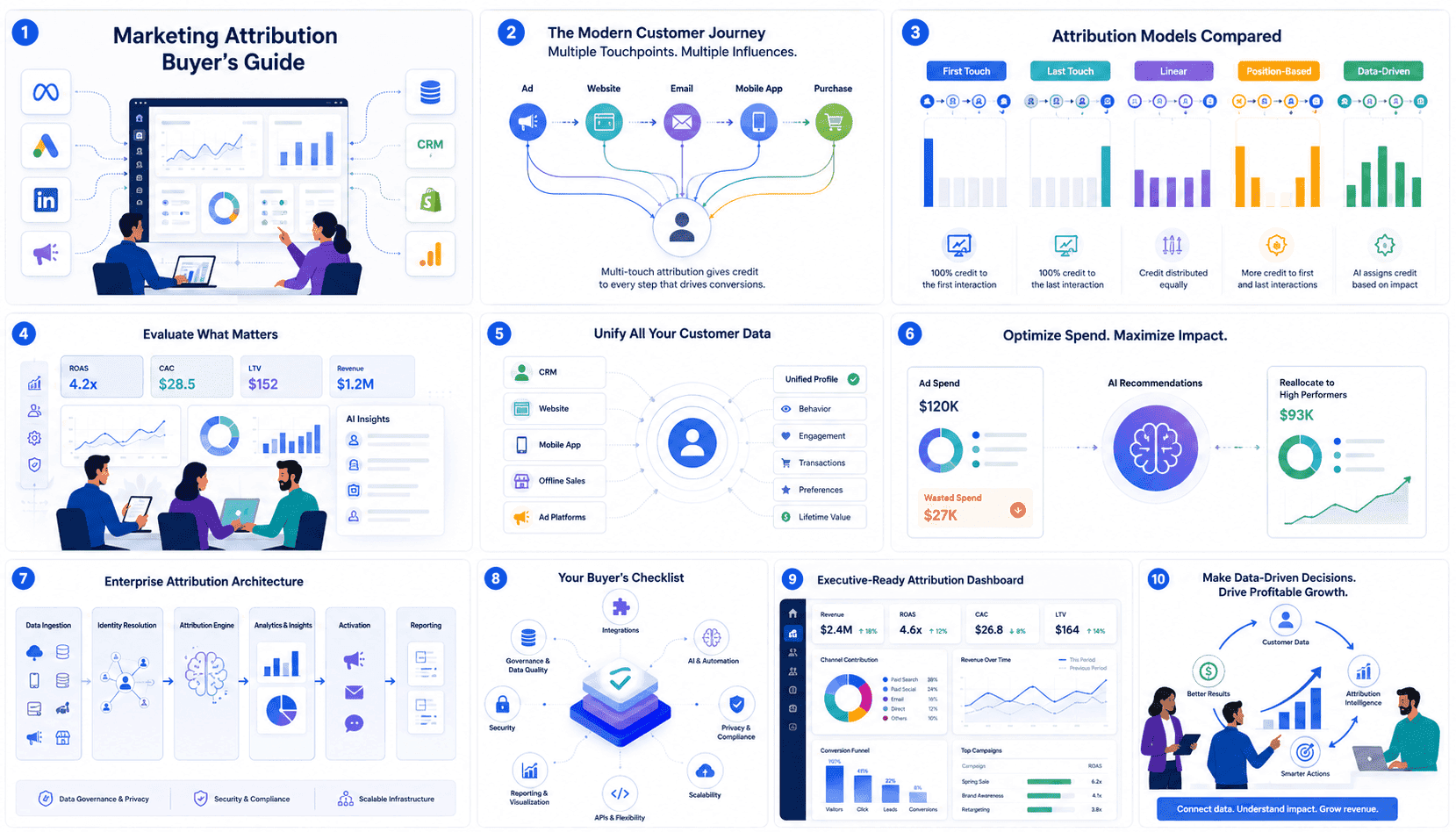
Navigate marketing attribution challenges and select the best software to optimize your campaign ROI.
Ranjeet Ranjan
AI Executive Brief
This Attribution Buyer's Guide helps marketing professionals understand key attribution models, evaluate critical software features, and follow a practical framework for selecting attribution solutions that fit their business needs and marketing maturity.
Marketing teams struggle to allocate budgets effectively when attribution data is incomplete or inconsistent. Fragmented customer data, privacy-driven signal loss, and complex attribution models make it hard to pinpoint which marketing efforts truly drive conversions. This Attribution Buyer's Guide navigates these challenges by explaining key marketing attribution models, detailing critical software features, and offering a practical decision framework to help marketers select a solution that fits their business needs and marketing maturity.
Understanding the Challenges in Marketing Attribution Today
Why Accurate Attribution Is Essential for Budget and Campaign Success
Attribution informs how marketing budgets are assigned by distributing value across touchpoints in the customer journey. Without accurate attribution, marketers risk overinvesting in channels that don’t generate real conversions, resulting in wasted spend and missed growth opportunities. Reliable attribution enables smarter campaign optimization, better identification of effective tactics, and stronger justification for marketing investments.
Key Obstacles: Fragmented Data, Privacy Restrictions, and Channel Silos
Customer data is often scattered across web analytics, CRM systems, advertising platforms, and offline sources. This fragmentation creates silos that block a unified customer view. Privacy regulations, cookie restrictions, and declining dependability of third-party data further reduce available measurement signals. Without robust data unification and privacy-conscious tools, attribution insights risk being incomplete, biased, or misleading.
Common Marketing Attribution Models and When to Use Them
Single-Touch Attribution: First Touch vs Last Touch
Single-touch attribution assigns 100% of conversion credit to one touchpoint. First Touch credits the initial brand interaction and helps evaluate lead generation success. Last Touch credits the final interaction before conversion, useful for optimizing conversion-centric tactics. While easy to implement, these models ignore other crucial interactions and can misrepresent channel contributions.
Multi-Touch Attribution: A More Complete View with Tradeoffs
Multi-touch attribution distributes credit among multiple touchpoints, offering a detailed view of how different channels contribute along the customer journey. Common approaches include linear (equal credit for each touch), time decay (higher credit for recent touches), and position-based (weighted credit among first, last, and middle touches). However, MTA depends on high-quality, integrated data and often struggles with cross-device or offline interactions without sophisticated identity resolution.
AI-Powered Attribution Models: Enhancing Accuracy with Machine Learning
AI-powered attribution applies machine learning to analyze large, multi-channel datasets, dynamically assessing the impact of each touchpoint. These models adapt to evolving customer behaviors, reduce arbitrary credit rules, and incorporate predictive analytics to forecast channel performance. AI enables marketers to uncover insights despite incomplete or noisy data, enhancing budget decisions amid privacy restrictions and measurement uncertainty.
Critical Features to Evaluate in Marketing Attribution Software
Comprehensive Data Unification and Identity Resolution
An effective attribution platform must consolidate data from online and offline sources including web analytics, mobile apps, CRM, advertising, and in-store activity. Identity resolution links interactions across devices and channels back to unique customers, reducing duplication and elevating the accuracy of attribution models.
Real-Time Event Tracking with Flexible Integration Options
Up-to-date event tracking provides marketers immediate visibility into customer interactions, making it easier to optimize campaigns on the fly. Platforms should offer broad integration support via APIs, SDKs, and data warehouse connectors to smoothly ingest and activate data from diverse marketing technologies.
Built-In Fraud Detection to Maintain Data Integrity
Advertising fraud and invalid traffic can distort attribution outcomes, leading to misguided budget allocations. Robust fraud detection mechanisms help identify and filter dubious activity, keeping attribution data trustworthy for reliable decision-making.
Privacy-First Governance in a Changing Regulatory Landscape
With evolving privacy laws and consumer expectations, platforms must embed privacy-first frameworks that comply with GDPR, CCPA, and other regulations. Essential features include consent management, minimal exposure of personal data, and resilient measurement methods that adapt to cookie restrictions and reduced third-party data signals.
Beyond Features: How to Compare Marketing Attribution Platforms
Integration Depth with CRM, Advertising, Web, and Offline Sources
Platforms that seamlessly connect to a broad range of data sources minimize manual integration efforts and deliver richer, more complete customer insights. Verify the breadth and depth of integrations to ensure they support your existing marketing ecosystem.
User Experience and Ease of Adoption for Marketing Teams
Adoption success depends on usability. Tools with intuitive interfaces, customizable dashboards, and accessible analytics empower marketers to explore insights independently without overreliance on technical specialists.
Scalability to Support Complex Customer Journeys
As customer journeys become more intricate, platforms must handle increasing data volume and sophisticated analytics needs. Ensure scalability to support ongoing model refinement, multi-channel journeys including offline touchpoints, and advanced measurement.
Implementing Marketing Attribution: Best Practices and Pitfalls
Step-by-Step Framework to Integrate Multi-Channel Data
- Audit current data sources and identify any coverage gaps.
- Establish ingestion pipelines across web, mobile, CRM, advertising, and offline platforms.
- Deploy identity resolution techniques to unify customer touchpoints.
- Validate data quality, removing duplicates and anomalies.
- Set up real-time event tracking where possible.
- Conduct end-to-end testing of data flows before launching attribution analysis.
Prioritizing Attribution Models Based on Your Marketing Maturity
Early-stage teams often start with simpler single-touch models to understand basic channel impact. With maturity and richer data, multi-touch and AI-powered models capture complex journeys more effectively. Align model choice with your team’s goals, data readiness, and operational resources.
Common Implementation Mistakes to Avoid
- Overlooking offline or CRM data, which leads to incomplete customer journey views.
- Neglecting data quality and validation before modeling.
- Commitment to a single attribution model without comparative testing.
- Ignoring privacy compliance and consent management needs.
- Underestimating the integration effort across systems.
- Treating attribution as a one-off initiative rather than an ongoing process.
Measuring Attribution Success and Driving Continuous Optimization
Key Metrics to Evaluate Attribution Effectiveness
Measure success by how well attribution data supports improved decisions. Track KPIs like credit assignment accuracy validated against revenue, data coverage completeness, reporting latency, reduction in wasted spend, and adoption rate among marketing users.
Leveraging Attribution Insights to Boost Campaign ROI
Use attribution reports to shift budgets toward top-performing channels, fine-tune audience segments, and identify overlooked touchpoints. Performing regular model reviews ensures insights stay relevant as customer behavior and market conditions evolve.
How DriveMetaData Supports Effective Attribution and Customer Data Management
Unified Data Integration Across All Key Marketing Channels
DriveMetaData consolidates fragmented customer data from web, mobile, CRM, advertising, and offline sources into a single, consistent platform—providing a reliable foundation for comprehensive attribution modeling.
AI-Powered Multi-Touch Attribution and Predictive Analytics
Powered by AI, DriveMetaData’s attribution models adapt to complex customer journeys and deliver predictive insights to optimize campaign spend and forecast marketing performance.
Integrated Fraud Detection and Privacy-Centric Governance
The platform features built-in fraud prevention to enhance data integrity, while embedding privacy-first governance to ensure compliance and maintain measurement effectiveness despite signal loss challenges.
Real-Time Event Tracking with Flexible API and SDK Integrations
DriveMetaData supports real-time tracking and offers flexible APIs and SDKs that integrate multiple data sources, enabling timely campaign adjustments and seamless data activation across marketing tools.
Final Checklist and Framework for Choosing Attribution Software
Assessing Business Needs and Marketing Team Readiness
- Clarify your primary marketing goals and how attribution supports them.
- Evaluate your team's data analytics experience and capacity to handle model complexity.
- Inventory current data sources and identify gaps in coverage.
- Consider future growth and scalability requirements.
Identifying Critical Features and Integration Requirements
- Capability to unify data from web, mobile, CRM, advertising, and offline channels.
- Identity resolution linking cross-device and cross-channel touchpoints.
- Real-time event tracking support.
- Flexible API and SDK integrations conforming with your marketing stack.
- Support for both multi-touch and AI-powered attribution models.
Evaluating Privacy Compliance and Fraud Prevention
- Built-in mechanisms ensuring compliance with GDPR, CCPA, and other laws.
- Privacy-first data handling and consent management.
- Fraud detection tools safeguarding data integrity.
- Adaptability to measurement challenges from declining third-party signals.
| Criteria | What to Look For | Why It Matters |
|---|---|---|
| Data Unification | Supports multiple online and offline channels with identity resolution | Ensures a comprehensive and accurate customer journey view |
| Attribution Models | Offers single-touch, multi-touch, and AI-powered advanced models | Matches complexity to marketing maturity and data capabilities |
| Integration Flexibility | APIs, SDKs, real-time event tracking | Enables seamless data flow and timely insights |
| Privacy Compliance | Built-in consent management and privacy-first governance | Reduces legal risks and maintains measurement despite restrictions |
| Fraud Detection | Identifies invalid traffic and suspicious activity | Protects data quality and reliability of attribution insights |
FAQ
What is the difference between single-touch and multi-touch attribution?
Single-touch attribution assigns credit to only one touchpoint—either the first or last—while multi-touch attribution distributes credit across multiple touchpoints throughout the customer journey, providing a more comprehensive view of marketing impact.
How do AI-powered attribution models improve marketing performance?
AI-powered models analyze complex data sets with machine learning, dynamically adapting to changing customer behaviors and reducing arbitrary credit assignments. This leads to more accurate attribution and smarter budget optimization.
Why is identity resolution important in attribution software?
Identity resolution links customer touchpoints across devices and channels to a single profile, reducing duplicate data and improving the accuracy and reliability of attribution insights.
How can I ensure my attribution platform complies with privacy regulations?
Look for platforms with built-in privacy-first governance features, consent management tools, and compliance with applicable regulations like GDPR and CCPA. These features minimize legal risks and maintain measurement capability amid privacy changes.
What are common mistakes to avoid when implementing attribution solutions?
Common mistakes include ignoring offline or CRM data, neglecting data quality, relying on a single attribution model, overlooking privacy compliance, underestimating integration effort, and treating attribution as a one-time task rather than a continuous process.
Choosing the right marketing attribution software involves assessing your business needs, evaluating critical features and integrations, and ensuring privacy compliance and fraud prevention. With a structured approach, marketers can implement effective attribution solutions that drive continuous optimization and maximize campaign ROI.
Attribution Audit
Find the gaps hiding in your attribution data.
Get a focused audit of campaign tracking, ROAS signals, and conversion paths before media spend leaks into blind spots.
Related Blogs
More from our insights
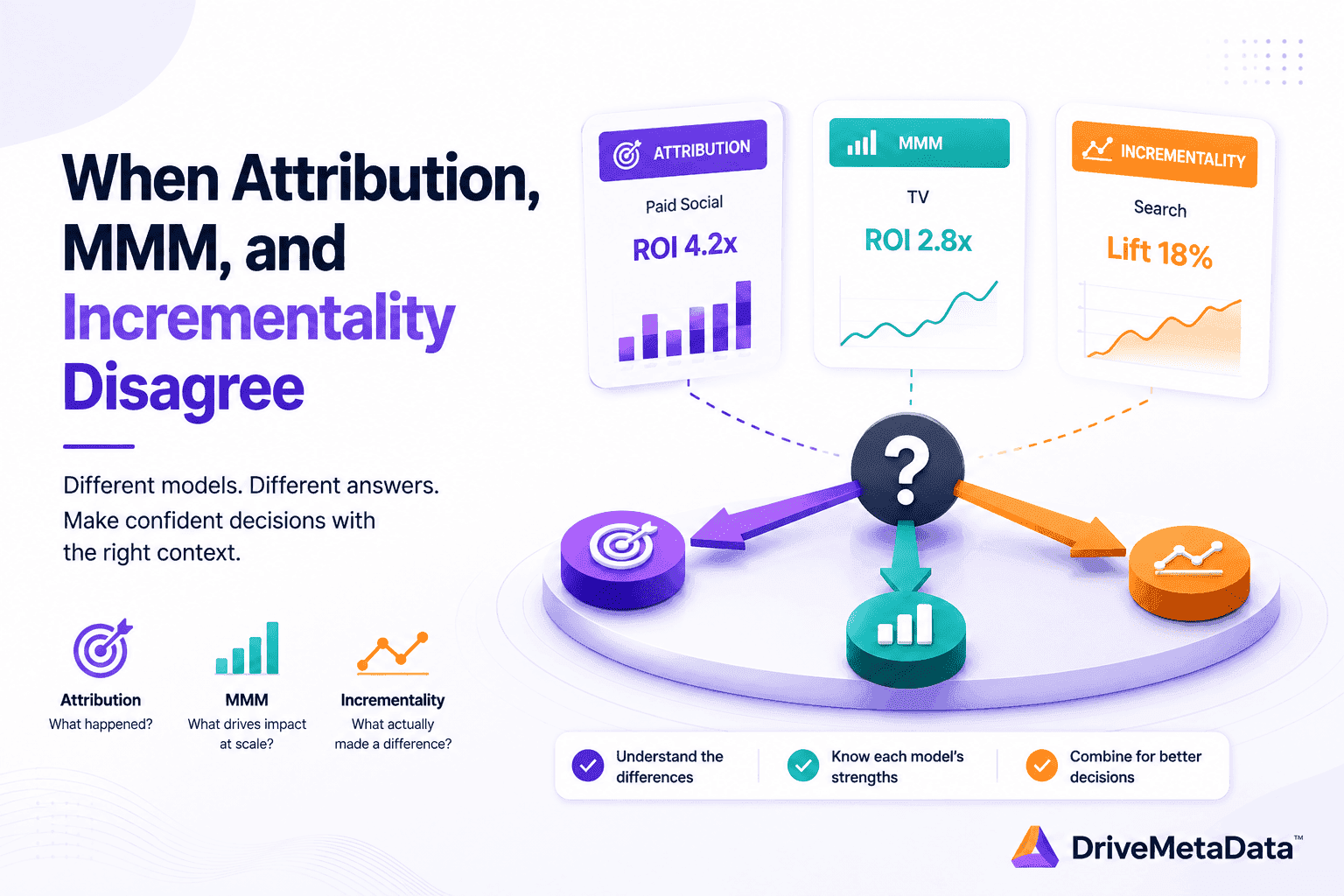
When Attribution, MMM, and Incrementality Disagree: A CFO-Ready Trust Framework
Marketing Attribution · 7 min read
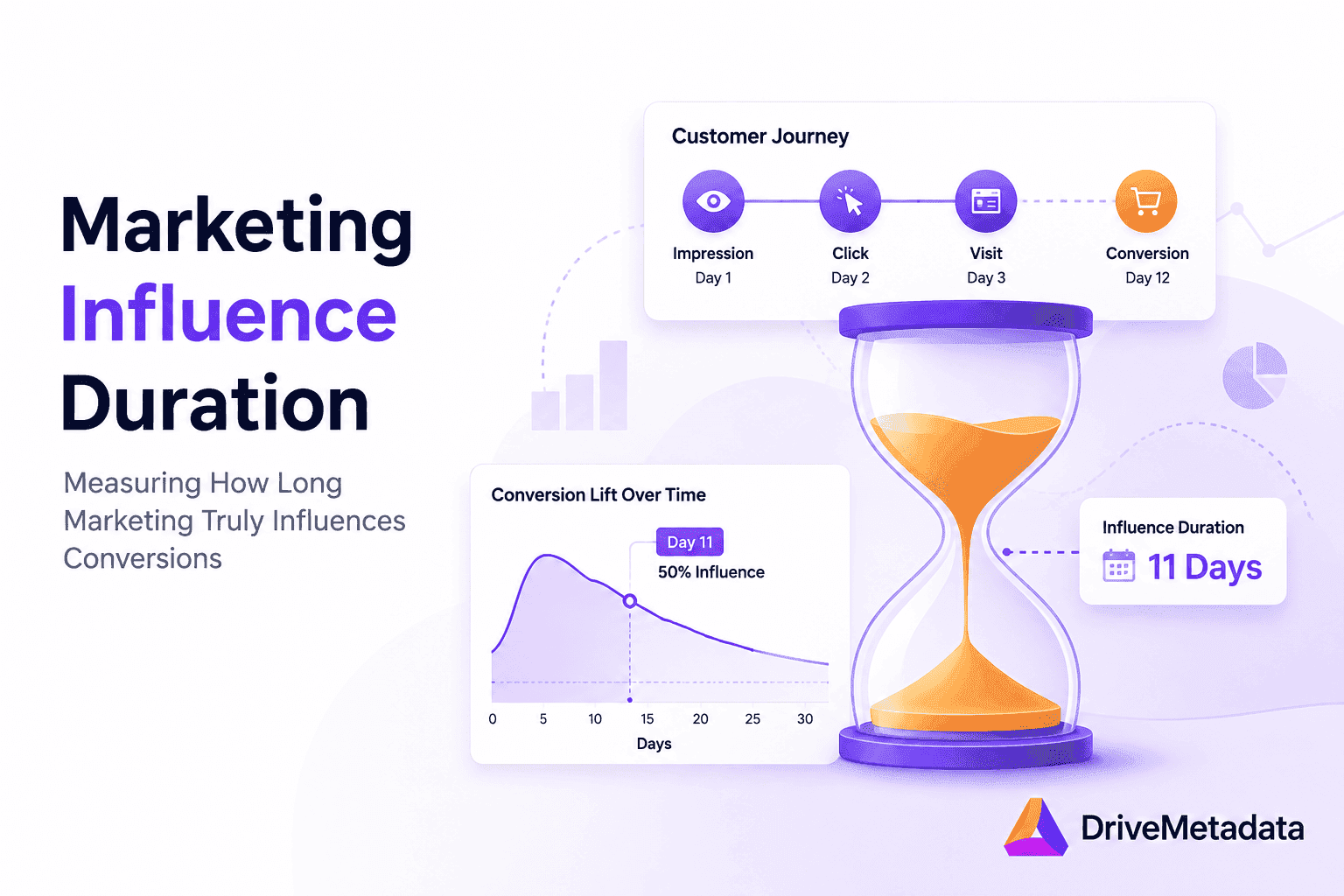
Marketing Influence Duration: Apply the Marketing Influence Half-Life™ for Smarter Attribution
Marketing Attribution · 5 min read
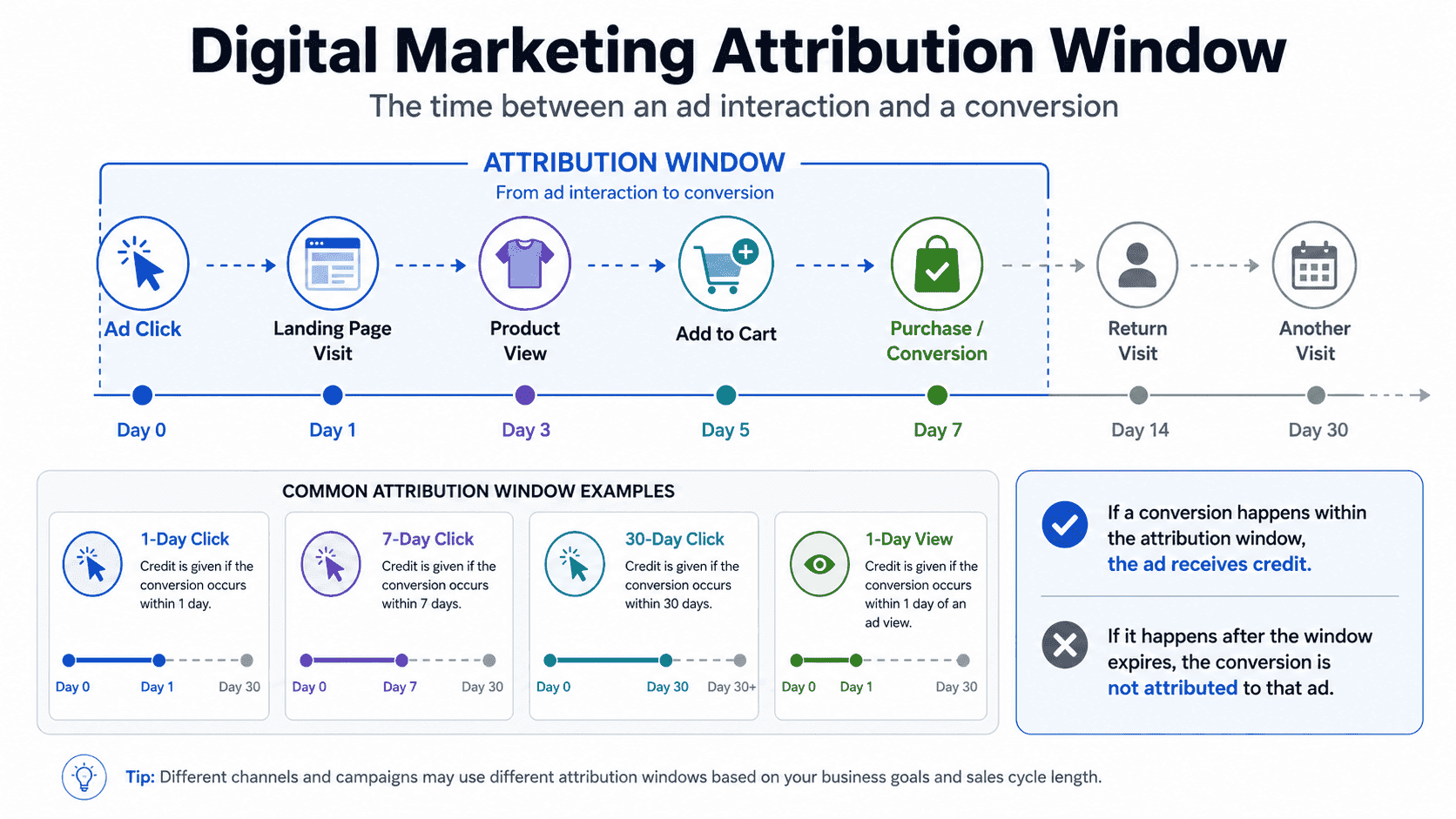
Understanding Attribution Windows: 1-Day, 7-Day, and 28-Day Explained
Marketing Attribution · 5 min read