
Ranjeet Ranjan
Boost Retargeting Performance Using Unified First-Party Data: A Practical Guide
Retargeting often fails when customer data is scattered, outdated, or incomplete. This leads to wasted ad spend, low conversion rates, and missed revenue—risks that grow as privacy regulations tighten and third-party data signals become less reliable. Marketers who unify and activate their first-party data can improve targeting accuracy, reduce inefficiencies, and maintain compliance.
This guide explains why first-party data retargeting matters now more than ever. You'll learn key data types to prioritize, steps to unify and segment your data effectively, privacy considerations, activation best practices, and criteria for selecting the right platforms. This content is designed for performance marketers, ecommerce founders, and growth leaders aiming to optimize retargeting in a privacy-conscious environment.
The Challenge: Inefficient Retargeting and Wasted Ad Spend
Fragmented and inconsistent customer data undermines retargeting success. When data sits isolated in CRMs, analytics tools, engagement systems, or offline sources, targeting accuracy suffers.
- Irrelevant ads reaching uninterested audiences
- Increased acquisition costs from wasted impressions
- Lower conversions as campaigns miss behavioral cues
- Difficulty attributing campaign results due to mismatched data
Without unified, reliable customer data, retargeting can become costly and ineffective.
Why First-Party Data Retargeting Matters More Than Ever
Privacy-driven measurement constraints and declining third-party data reliability mean marketers must focus on the customer data they collect and own directly.
- Ownership and control: Manage your own data rather than relying on external sources.
- Improved accuracy: First-party signals from your website, app, and CRM better reflect actual customer behavior.
- Privacy compliance: Use consented data transparently to align with regulations.
- Personalization potential: Rich data supports tailored messaging that better engages audiences.
Smart retargeting depends on maximizing these clean, consented data assets.
Key Types of First-Party Data for Effective Retargeting
Effective retargeting combines multiple first-party data types, such as:
- Purchase data: Transactions, product preferences, order values
- Behavioral data: Visits, page views, time spent, cart abandonment
- Engagement data: Email opens, app usage, support interactions
- CRM/profile data: Demographics, customer lifecycle stage, loyalty
Together, these create detailed profiles for meaningful audience segmentation using a robust customer data platform.
Overcoming Privacy and Data Fragmentation Challenges in Retargeting
Regulations like GDPR and CCPA require transparency and explicit consent for data use. Alongside cookie restrictions, this environment:
- Reduces availability of third-party signals
- Emphasizes consent-driven first-party data collection
- Increases data silos and fragmentation due to varying consent states across systems
Success depends on strong infrastructure for data integration, compliance management, and quality assurance without invasive tracking.
Best Practices for Unifying and Segmenting First-Party Data
Data Ingestion and Cleansing
Consolidate all first-party sources into a unified repository:
- Collect data via APIs, batch processes, or streaming from CRM, web analytics, email, customer service
- Clean duplicates, correct errors, standardize formats (e.g., email normalization)
- Enrich profiles by filling gaps where possible
- Keep data fresh with automated refreshes
Segmentation Strategies for Precision Targeting
Transform unified data into actionable audiences:
- Use recent behavioral triggers (e.g., site visits, cart abandonment)
- Combine demographics and purchase history for value-based segments
- Layer engagement signals to identify warm prospects
- Build exclusion lists to avoid over-targeting converted or inactive users
Journey orchestration techniques can further enhance audience targeting by personalizing multi-channel communication.
A Framework to Activate First-Party Data for Retargeting Campaigns
Step 1: Data Collection and Quality Assessment
Audit your first-party data for completeness and recency. Identify stale or incomplete sources.
Step 2: Creating Actionable Audience Segments
Apply segmentation rules focusing on recent activity and purchase intent.
Step 3: Activation Across Paid Channels
Sync segments to retargeting platforms (e.g., Facebook, Google Ads, DSPs), ensuring compliance with privacy and consent requirements.
Use feedback loops to monitor segment performance and refine targeting using marketing analytics for data-driven optimization.
What to Evaluate When Choosing Platforms for First-Party Data Retargeting
Integration Capabilities and Data Unification
Look for platforms that ingest from many first-party sources, automate cleansing, and enrich profiles.
Privacy Compliance and Future-Proofing
Prioritize solutions with built-in consent management and support for cookie-less environments.
Measurement and Attribution Support
Select tools that connect first-party data to conversions to enable performance optimization through marketing attribution.
| Criteria | What to Look For |
|---|---|
| Data Integration | Multi-source ingestion, automated data cleansing |
| Privacy Compliance | Consent management, support for cookie-less targeting |
| Segmentation Flexibility | Behavioral, demographic, and lifecycle-based segments |
| Activation Channels | Syncs with major ad platforms and DSPs |
| Attribution & Analytics | Links audience segments to measurable campaign metrics |
Avoiding Common Pitfalls in First-Party Data Retargeting
- Ignoring data quality issues, which reduce targeting accuracy
- Over-segmenting audiences and limiting scale
- Failing to update segments frequently, causing stale targeting
- Using data without proper consent, risking compliance and reputation
- Relying on single data sources and missing fuller customer context mitigated through identity resolution
How DriveMetaData Supports Smarter First-Party Data Activation for Retargeting
DriveMetaData provides a unified platform to integrate, cleanse, segment, and activate first-party data with privacy-focused architecture. This infrastructure helps marketers comply with evolving regulations while maintaining data accuracy.
Its combined capabilities—including customer data unification, marketing attribution, and analytics—offer insights to optimize retargeting campaigns based on reliable first-party signals. DriveMetaData bridges the gap between data ownership and effective retargeting execution across paid channels.
Conclusion and Next Steps for Performance-Driven Retargeting
Effective retargeting depends on unified, high-quality first-party data managed with privacy compliance and smart segmentation. Tackling data fragmentation and adopting a clear activation framework can reduce wasted ad spend and improve conversions.
Choosing platforms with strong integration, privacy features, and attribution capabilities will help future-proof your retargeting strategy amid ongoing industry changes.
Frequently Asked Questions
What is first-party data retargeting and why is it important?
First-party data retargeting uses customer data you directly collect to create targeted audience segments. It enhances accuracy, privacy compliance, and campaign ROI by relying on owned, consented data.
How can first-party data improve retargeting accuracy and reduce wasted spend?
By unifying and cleansing data, marketers ensure ads reach relevant audiences demonstrating real intent, reducing irrelevant impressions and inefficient spend.
What types of first-party data are best for retargeting?
Purchase history, website behavior, app/email engagement, and CRM profile data are key inputs to build effective segments.
How do privacy laws impact using first-party data for retargeting?
Regulations require consent and transparency, reducing reliance on third-party cookies and emphasizing privacy-compliant first-party data strategies.
What tools help unify and activate first-party data for retargeting?
Customer data platforms that combine multi-source ingestion, data cleansing, segmentation, and activation support end-to-end retargeting.
How can marketers segment first-party data effectively?
Use a combination of behavioral, demographic, and lifecycle data with ongoing refinement based on recent activity and channel performance.
What are common mistakes in first-party data retargeting?
Ignoring data quality, over-segmentation, stale audiences, non-compliance, and dependence on siloed data sources.
How does first-party data retargeting compare with third-party cookie targeting?
It offers greater ownership, privacy compliance, and accuracy, while third-party approaches face increasing restrictions and signal loss.
What metrics track improved retargeting performance?
Monitor conversion rates, cost per acquisition (CPA), return on ad spend (ROAS), audience engagement, and frequency relative to conversions.
Attribution Audit
Find the gaps hiding in your attribution data.
Get a focused audit of campaign tracking, ROAS signals, and conversion paths before media spend leaks into blind spots.
Related Blogs
More from our insights
AI-Powered Marketing Attribution and Customer Data Platform
First-Party Data Strategy · 4 min read
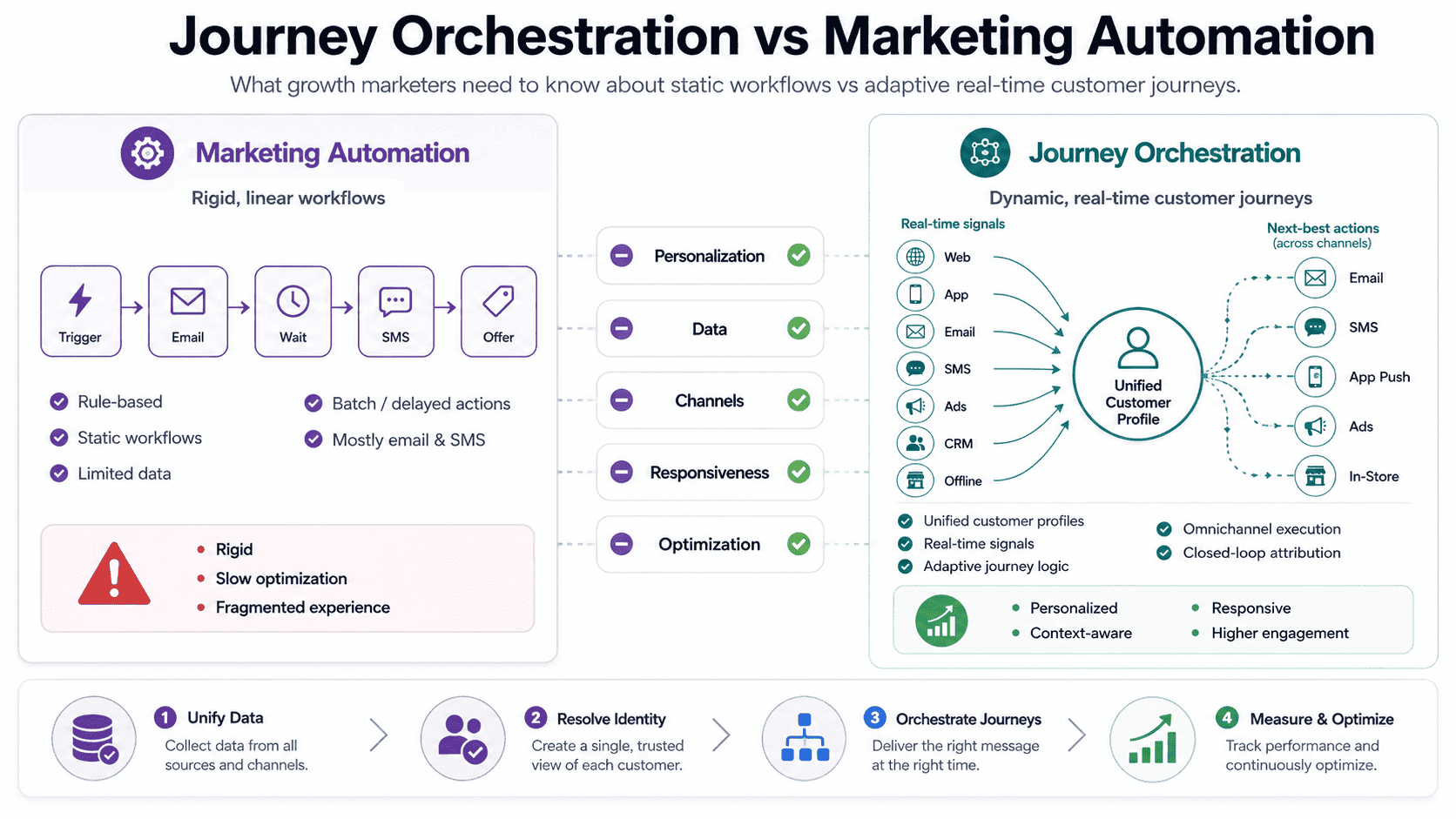
Journey Orchestration vs Marketing Automation: What Growth Marketers Need to Know
Journey Orchestration · 2 min read
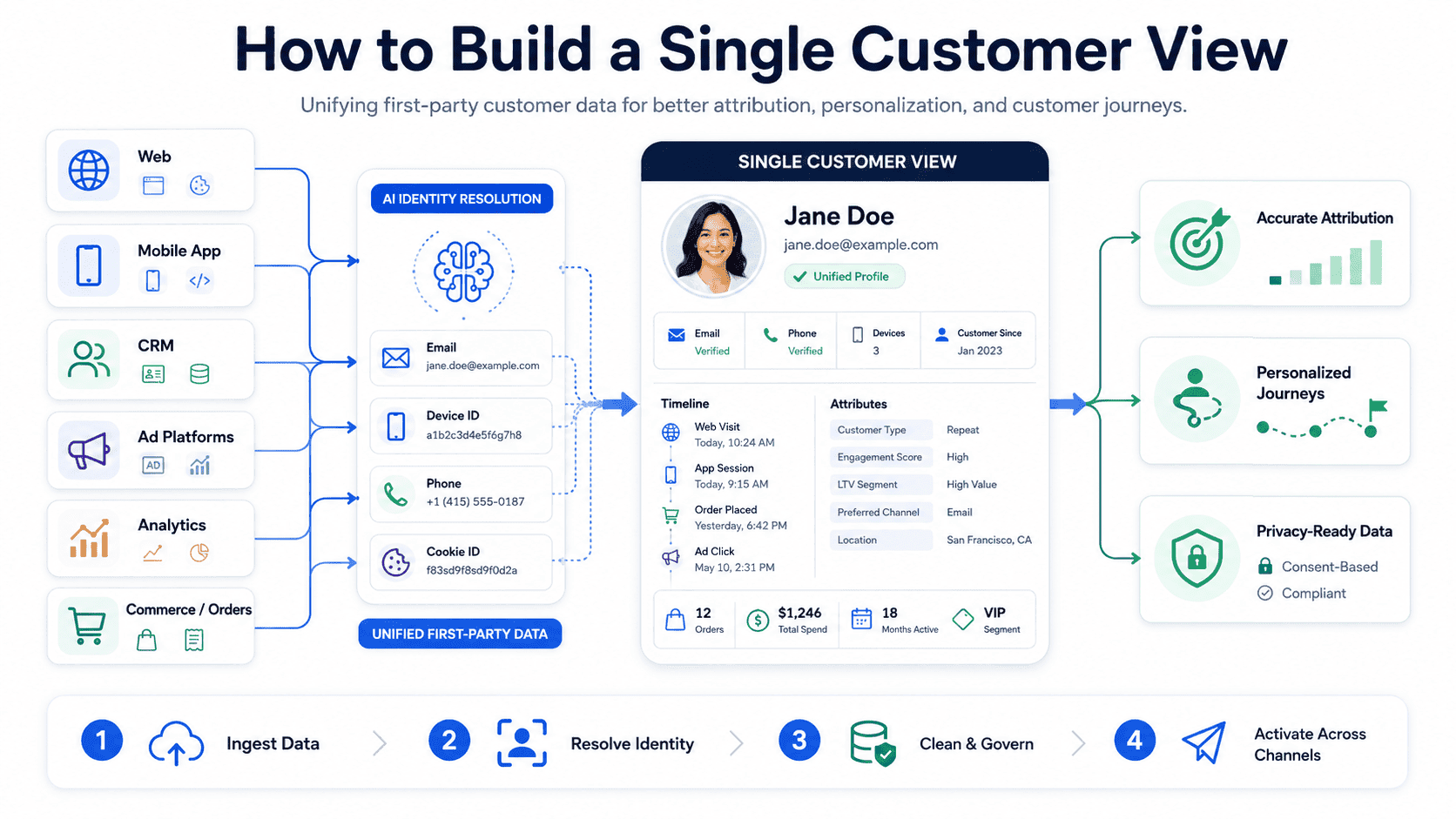
How to Build a Single Customer View Using Unified First-Party Customer Data
Customer Data Platform · 4 min read