
Unifying fragmented customer data for better ecommerce marketing results
Ranjeet Ranjan
AI Executive Brief
Building a unified single customer view from first-party data enables ecommerce and D2C brands to overcome fragmented data challenges, improve marketing attribution, and orchestrate personalized customer journeys using AI-powered identity resolution and privacy-conscious data management.
Fragmented customer data creates serious risks for ecommerce and D2C brands. When customer interactions are scattered across websites, apps, CRM systems, advertising channels, and analytics tools, marketers lose vital signals needed to personalize marketing effectively.
The Business Risks of Fragmented Customer Data in Ecommerce and D2C Marketing
Fragmented customer data creates serious risks for ecommerce and D2C brands. When customer interactions are scattered across websites, apps, CRM systems, advertising channels, and analytics tools, marketers lose vital signals needed to personalize marketing effectively. This leads to inefficient ad spend on poorly targeted campaigns, lost conversions, and wasted budget.
Fragmented data also makes it difficult to attribute conversions accurately. Without connecting customer touchpoints across channels, marketing ROI becomes unclear, hampering budget optimization and strategic decision-making.
Moreover, inconsistent messaging caused by fragmented profiles confuses customers, damages brand trust, and reduces engagement, often resulting in higher churn.
This article guides ecommerce marketers through building a unified single customer view (SCV) from first-party data, helping to overcome fragmentation, improve attribution, and orchestrate personalized customer journeys.
Understanding the Single Customer View and Its Role in Ecommerce
What Is a Single Customer View?
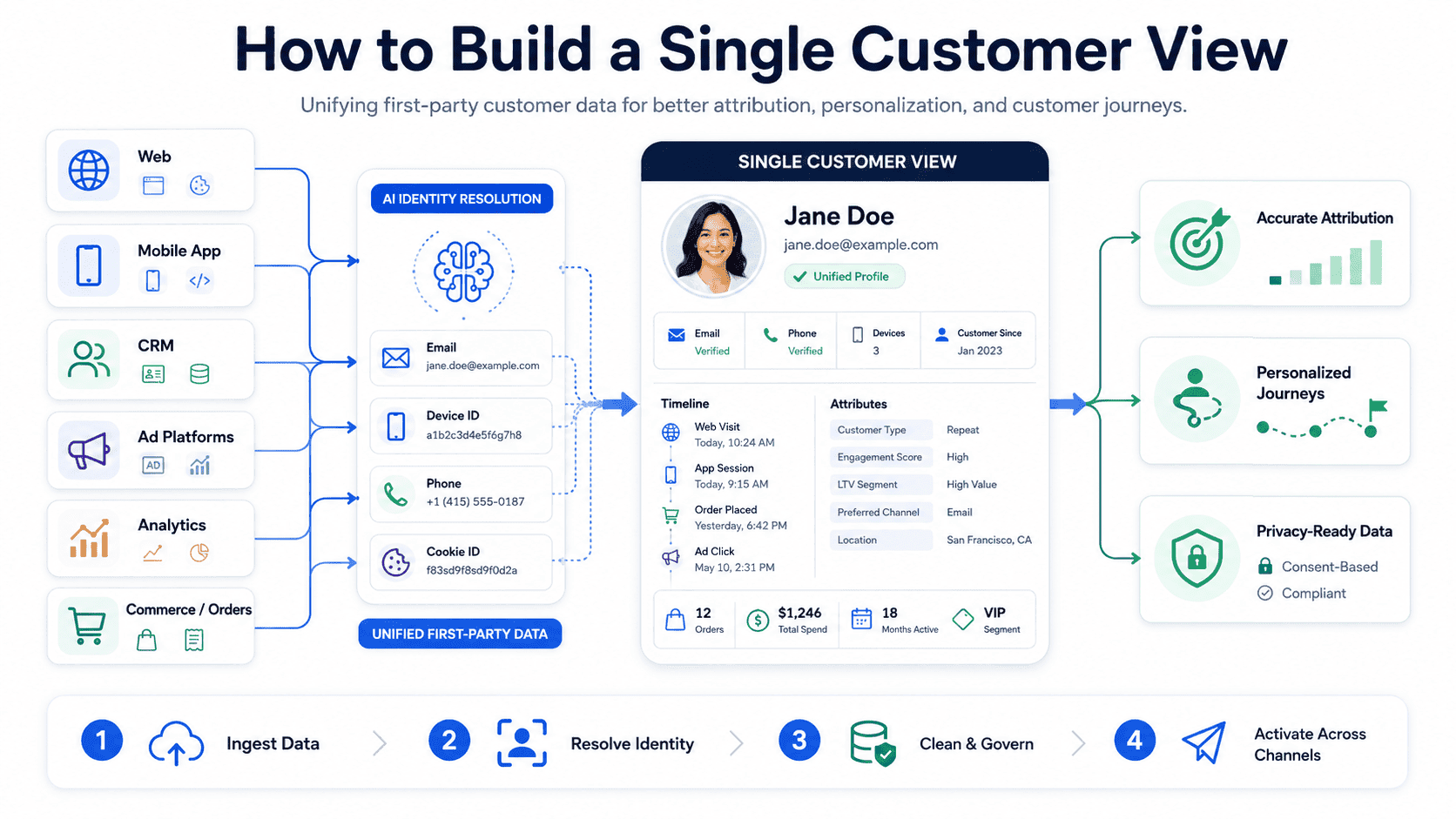
A single customer view consolidates all known data points about a customer into one persistent, comprehensive profile. By unifying data from multiple sources, it enables a deep understanding of customer behavior, preferences, and interactions across channels.
A strong SCV forms the foundation for accurate personalization, reliable measurement, and coordinated marketing efforts.
Key Data Sources for Building a Unified Customer Profile
- Web and Mobile: Browsing behavior, in-app actions, device signals
- CRM Systems: Contact details, purchase history, customer support data
- Advertising Platforms: Campaign exposures, clicks, conversions
- Analytics Tools: Funnel metrics, behavioral insights
- Commerce Platforms: Order history, subscription status, lifetime value
Each source contributes critical pieces that must be carefully linked to avoid fragmented or duplicated customer records.
Practical Framework for Building a Unified Single Customer Profile
Step 1: Centralize and Continuously Ingest First-Party Data
Establish reliable pipelines to collect data from all relevant platforms. Prioritize direct integrations or streaming APIs to keep profiles up to date and avoid manual data exports or disconnected silos.
Step 2: Address Identity Resolution Challenges with AI
Linking multiple customer identifiers—emails, device IDs, cookie IDs—is complex, especially at scale. Manual or rule-based matching can create duplicates or incomplete profiles.
AI-powered identity resolution uses probabilistic models and machine learning to unify identities more accurately, handling transitions from anonymous to known users and updating profiles dynamically.
Step 3: Maintain Data Quality and Privacy Compliance
High-quality data is essential. Implement routines for deduplication, normalization, and validation to ensure accuracy.
Integrate privacy compliance throughout data collection and management. Respect user consent, apply relevant privacy regulations, and avoid reliance on deprecated third-party signals affected by cookie restrictions and privacy-driven measurement constraints.
Step 4: Integrate the SCV into Marketing Workflows and Campaigns
Connect your unified profiles to marketing systems to enhance segmentation, personalize content, and orchestrate customer journeys. A unified SCV also improves attribution by linking conversions to single customer profiles instead of fragmented identifiers.
Common Challenges and Mistakes to Avoid When Building an SCV
Fragmented Data Silos
Partial consolidation or slow data processing leaves silos intact. Ensure ingestion covers all key sources, including offline and unstructured data where possible.
Inaccurate Identity Matching
Relying solely on rule-based matching can cause duplicates or wrongly merged profiles, leading to ineffective segmentation and inconsistent experiences. AI-driven probabilistic matching reduces these risks.
Neglecting Data Hygiene and Privacy
Poor data quality weakens personalization and measurement. Ignoring privacy introduces compliance risks and harms brand reputation. Embed strict governance on data accuracy, consent, and security.
How a Unified Single Customer View Enhances Attribution and Journey Tracking
Enabling Accurate Cross-Channel Attribution
A single customer profile consolidates data across channels, allowing marketers to attribute revenue with greater accuracy and granularity. This clarity supports better budget allocation and campaign optimization. See more on marketing attribution.
Orchestrating Personalized Customer Journeys
Comprehensive profiles enable triggering relevant, timely messages tailored to customer behaviors and preferences, improving engagement and retention while minimizing redundant or irrelevant communications. Learn about customer journey orchestration.
Evaluating AI-Powered Platforms for Building and Activating Your SCV
Essential Capabilities to Consider
- Robust data ingestion across web, mobile, CRM, ads, and commerce platforms
- Advanced AI-driven identity resolution for known and anonymous profiles
- Support for data hygiene and privacy compliance workflows
- Integration with marketing attribution and journey orchestration tools
How DriveMetaData Supports Unified Customer Profiles and Marketing Activation
DriveMetaData offers an AI-driven platform that consolidates fragmented first-party data into persistent, accurate customer profiles. Its probabilistic identity resolution connects customer signals across multiple touchpoints, simplifying data unification. Read more about our identity resolution capabilities.
These unified profiles power cross-channel attribution and personalized journey orchestration, helping marketers improve targeting, measurement, and campaign effectiveness.
Measuring Success and Optimizing Your Single Customer View
Track Attribution Accuracy and ROI
Measure improvements in multi-touch attribution, evaluating how well marketing spend correlates with revenue using marketing analytics.
Monitor Customer Engagement and Retention
Assess changes in engagement, repeat purchases, and churn as personalization improves.
Ensure Data Quality and Compliance
Regularly audit data freshness, completeness, and adherence to privacy regulations using dashboards and automated alerts.
Get Started: Unlock Better Marketing with a Unified Single Customer View
Fragmented customer data creates tangible business risks—lost conversions, inefficient spend, and inaccurate attribution. Building a unified single customer view from first-party data is critical to overcoming these challenges.
By leveraging AI-powered identity resolution and privacy-conscious data management, brands can create accurate, persistent profiles. This foundation enhances marketing attribution and customer journey orchestration, enabling smarter decisions and more effective campaigns.
Request a personalized demo to learn how DriveMetaData’s customer data platform can help unify your customer data, resolve identities, and activate personalized marketing journeys with better attribution.
Fragmented customer data creates tangible business risks—lost conversions, inefficient spend, and inaccurate attribution. Building a unified single customer view from first-party data is critical to overcoming these challenges. By leveraging AI-powered identity resolution and privacy-conscious data management, brands can create accurate, persistent profiles. This foundation enhances marketing attribution and customer journey orchestration, enabling smarter decisions and more effective campaigns.
Attribution Audit
Find the gaps hiding in your attribution data.
Get a focused audit of campaign tracking, ROAS signals, and conversion paths before media spend leaks into blind spots.
Related Blogs
More from our insights
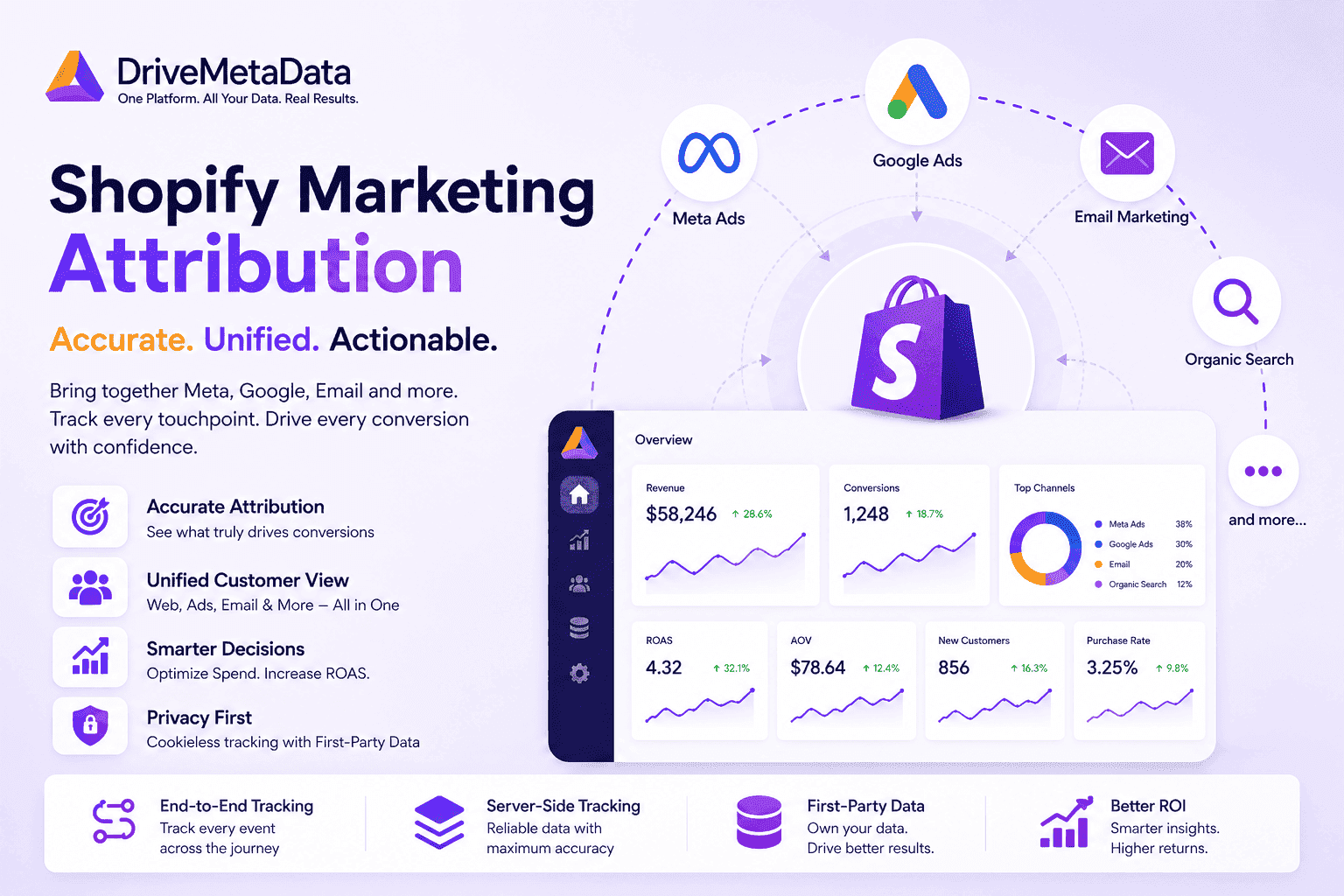
Shopify Marketing Attribution Across Meta, Google Ads, and Email: A Revenue Truth Framework
Customer Data Platform · 11 min read
Shopify Customer Journey Attribution: Multi-Touch Models & Repeat Order Tracking
Customer Data Platform · 6 min read
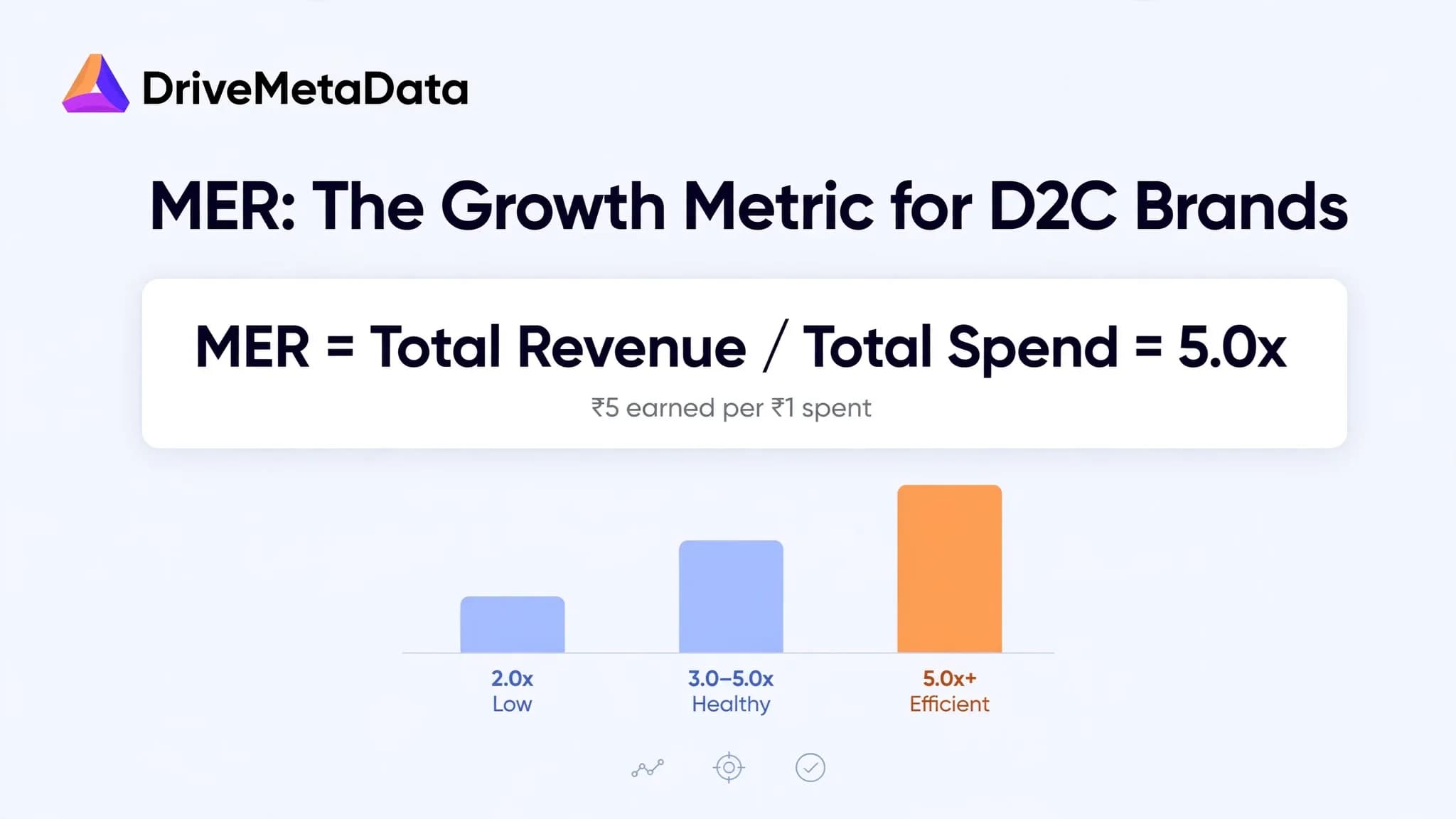
Marketing Efficiency Ratio (MER) Needs A Warning Label For D2C Growth
Customer Data Platform · 8 min read