
Understanding the strategic importance of identity resolution for marketing efficiency and financial accountability
Ranjeet Ranjan
AI Executive Brief
This article explains why embracing the economic value of identity resolution as a strategic business investment is essential for CFOs, CMOs, and revenue leaders. It provides a practical framework linking identity resolution to financial KPIs, marketing efficiency, and data-driven decision-making — empowering better budgeting and measurable growth.
For CFOs, CMOs, and revenue leaders, justifying investments in identity resolution can be challenging. The risk of viewing it as a mere data management task is costly: wasted marketing budgets, inaccurate campaign attribution, and missed revenue growth.
Why Identity Resolution Is a Strategic Investment, Not Just a Data Management Project
For CFOs, CMOs, and revenue leaders, justifying investments in identity resolution can be challenging. The risk of viewing it as a mere data management task is costly: wasted marketing budgets, inaccurate campaign attribution, and missed revenue growth. This article explains why embracing the economic value of identity resolution as a strategic business investment is essential. You’ll gain a practical framework linking identity resolution to financial KPIs, marketing efficiency, and data-driven decision-making — empowering better budgeting and measurable growth.
The Business Risks of Underestimating Identity Resolution’s Value
Inefficient Marketing Spend and Media Waste
Without reliable identity resolution, marketers face fragmented data across channels and devices. This fragmentation causes duplicate ad impressions and irrelevant targeting, inflating media waste — spend that fails to generate measurable returns. Targeting inaccuracies and attribution gaps reduce budget efficiency and increase acquisition costs, leaving executives in the dark about true campaign performance and hampering spend optimization.
Challenges in Capital Allocation and Marketing Accountability
Marketing and finance teams struggle to confidently allocate capital when there is no unified customer view tying campaigns to incremental revenue. This uncertainty drives suboptimal investment decisions—either underfunding effective channels or overspending on less profitable ones. Without trustworthy data on marketing ROI anchored by identity resolution, CFOs and revenue leaders cannot justify ongoing budget increases, missing vital opportunities to scale profitable growth.
Fragmented Customer Data and Its Impact on Attribution and Personalization
Fragmented customer information limits marketers’ ability to deliver personalized experiences and orchestrate seamless journeys. Partial or conflicting data distorts attribution models, misallocating credit across touchpoints. Lacking a consistent identity backbone undermines engagement, increases churn risk, and weakens the precision needed for efficient customer acquisition and sustained loyalty.
Linking Identity Resolution to Financial KPIs: A Practical Framework
Key Metrics to Evaluate Identity Resolution ROI
- Media Waste Reduction: Measuring decreases in duplicated ad impressions and misdirected targeting.
- Marketing Efficiency Ratio: Revenue contribution relative to marketing spend, enhanced by unified data.
- Attribution Accuracy: Improved precision in assigning revenue to campaigns and channels.
- Customer Acquisition Cost (CAC): Lowered by targeting the right prospects and cutting waste.
- Incremental Revenue: Additional income driven by optimized marketing enabled through identity resolution.
- Customer Lifetime Value (CLV): Increased by personalized engagement based on comprehensive profiles.
These metrics translate identity resolution improvements into tangible financial outcomes, providing executives with clear indicators to justify and optimize their investments.
Reducing Media Waste and Improving Marketing Efficiency Ratio
Consolidating fragmented data into a unified customer view reduces redundant targeting and wasted impressions. This efficiency optimizes budget allocation, improving the marketing efficiency ratio — a critical KPI comparing marketing revenue to investment. Demonstrable improvements in this ratio clarify the financial merit of investing in identity resolution beyond technical benefits.
Connecting Attribution Accuracy to Incremental Revenue and Customer Lifetime Value
Accurate attribution depends on mapping all customer interactions to a single identity. Identity resolution resolves fragmented identifiers (e.g., devices, emails, CRM data) into cohesive profiles, revealing the true influence of campaigns on incremental revenue and long-term customer value. These insights support smarter budget allocation and continual optimization of customer journeys.
Strategic Marketing Benefits of a Unified Customer Identity
Improving Campaign Effectiveness and Reducing Customer Acquisition Cost
Unified customer identities enable more precise targeting and personalization by eliminating duplicate audience segments and tailoring messages based on comprehensive profiles. This focused approach improves campaign outcomes and lowers acquisition costs by concentrating efforts on high-potential prospects, fostering sustainable growth.
Enhancing Data-Driven Decision Making for Marketing and Finance Teams
Providing a single source of customer truth bridges marketing and finance, fostering alignment on performance metrics, attribution models, and ROI benchmarks. This transparency supports agile budget adjustments, cross-channel optimization, and strategic planning tied directly to financial goals.
Role in First-Party Data Strategies and Privacy-Compliant Measurement
As reliance on third-party data declines amid privacy regulations and cookie limitations, identity resolution becomes essential for effective first-party data strategies. It consolidates customer signals from owned channels, enabling compliant, privacy-safe attribution and consistent marketing insights despite evolving data environments.
Practical Steps to Measure and Maximize Identity Resolution ROI
Implementation Priorities and Readiness Criteria
- Assess Data Maturity: Review data sources for completeness and fragmentation.
- Align Stakeholders: Ensure marketing, finance, and IT agree on goals and KPIs.
- Define Success Metrics: Tailor financial and marketing KPIs to your business context.
- Integrate Systems: Connect CRM, marketing platforms, and analytics beneath a unified identity layer.
- Ensure Privacy Compliance: Incorporate controls that meet regulations and address signal-loss challenges.
Common Pitfalls and Mistakes to Avoid
- Limiting identity resolution to a technical project without business alignment.
- Focusing on data volume over data quality and identity matching accuracy.
- Neglecting cross-department collaboration, causing misaligned KPIs and underused insights.
- Failing to implement ongoing measurement and adapt based on attribution feedback.
- Overlooking privacy and regulatory requirements impacting data usage.
How to Define and Track Success Metrics
- Establish baseline KPIs pre-implementation for media waste, CAC, and marketing efficiency ratio.
- Deploy dashboards integrating marketing performance with financial metrics.
- Regularly validate attribution accuracy improvements from identity resolution.
- Monitor changes in incremental revenue and customer lifetime value tied to unified identities.
- Use these insights to guide investment reviews, budget adjustments, and vendor performance.
How DriveMetaData’s Identity Resolution Supports Strategic Investment Decisions
Enabling Unified Customer Views to Improve Attribution Accuracy
DriveMetaData consolidates fragmented customer identifiers into comprehensive profiles, creating a trusted single source of truth. This foundation enhances attribution accuracy, helping marketing and finance teams better identify revenue-driving campaigns and channels.
Reducing Media Waste Through Marketing Efficiency Metrics
By unifying data and improving accuracy, DriveMetaData reduces duplicated targeting and wasted spend. This supports clearer measurement and reduction of media waste, crucial for CFOs and CMOs evaluating marketing ROI and capital allocation.
Bridging Marketing Performance and Financial KPIs with Analytics Dashboards
DriveMetaData integrates marketing and financial data into analytics dashboards that track KPIs such as marketing efficiency ratio, CAC, incremental revenue, and CLV. This integrated visibility drives smarter capital allocation and ongoing ROI measurement for identity resolution.
Conclusion and Next Steps
Identity resolution is a strategic enabler of marketing efficiency and financial accountability, not just a technical data task. CFOs, CMOs, and revenue leaders who recognize its economic value can justify investments that reduce media waste, improve attribution, and increase customer lifetime value. Establishing clear KPIs tied to identity resolution creates a solid foundation for better decision-making, budget allocation, and sustainable enterprise growth.
Your next step is to assess your identity resolution maturity aligned with financial and marketing goals. Define measurable success metrics, foster cross-functional collaboration, and embed continuous measurement practices. These actions prepare your organization to unlock the full ROI potential of identity resolution investments and drive transformative marketing performance.
FAQ
What is the economic value of identity resolution?
Its economic value lies in reducing marketing waste, improving attribution accuracy, lowering customer acquisition costs, and increasing revenue through better data-driven decisions.
How does identity resolution impact marketing ROI?
By unifying customer data and improving attribution, identity resolution ensures marketing budgets target the right audiences efficiently, increasing ROI and reducing wasted spend.
Which KPIs best measure the ROI of identity resolution?
Key KPIs include media waste reduction, marketing efficiency ratio, attribution accuracy, customer acquisition cost, incremental revenue, and customer lifetime value.
How can organizations prepare to maximize identity resolution ROI?
They should assess data maturity, align stakeholders, define relevant success metrics, integrate systems under a unified identity layer, and ensure privacy compliance.
Why is first-party data strategy important in identity resolution?
With declining third-party data reliability and privacy regulations, focusing on first-party data consolidated through identity resolution ensures compliant, effective marketing measurement.
Identity resolution is a strategic enabler of marketing efficiency and financial accountability, not just a technical data task. CFOs, CMOs, and revenue leaders who recognize its economic value can justify investments that reduce media waste, improve attribution, and increase customer lifetime value. Establishing clear KPIs tied to identity resolution creates a solid foundation for better decision-making, budget allocation, and sustainable enterprise growth.
Attribution Audit
Find the gaps hiding in your attribution data.
Get a focused audit of campaign tracking, ROAS signals, and conversion paths before media spend leaks into blind spots.
Related Blogs
More from our insights
Marketing Truth vs Marketing Claims: Your ROAS Is Not Your ROAS
Customer Data Platform · 13 min read
Select Marketing Attribution Software for Accurate ROAS Tracking
Customer Data Platform · 6 min read
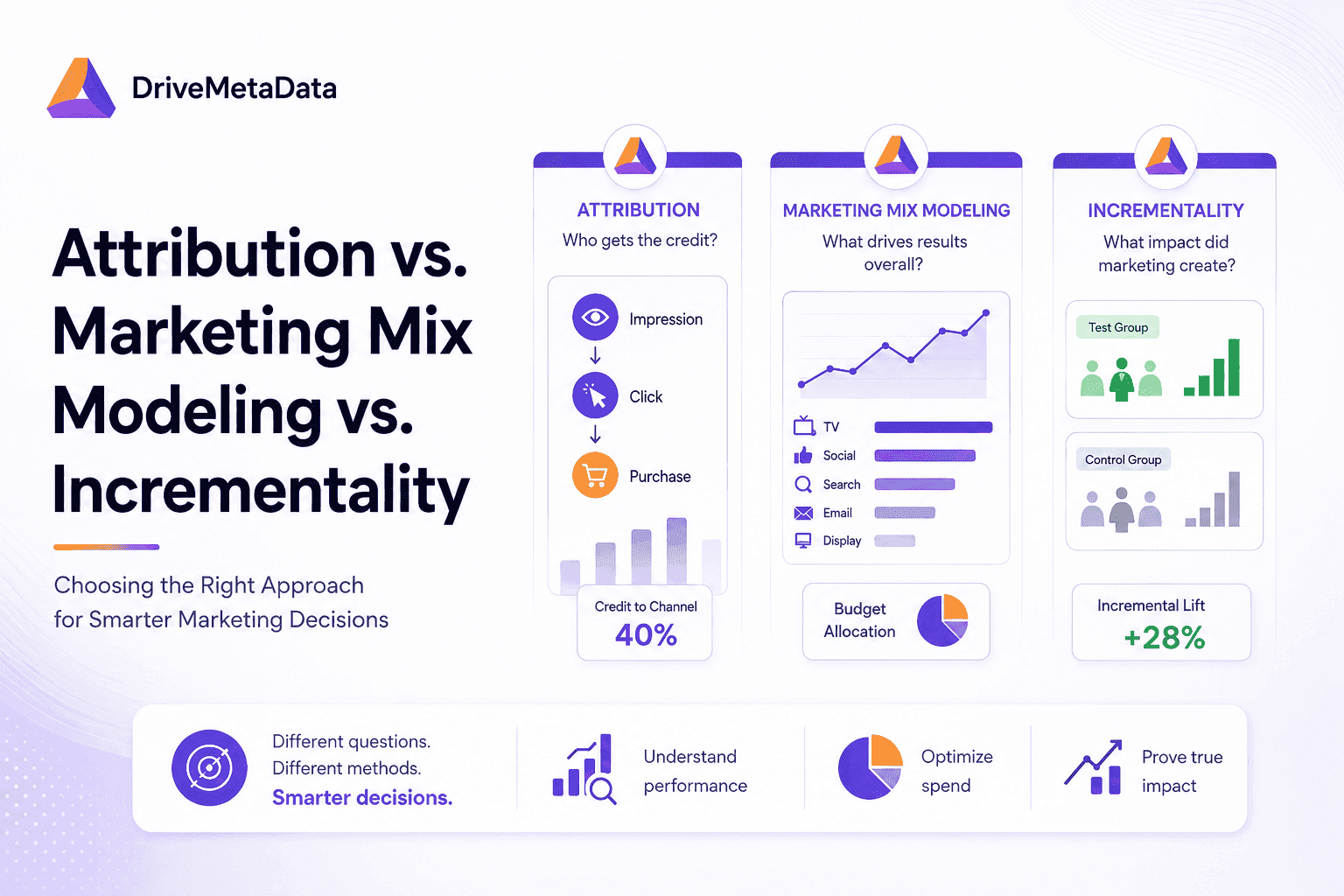
Attribution vs Marketing Mix Modeling vs Incrementality: Choosing the Right Marketing Measurement
Customer Data Platform · 7 min read