
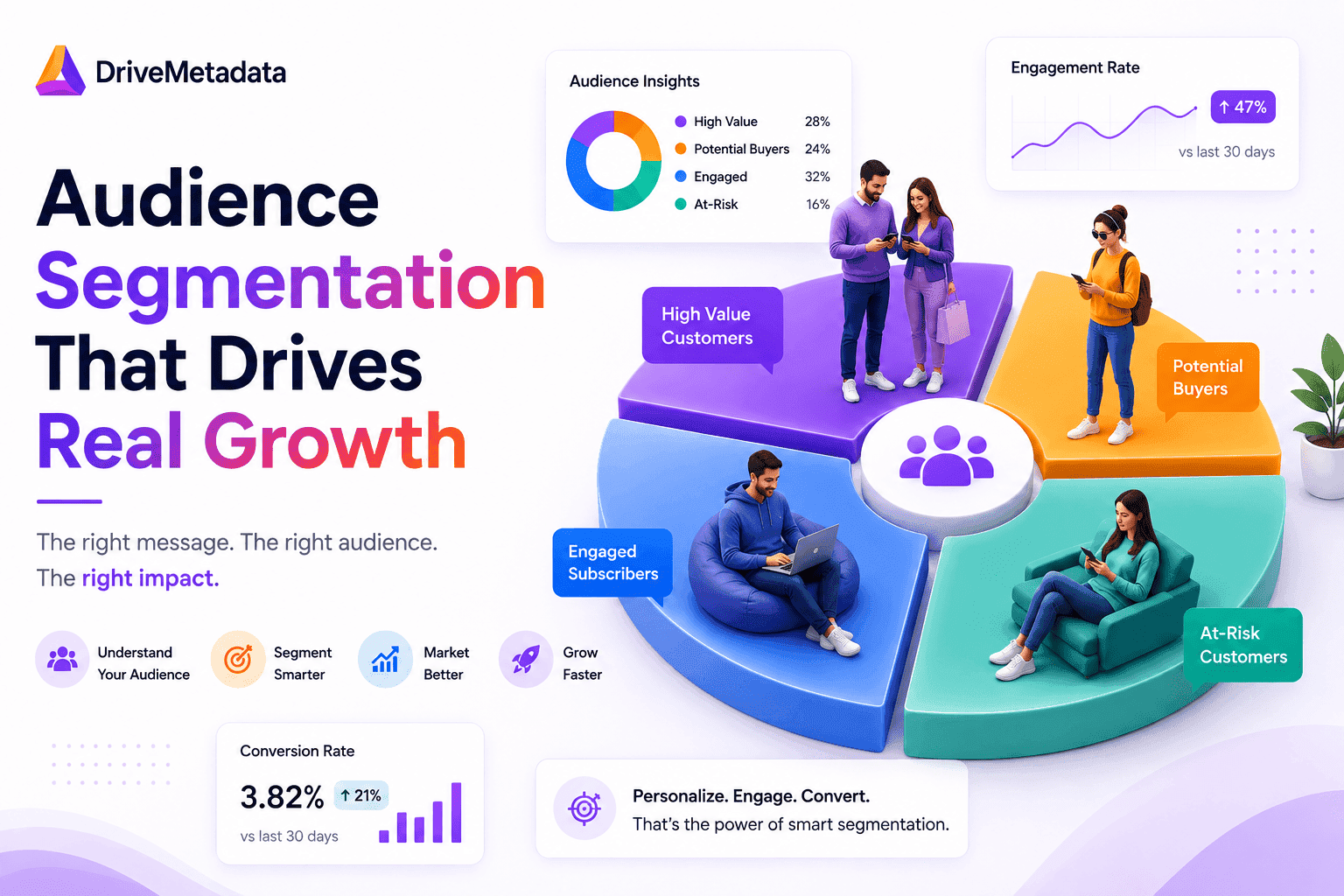
How targeted audience segmentation drives activation success in marketing campaigns
Ranjeet Ranjan
AI Executive Brief
Precise audience segmentation is crucial to marketing activation campaigns, enabling businesses to target the right customers with relevant messaging. This article explores segmentation models, the role of metadata in segment accuracy, and provides a framework for designing effective campaigns that improve engagement and ROI.
Precise audience segmentation in marketing is essential for activation campaigns to reach the right customers with the right message. Without accurate segments, campaigns risk wasted budget, low engagement, and missed revenue opportunities—jeopardizing marketing ROI and brand trust. This article explains the critical role audience segmentation plays in activation success, explores key segmentation models, illustrates how metadata improves segment accuracy, and provides a practical framework to design targeted campaigns that deliver measurable results.
How Audience Segmentation Boosts Activation Campaign Performance
Why Precise Audience Segmentation Is Critical for Marketing Activation
Business Risks from Poor Audience Segmentation
When audience segmentation is imprecise or outdated, marketing activation campaigns often target irrelevant or uninterested groups. This inefficiency leads to diluted messaging, lower engagement rates, higher customer acquisition costs, and ultimately reduced return on marketing investment. Beyond lost revenue, poor segmentation can strain brand reputation as customers receive irrelevant communications, eroding trust. For marketers, the risk is clear: even well-funded campaigns falter without segmentation that truly reflects customer needs and behaviors.
Challenges Marketers Face in Audience Segmentation
- Fragmented customer data across multiple platforms complicates reliable segment creation.
- Inconsistent data definitions and lack of unified metadata cause confusion over segment attributes.
- Difficulty dynamically updating segments to capture evolving customer behaviors.
- Limited insights into segment performance and its effect on campaign goals.
- Difficulty aligning segmentation strategies with overall marketing objectives.
Core Concepts of Audience Segmentation and Its Impact on Campaign Activation
What Is Audience Segmentation in Marketing?
Audience segmentation divides a broad customer or prospect base into smaller, more homogenous groups defined by shared traits. These may include demographics, behaviors, psychographics, or firmographics. This grouping allows marketers to tailor messaging, offers, and tactics to each segment’s unique preferences or needs—moving beyond generic campaigns to ones with higher relevance and resonance.
How Segmentation Improves Targeting and Engagement
Well-defined segments enable targeted activation campaigns that deliver relevant messages to each audience slice. This focus typically drives higher open and click rates, conversion, and customer satisfaction since communications feel personalized and timely. Conversely, poor segmentation risks generic content that fails to capture attention or motivate action, reducing overall campaign effectiveness.
Effective Customer Segmentation Strategies to Enhance Marketing Activation
Key Segmentation Models: Behavioral, Demographic, and Psychographic
Marketers commonly combine several segmentation models for richer audience profiles. Behavioral segmentation reflects actions such as purchase frequency and browsing habits, showing active interests. Demographic segmentation categorizes static traits like age or location. Psychographic segmentation explores motivations, values, and lifestyles underlying customer decisions. Blending these approaches supports nuanced activation campaigns tailored to complex customer needs.
Choosing the Best Segmentation Approach for Your Campaign
Your choice of segmentation depends on campaign goals, data availability, and business context. Behavioral segments often suit re-engagement campaigns, while demographic and psychographic profiles can enhance brand awareness with targeted creativity. Marketers should assess which attributes align best with purchase triggers and KPIs while ensuring segment data remains current. Ongoing testing and refinement optimize segment relevance over time.
Leveraging Metadata to Boost Audience Segmentation Accuracy
What Is Metadata and Why Does It Matter for Segmentation?
Metadata—data that describes other data—provides essential context such as data source, update frequency, and attribute definitions. In audience segmentation, centralized metadata organizes these details, enabling marketers to better understand and reliably use customer data across platforms. This clarity helps identify which attributes provide consistent, actionable segmentation criteria and supports automation in data workflows.
Improving Data Governance and Segmentation Precision Through Metadata
Centralizing metadata supports strong data governance by enforcing consistency, reducing duplicates, and clarifying data ownership. This governance builds trust in segmentation processes since marketers operate from a single source of truth. Additionally, proper metadata management eases compliance with data use policies and retention requirements. Together, these benefits lead to more accurate, confident audience segments that improve targeting precision.
Addressing Data Fragmentation for Unified Audience Profiles
Customer data often lives in disparate systems—CRMs, web analytics, ad platforms—each with unique formats. Metadata management bridges these gaps by standardizing attribute definitions and mapping data flows, creating unified audience profiles that reflect the complete customer journey instead of isolated data points. Reducing fragmentation removes inconsistencies that erode segment validity.
A Practical Framework: From Creating Segments to Activating Campaigns
1. Analyze Customer Attributes Relevant to Business Goals
Begin by mapping your data attributes to key marketing objectives. Identify customer traits strongly linked to behaviors or revenue outcomes. Build segments that are distinct, actionable in size, and aligned with marketing tactics. Use exploratory data analysis and testing to refine segment definitions for operational effectiveness.
2. Align Segments with Tailored Messaging and Activation Strategies
Develop messaging that speaks directly to each segment’s motivations and preferences. Match activation tactics—email, paid media, website personalization—to these segments to increase relevance and engagement. Ensure campaign elements reflect segment uniqueness for better performance.
3. Prioritize Segments Based on Impact Potential and Strategic Value
Not all segments warrant equal investment. Focus resources on segments with optimal size, conversion likelihood, and alignment with business priorities. Continuously reassess priorities considering campaign results and evolving market trends.
Common Mistakes in Audience Segmentation and How to Avoid Them
Using Inconsistent or Outdated Data for Segment Definitions
Creating segments based on incomplete or inconsistent data across systems leads to unreliable targeting and lost marketer confidence. Validate segment criteria against available, up-to-date data sources to maintain precision.
Neglecting Metadata Management and Data Governance
Without robust metadata governance, segments risk ambiguity, overlap, or redundancy—wasting budget and weakening campaign impact. Prioritize metadata consistency to uphold segmentation integrity.
Failing to Measure Segment-Level Campaign Performance
Marketers often overlook tracking how different segments perform, limiting optimization opportunities. Establish measurement frameworks linking segment definitions with activation outcomes to refine efforts and justify investment.
How Drivemetadata Supports Scalable Metadata Management and Audience Segmentation
Centralizing Metadata to Unite Customer Data Attributes
Drivemetadata’s platform centralizes metadata from diverse sources, unifying customer data and behaviors. This consolidation addresses fragmentation, providing marketers with a consistent, trustworthy foundation for defining and managing audience segments.
Creating Dynamic, Accurate Segments for Activations
With scalable metadata governance, Drivemetadata enables dynamic segments that evolve with changing customer profiles and campaign needs, supporting marketers in delivering precise, targeted activation campaigns.
Enhancing Data Governance and Campaign Analytics
Drivemetadata promotes consistent data definitions and quality control, strengthening data governance. This foundation improves analytics capabilities, helping marketers measure segmentation’s impact on activation effectiveness and make informed adjustments.
Measuring Audience Segmentation Effectiveness: Key Metrics
Engagement and Conversion Rates by Segment
Monitor open rates, click-throughs, and conversions for each segment to identify high-performing groups and areas needing refinement. Segment-level data supports targeted messaging adjustments and better campaign ROI.
Campaign ROI Relative to Segmentation Quality
Assessing ROI by segment reveals whether the complexity and effort in segmentation translate to financial benefits. This insight helps balance segmentation depth with campaign resource allocation.
Data Quality and Metadata Completeness as Early Indicators
Maintaining up-to-date, comprehensive metadata supports ongoing segmentation reliability. Tracking metadata completeness and data freshness can flag risks before they affect campaign performance.
Conclusion: Next Steps for Marketers Enhancing Audience Segmentation
Make Metadata Management a Priority
Effective audience segmentation relies on unified metadata management that standardizes data definitions, reduces fragmentation, and supports dynamic, accurate segment updates. This investment is key to improving activation relevance and efficiency.
Integrate Segmentation Frameworks into Campaign Planning
Adopt clear frameworks that connect data analysis, segment creation, personalized messaging, and prioritization. Coupling these with segment-level performance measurement drives continuous optimization and more predictable marketing outcomes.
What is audience segmentation in marketing?
Audience segmentation divides a broad customer base into smaller, more similar groups based on shared traits to enable targeted and relevant marketing communications.
Why is metadata important for audience segmentation?
Metadata provides context about customer data, standardizing definitions and improving data governance, which ensures more accurate and reliable segmentation.
How do I choose the right segmentation strategy for my campaign?
Select segmentation approaches based on your campaign goals, data quality, and business context, and test different models like behavioral, demographic, or psychographic segments to find what works best.
What common mistakes should I avoid in audience segmentation?
Avoid using inconsistent or outdated data, neglecting metadata management, and failing to track segment-level campaign outcomes.
How can I measure the success of my audience segmentation?
Track engagement and conversion rates per segment, evaluate ROI linked to targeting quality, and monitor data and metadata completeness as early indicators of segmentation health.
Effective audience segmentation relies on unified metadata management that standardizes data definitions, reduces fragmentation, and supports dynamic, accurate segment updates. This investment is key to improving activation relevance and efficiency. Adopting clear frameworks linking data analysis, segment creation, personalized messaging, and prioritization, combined with segment-level performance measurement, drives continuous optimization and more predictable marketing outcomes.
Attribution Audit
Find the gaps hiding in your attribution data.
Get a focused audit of campaign tracking, ROAS signals, and conversion paths before media spend leaks into blind spots.
Related Blogs
More from our insights
Shopify Customer Journey Attribution: Multi-Touch Models & Repeat Order Tracking
Customer Data Platform · 6 min read
Marketing Efficiency Ratio (MER) Needs A Warning Label For D2C Growth
Customer Data Platform · 8 min read
Returns-Adjusted ROAS: Formula, Calculation & How to Measure True Ecommerce Profitability
Customer Data Platform · 11 min read