
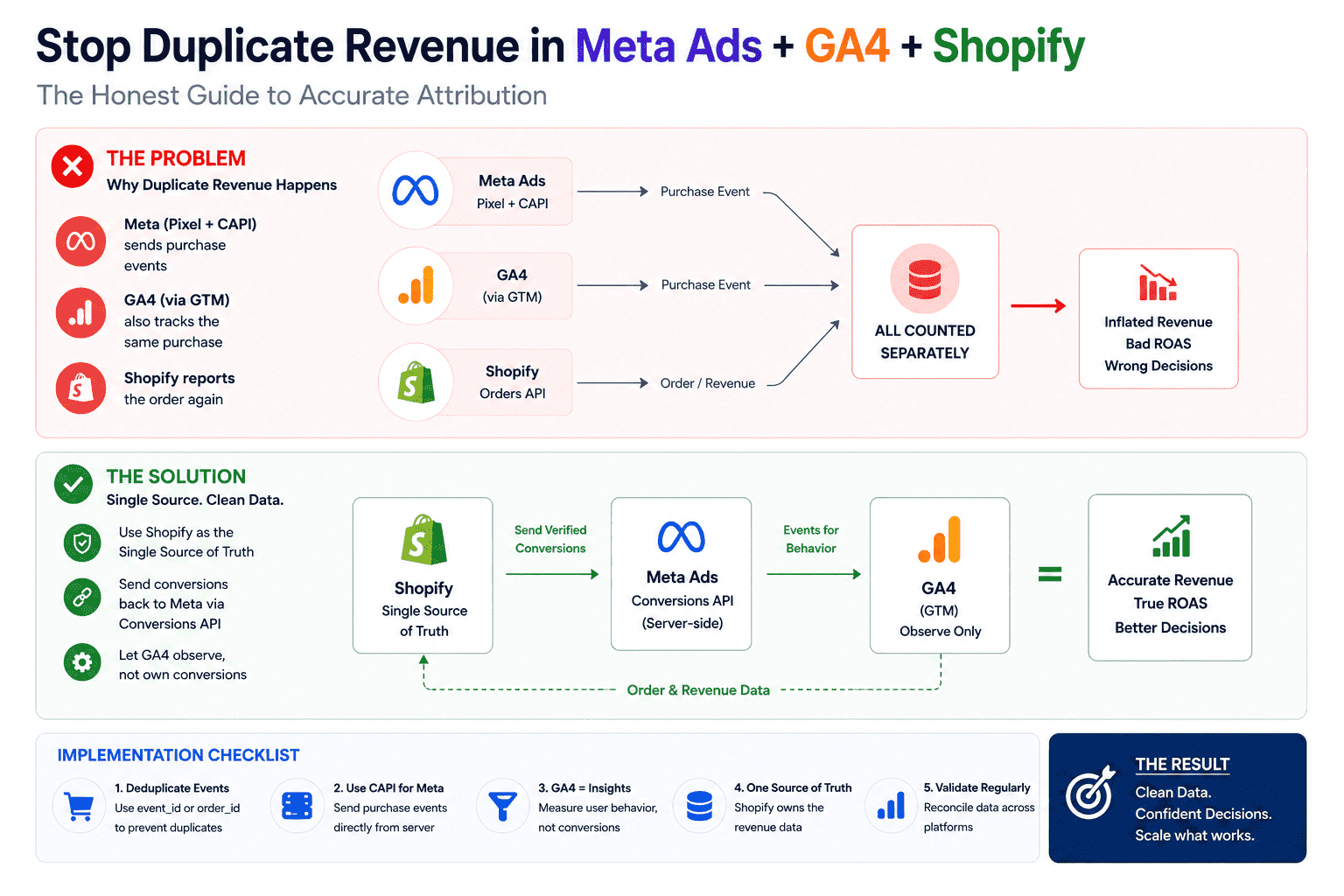
Understanding and resolving conflicting revenue in ecommerce platforms to improve marketing accuracy.
Ranjeet Ranjan
AI Executive Brief
Conflicting revenue reports across Meta, Google GA4, and Shopify create challenges for ecommerce marketers by distorting campaign performance measurement. This article explores the primary causes of duplicate revenue, provides a detailed framework for auditing and reconciling data, and outlines best practices for unifying revenue reporting to enable confident, data-driven marketing decisions.
As an ecommerce marketer or business operator, encountering duplicate revenue problem in Meta, Google GA4, and Shopify reports creates serious challenges. When revenue figures conflict or the same sale appears multiple times across these platforms, your marketing decisions risk becoming misguided. This can lead to overspending, missed growth, and a blurred understanding of your customer journey. This article unpacks the top causes behind these revenue discrepancies and provides a detailed, practical framework to audit, reconcile, and unify your revenue data for clearer, confident campaign insights.
The Business Impact of Conflicting Revenue Reports
How Inaccurate Revenue Data Slows Marketing Growth
Revenue data is the foundation of ecommerce marketing strategy. Conflicting or duplicate reports create a distorted view of which campaigns truly drive sales and how customers engage. This uncertainty obstructs accurate ROAS measurement, budget optimization, and personalization efforts. As a result, marketers hesitate, delaying decisions that could accelerate growth or protect profitability.
Real-World Risks of Revenue Data Mismatches
- Budget inefficiency from overspending on poorly performing channels
- Underinvestment due to undercounted sales
- Faulty campaign attribution limiting optimization
- Impaired customer experiences from unreliable journey data
- Fragmented internal reporting causing misaligned teams
Common Causes of Duplicate Revenue Across Meta, GA4, and Shopify
Attribution Models and Conversion Windows Differ
Each platform assigns revenue using unique attribution models and conversion windows. Meta relies on data-driven or last-click attribution focused on ad interactions, GA4 uses flexible cross-channel models with customizable lookback windows, and Shopify reports finalized sales based on completed orders. These differences mean the same transaction may be credited by multiple platforms at different times, causing duplicates or omissions.
Varied Event Definitions and Tracking Methods
Platforms use distinct event definitions and tracking techniques:
- Meta tracks purchases attributed via Facebook Pixel or Conversions API
- GA4 depends on enhanced ecommerce events requiring accurate parameter setup
- Shopify logs transactions processed through its checkout
Mismatch or inconsistency in tagging and implementation leads to double counting (e.g., purchase events and order records both counted) or missing data.
Timing Differences and Data Latency
Shopify finalizes sales after payment processing, which can lag hours or days behind the user actions captured by Meta or GA4. Reporting delays, differences in hourly versus daily aggregation, and unsynchronized time zones add to revenue discrepancies when comparing daily totals.
Fraud and Identity Resolution Challenges
Fraudulent activities like click injection and fake conversions inflate reported revenue, especially on ad-centric platforms like Meta. Incomplete identity resolution results in the same customer being counted multiple times across systems, artificially duplicating revenue attribution. Proactively detecting fraud and unifying identities are critical to preventing false marketing insights.
How to Identify and Audit Revenue Discrepancies
Checklist for Reconciling Revenue in Meta, GA4, and Shopify
- Use consistent date ranges and time zones for all platform comparisons
- Align attribution windows and conversion lookback periods
- Validate tracking setups ensuring event names, triggers, and parameters match across platforms
- Check for duplicate events or overlapping conversion triggers causing double counts
- Confirm Shopify sales finalization versus pre-orders or abandoned carts
- Integrate fraud detection reports to filter invalid conversions
- Map customer journey touchpoints to track which platform credited sales when
- Trace sales using sample transaction or order IDs across platforms
- Audit webhook and API data flows for consistency and latency issues
Leveraging Customer Journey Analytics to Understand Revenue Sources
Customer journey analytics enable tracing the exact sequence of interactions leading to conversion. This helps identify where attribution overlaps or gaps occur across Meta, GA4, and Shopify, revealing which platform’s revenue reporting best aligns with your true sales funnel. This insight supports more informed data alignment and decision-making.
Best Practices to Unify Ecommerce Revenue Data
Centralize Data Through API Integration
Centralizing raw data from Meta, GA4, Shopify, and additional platforms using API integrations allows marketers to normalize and deduplicate revenue before reporting. This approach moves beyond siloed dashboards with inconsistent attribution models and event setups, providing a clearer, consolidated view of cross-channel performance.
Create a Single Source of Truth for Revenue
Defining clear attribution rules, standardizing event definitions, and enforcing consistent time zones and reporting windows help establish a trusted, unified revenue dataset. This authoritative source is essential for budgeting, ROI measurement, and reconciling privacy-driven signal loss and platform nuances.
Adapt to Privacy-Driven Tracking Limitations
Privacy regulations and browser settings reduce availability of third-party data signals, complicating accurate conversion tracking. Marketers should employ privacy-first strategies such as server-side event tracking, probabilistic attribution models, and combined identifier resolution to maintain accurate revenue data despite these constraints.
Practical Framework for Resolving Duplicate Revenue Problems
Step 1: Map Attribution Models and Conversion Windows
Document Meta, GA4, and Shopify’s attribution methods, conversion windows, and event timing details. Understanding these distinctions is foundational for aligning data and identifying potential overlaps or gaps causing duplicates.
Step 2: Implement Identity Resolution and Fraud Detection
Use identity resolution techniques that combine device IDs, emails, and behaviors to match customer records across platforms, reducing duplicate revenue counts. Incorporate fraud detection tools to filter out invalid or suspicious conversions inflating revenue data.
Step 3: Standardize Event Timing and Reporting
Harmonize time zones, conversion windows, and reporting cadences across platforms. Adjust data pipelines and reporting tools to align event timestamps and prevent mismatches caused by cross-day or delayed reporting.
Step 4: Continuously Monitor and Audit Revenue Data
Set regular audit schedules to compare revenue across platforms. Define acceptable variance thresholds and configure alerts for abnormal deviations signaling tracking issues or fraud spikes. Utilize dashboards and anomaly detection tools to uphold data quality.
Common Mistakes to Avoid When Reconciling Revenue Data
Ignoring Time Zone and Attribution Window Differences
Failing to normalize data for timezone inconsistencies or platform-specific conversion windows causes false interpretations of duplication or loss, leading to incorrect remediation efforts.
Overlooking Fraud and Duplicate Conversion Signals
Neglecting to apply fraud filters and duplicate event de-duplication results in inflated revenue figures that skew marketing effectiveness assessments.
Not Integrating Data Sources into Unified Customer Profiles
Treating Meta, GA4, and Shopify data as isolated silos rather than linking customer identities and transactions prevents establishing trustworthy, single-customer revenue views.
Measuring Success in Resolving Duplicate Revenue Issues
Key Post-Implementation Metrics
- Reduced revenue variance across Meta, GA4, and Shopify reports
- Fewer duplicated conversion events post de-duplication implementation
- ROAS estimates that align more closely with actual sales
- Higher confidence and data quality scores from analytics tools
- Lower rates of flagged fraudulent conversions impacting revenue
Evaluating Marketing ROI with Trusted Attribution Data
With reconciled data, leverage multi-touch attribution and customer journey analytics to accurately identify channel, campaign, and message contributions throughout the purchase journey. This deeper insight supports smarter budget allocations and maximizes lifetime customer value.
How DriveMetaData Supports Unified Revenue Tracking and Analysis
AI-Powered Multi-Touch Attribution and Customer Journey Analytics
DriveMetaData enables marketers to unify fragmented revenue data from Meta, GA4, Shopify, and other systems. Its AI-driven multi-touch attribution connects customer touchpoints across channels into holistic journey insights, clarifying true revenue drivers.
Real-Time Event Monitoring and Fraud Detection
Real-time event ingestion and fraud detection capabilities help identify and filter fraudulent or suspicious conversions before they distort marketing metrics, safeguarding budgets and data accuracy.
Advanced Identity Resolution Across Platforms
Using identity resolution, DriveMetaData consolidates customer data from disparate sources into accurate single profiles, reducing duplicate revenue counts caused by fragmented identity data.
Seamless API and SDK Integrations for Data Consolidation
API integrations ingest and harmonize data from Meta, GA4, Shopify, and other ecommerce and advertising platforms into a centralized warehouse, enabling normalized, consistent revenue reporting.
FAQ
Why do Meta, GA4, and Shopify show different revenue numbers?
Each platform uses distinct attribution models, conversion windows, and event tracking methods, which leads to timing and counting differences causing revenue discrepancies.
How can I detect duplicate revenue in my ecommerce reports?
Compare data using consistent dates and time zones, audit event setups, check for duplicate conversion triggers, and use transaction IDs to trace cross-platform sales.
What role does identity resolution play in fixing revenue duplicates?
Identity resolution links customer data across platforms, preventing the same individual from being counted multiple times, which reduces duplicate revenue attribution.
How do privacy changes affect revenue tracking accuracy?
Privacy regulations limit third-party data signals, causing partial or delayed conversion data. Adopting server-side tracking and probabilistic attribution helps maintain revenue accuracy.
What are common mistakes to avoid during revenue reconciliation?
Ignoring time zone differences, overlooking fraud and duplicate signals, and failing to integrate data sources into a unified customer profile are frequent pitfalls.
DriveMetaData helps marketers unify fragmented revenue data by leveraging AI-powered multi-touch attribution, real-time fraud detection, and advanced identity resolution. Its centralized API integrations enable consistent, normalized revenue reporting from Meta, GA4, Shopify, and other platforms. This trusted source of truth supports accurate marketing ROI measurement and smart budget allocation, resolving duplicate revenue challenges and empowering ecommerce growth.
Attribution Audit
Find the gaps hiding in your attribution data.
Get a focused audit of campaign tracking, ROAS signals, and conversion paths before media spend leaks into blind spots.
Related Blogs
More from our insights
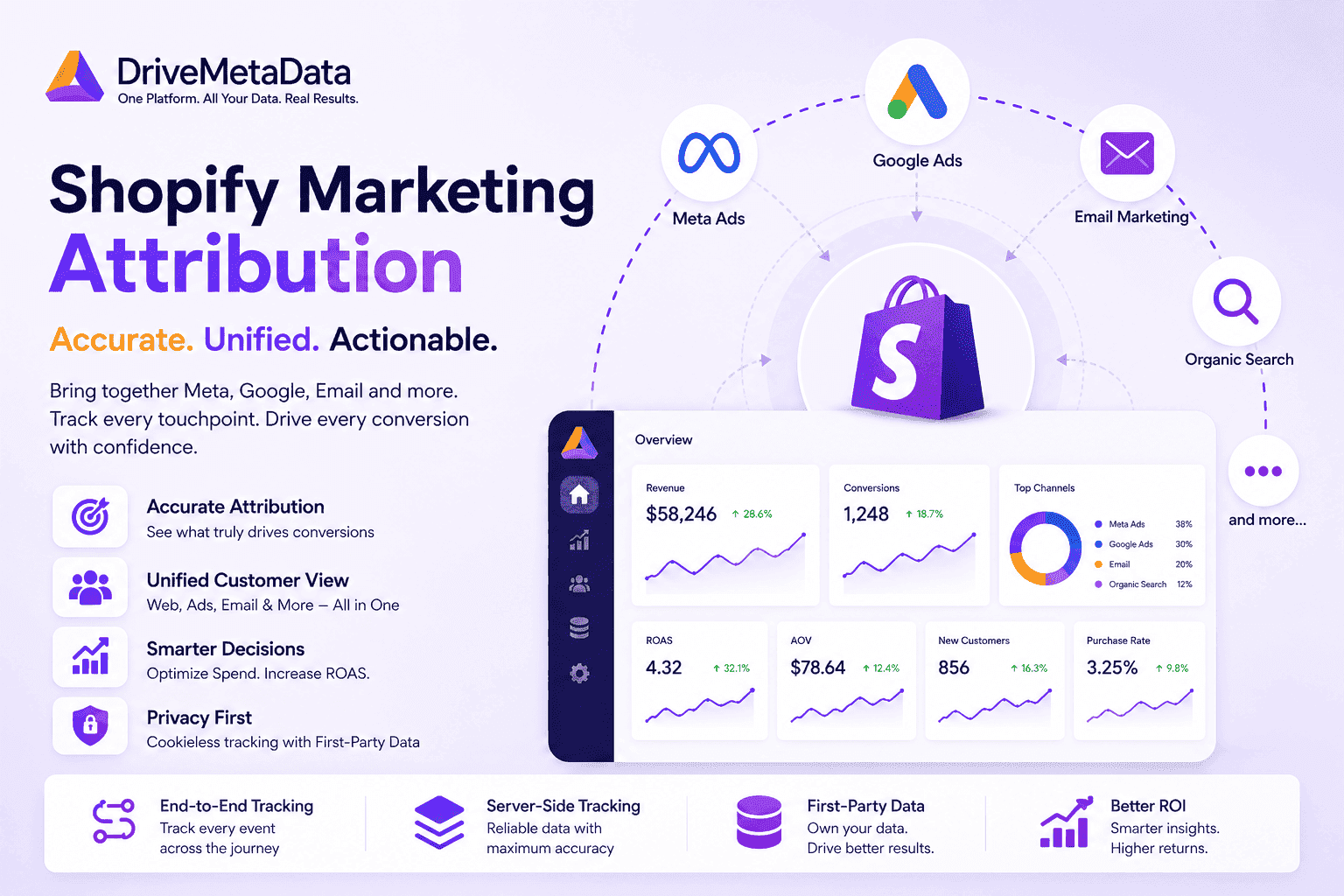
Shopify Marketing Attribution Across Meta, Google Ads, and Email: A Revenue Truth Framework
Customer Data Platform · 11 min read
Shopify Customer Journey Attribution: Multi-Touch Models & Repeat Order Tracking
Customer Data Platform · 6 min read
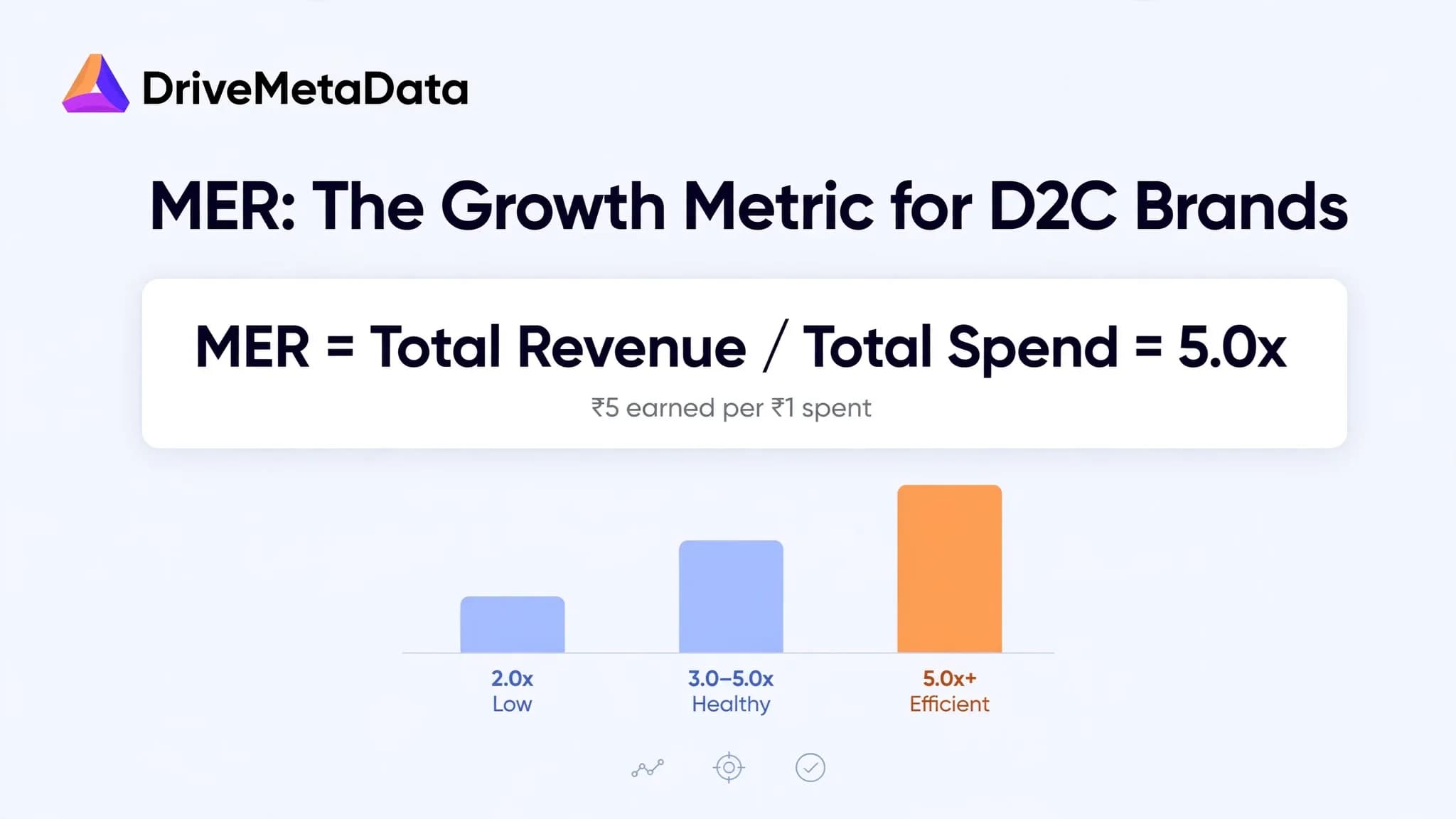
Marketing Efficiency Ratio (MER) Needs A Warning Label For D2C Growth
Customer Data Platform · 8 min read