
How to exclude low-value customers and improve lookalike audience seed quality before scaling campaigns
Ranjeet Ranjan
AI Executive Brief
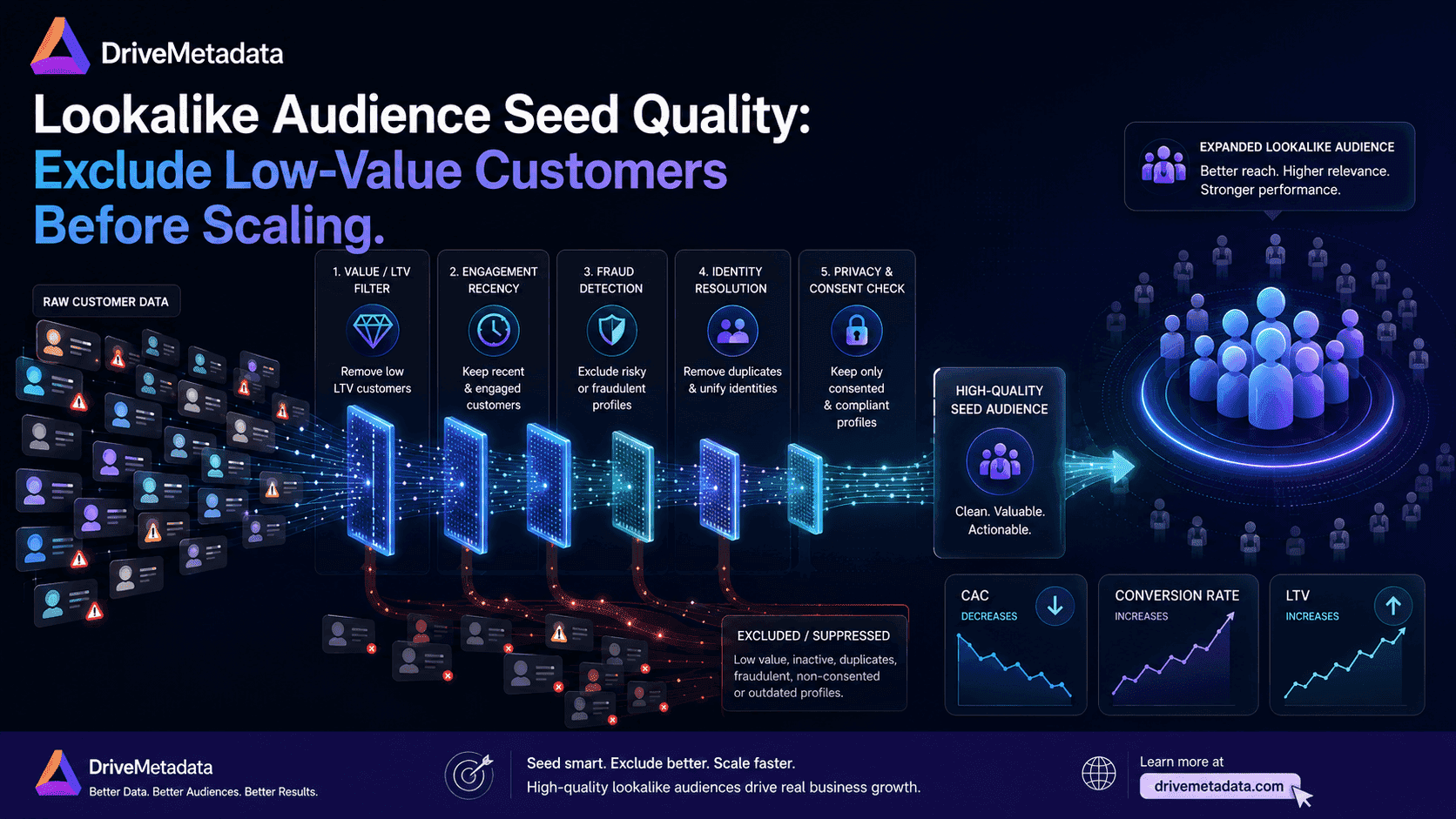
Marketers scaling paid campaigns with lookalike audiences must exclude low-value, inactive, or fraudulent customers to optimize campaign performance. This article provides practical exclusion criteria, a five-step filtering framework, and key metrics to monitor seed quality impact—helping reduce acquisition costs and increase conversion rates.
Marketers scaling paid campaigns with lookalike audiences face a critical challenge: poor seed quality that includes low-value, inactive, or fraudulent customers. This hidden drain inflates customer acquisition costs (CAC), lowers conversion rates, and wastes precious budget by targeting unqualified prospects. Without effective seed customer filtering, even advanced creatives and bidding strategies fall short. In this article, you’ll learn practical exclusion criteria, a five-step filtering framework, and metrics to measure seed quality impact—equipping you to optimize audience seed quality before scaling.
Why Poor Lookalike Seed Quality Threatens Campaign ROI
How Low-Value Seed Data Inflates CAC and Undermines Targeting
Lookalike audiences depend on a high-quality seed to accurately represent your ideal customers. If your seed audience contains unqualified or irrelevant profiles, your campaigns waste spend targeting individuals unlikely to convert or generate meaningful lifetime value (LTV). This not only drives up CAC but also leads to deteriorating return on ad spend (ROAS) and lower overall conversion rates. Poor seed quality effectively hides a "growth tax"—an unnecessary expense hindering sustainable marketing scale.
Key Metrics Impacted by Seed Quality Issues
Seed quality directly affects key indicators marketers track daily: CAC increases as you pay more to acquire less valuable customers; conversion rates drop when ads reach unengaged audiences; and LTV declines when newly acquired prospects don’t deliver long-term revenue. Over time, these measurable effects erode campaign efficiency and budget leverage.
Essential Criteria for Filtering Seed Customers
Applying Lifetime Value Thresholds and Engagement Decay Filters
Set minimum LTV thresholds to exclude customers unlikely to replicate profitable behavior. Pair this with engagement decay filters—such as purchase recency or inactivity windows—to remove stale profiles that no longer represent active buyers. This continual segmentation enhances the predictive power and relevance of lookalike models.
Leveraging Fraud Detection, Identity Resolution, and Data Recency
Fraudulent accounts and duplicate records add noise that distorts audience signals. Integrate fraud detection systems to remove synthetic or suspicious profiles and apply identity resolution tools to merge fragmented customer data into unique, accurate records. Additionally, maintain data freshness with frequent syncing to ensure the seed aligns with current customer behavior patterns.
Incorporating Privacy and Compliance into Seed Selection
Privacy regulations and consent management must govern seed audience inclusion. Exclude customers lacking verified consent or those restricted by jurisdictional compliance frameworks to mitigate legal risks and safeguard brand trust—especially in highly regulated sectors like fintech.
A Practical Five-Step Framework to Exclude Low-Value Seed Customers
Step 1: Data Quality Assessment
Audit your customer data for completeness, accuracy, and timeliness. Identify missing or invalid fields and apply cleansing or enrichment processes to optimize seed inputs before modeling.
Step 2: Fraud and Duplicate Profile Removal
Use fraud detection algorithms to filter out bots, synthetic accounts, and suspicious behaviors. Employ identity resolution to merge duplicate profiles—ensuring your seed reflects verified, unique customers.
Step 3: Value and Engagement-Based Segmentation
Segment customers by clear LTV cutoffs and exclude those below threshold. Apply recency filters on purchases and interactions to keep seeds representative of active, high-value audiences.
Step 4: Implement Vertical-Specific Exclusion Rules
Tailor your seed filters for industry contexts—like excluding customers failing Know Your Customer (KYC) verification in fintech or filtering by churn or return rates in direct-to-consumer (D2C) brands—to mitigate sector-specific risks.
Step 5: Privacy-First Governance and Consent Verification
Confirm that all seed records comply with privacy policies and consent mandates. Conduct regular audits to uphold governance standards and reduce risk from data misuse or leakage.
Auditing Your Lookalike Seed Audience: A Practical Checklist
| Audit Step | Description | Action | Purpose |
|---|---|---|---|
| Data Completeness Check | Assess missing fields and incomplete customer records | Fill in gaps or exclude flawed profiles | Ensure lookalike models receive accurate, full data inputs |
| Duplicate Profile Identification | Detect duplicates using identity resolution tools | Merge or remove duplicates | Prevent inflated audience sizes and noisy signals |
| Fraudulent Account Detection | Analyze account behaviors for bot or fake user signals | Exclude flagged fraudulent accounts | Keep seed pure to avoid targeting drift |
| LTV Threshold Setting | Set minimum lifetime value for inclusion | Segment out customers below threshold | Focus seed on profitable archetypes |
| Engagement Recency Filtering | Identify dormant or stale customers | Remove accounts inactive beyond acceptable window | Maintain alignment with current buyer activity |
| Vertical/Regulatory Filters | Apply industry-specific exclusion criteria (e.g., KYC, churn) | Flag and remove non-compliant profiles | Reduce business and legal risks |
| Consent and Governance Review | Verify compliance with legal consent and privacy rules | Exclude non-compliant records | Protect brand trust and avoid penalties |
Industry Scenarios: Applying Lookalike Seed Filters in Fintech and D2C
Fintech: Balancing Aggressive Growth with Compliance and Fraud Controls
Fintech marketers face intense regulatory hurdles and elevated fraud risks. Seeds must exclude customers failing KYC or AML checks and identify synthetic profiles to maintain compliance and data quality. Overlooking these facets risks costly violations and ineffective targeting, diminishing campaign ROI despite growth ambitions.
D2C: Managing Rapid Churn and Customer Value Decline
D2C brands combat fluctuating purchase behaviors and swift churn. Lookalike seed filtering must exclude recently inactive or low-value segments, focusing on frequent purchasers and engaged customers. Respect for opt-in preferences further sustains brand-consumer trust essential in direct marketing.
Measuring and Validating Your Lookalike Seed Quality Improvements
Tracking Core Metrics: CAC, Conversion Rate, and LTV
Evaluate seed filtering success by monitoring CAC trends, conversion rates, and LTV over campaign cycles. Effective seed exclusion should yield lower CAC, higher conversion efficiency, and improved long-term customer value. Be mindful of external factors affecting data and assess trends over sufficient timeframes.
Using Predictive AI and Analytics to Forecast Seed Performance
Leverage AI models to simulate how different seed exclusion rules influence campaign outcomes. Integrate historical purchase and engagement data with live performance analytics for scenario testing—enabling proactive tuning of filters to maximize budget impact before scaling.
Metrics Table: Calculations, Sources, and When to Act
| Metric | Formula / How to Calculate | Source Type | Freshness Needed | What It Proves | Caveat | Action Trigger |
|---|---|---|---|---|---|---|
| Customer Acquisition Cost (CAC) | Total Campaign Spend / Number of New Customers Acquired | Campaign Spend and CRM Data | Monthly | Spend efficiency on acquiring customers | External factors like seasonality or offers affect values | Sustained CAC rise after filtering indicates seed quality issues |
| Conversion Rate | (Conversions / Ad Clicks) x 100 | Ad Platform and Analytics Data | Weekly | Effectiveness of targeting relevant audiences | Compare similar campaign types for accuracy | Conversion drop signals dilution in seed audience quality |
| Customer Lifetime Value (LTV) Impact | Sum of Customer Revenue Over Time / Number of Customers | CRM and Sales Data | Quarterly | Long-term revenue contribution of acquired users | Requires time to accumulate; data delays common | Declining LTV suggests low-value customers included |
| Seed Audience Engagement Decay | Percentage of Seed Members With No Activity in Last X Months | CRM and Behavioral Data | Monthly | Freshness of seed profiles | Varies by industry and purchase cycles | High decay rates prompt re-segmentation |
| Fraud Detection Rate in Seed | Number of Fraud-Flagged Customers / Total Seed Audience | Fraud Detection Systems | Real-time to Weekly | Contamination level of invalid profiles | False positives may occur; requires tuning | High fraud demands stricter exclusion |
Common Mistakes to Avoid When Filtering Lookalike Seed Audiences
- Over-filtering that shrinks seed size below effective volume for modeling.
- Neglecting data freshness, resulting in seeds with outdated customer profiles.
- Skipping fraud detection, allowing bots or synthetic accounts to skew models.
- Failing to align filters with vertical-specific regulatory and behavioral nuances.
- Ignoring privacy and consent checks, risking compliance and reputational damage.
How DriveMetaData Enhances Lookalike Audience Seed Quality
AI-Driven Segmentation for Automated Customer Exclusion
DriveMetaData applies AI-powered segmentation to automatically filter out low-value and irrelevant customers from seed audiences. This minimizes manual effort and dynamically adapts filtering based on evolving customer data patterns.
Fraud Detection and Identity Resolution for Clean Seed Lists
Integrating advanced fraud detection with identity resolution, DriveMetaData identifies suspicious accounts and merges duplicate profiles to ensure seed audiences consist of unique, verified customers—critical for sectors like fintech and D2C.
Campaign Analytics and Predictive Models to Monitor Seed Impact
DriveMetaData offers robust dashboards and AI forecasting tools so marketers can measure how seed filtering impacts CAC, conversion rates, and LTV—enabling continuous, data-driven optimization of audience quality and ad spend.
FAQ
What is lookalike audience seed quality?
Lookalike audience seed quality refers to how well the initial customer segment used to build lookalike models represents your ideal, high-value customers. Better seed quality leads to more accurate targeting and improved campaign results.
How can I identify low-value customers in my seed audience?
Use lifetime value (LTV) thresholds, engagement recency filters, and fraud detection tools to identify and exclude customers who show low purchase value, inactivity, or suspicious behaviors that reduce seed efficacy.
Why is identity resolution important for seed audiences?
Identity resolution merges duplicate or fragmented customer records, ensuring your seed audience contains unique individuals. This reduces noise and improves the accuracy of lookalike modeling.
How do privacy regulations affect lookalike seed selection?
Privacy laws require that you only use customer data with verified consent and compliant governance. Including non-compliant customers risks legal penalties and damages brand trust.
What metrics indicate my seed filtering is working?
Improved seed filtering typically lowers Customer Acquisition Cost (CAC), increases conversion rates, and boosts Customer Lifetime Value (LTV). Monitoring these over time helps validate seed quality improvements.
DriveMetaData enables marketers to enhance lookalike audience seed quality by applying AI-driven customer segmentation, fraud detection, identity resolution, and predictive analytics. This ensures cleaner seed audiences, improved CAC, conversion rates, and customer lifetime value—empowering continuous, data-driven optimization for sustainable marketing growth.
Attribution Audit
Find the gaps hiding in your attribution data.
Get a focused audit of campaign tracking, ROAS signals, and conversion paths before media spend leaks into blind spots.
Related Blogs
More from our insights
Shopify Marketing Attribution Across Meta, Google Ads, and Email: A Revenue Truth Framework
Customer Data Platform · 11 min read
Shopify Customer Journey Attribution: Multi-Touch Models & Repeat Order Tracking
Customer Data Platform · 6 min read
Marketing Efficiency Ratio (MER) Needs A Warning Label For D2C Growth
Customer Data Platform · 8 min read