
Improving customer acquisition cost accuracy through advanced tracking technologies
Ranjeet Ranjan
AI Executive Brief
This article compares server-side and pixel tracking methods, highlighting how server-side tracking provides more reliable data, better fraud detection, and privacy compliance to improve Customer Acquisition Cost (CAC) measurement and marketing attribution.
Customer Acquisition Cost (CAC) is a critical metric that guides marketing budgets and measures campaign effectiveness. Inaccurate CAC data can mislead marketers into overspending on underperforming channels or undervaluing successful campaigns, directly impacting ROI. The main challenge is that capturing reliable customer interaction and conversion data is increasingly difficult due to complex user behavior, multiple devices, and evolving privacy restrictions. Without trustworthy tracking, CAC calculations become unreliable, leading to poor strategic decisions.
The Challenge of Accurate CAC Measurement in Modern Marketing
Why Inaccurate CAC Leads to Misallocated Budgets and Poor Decisions
Customer Acquisition Cost (CAC) is a critical metric that guides marketing budgets and measures campaign effectiveness. Inaccurate CAC data can mislead marketers into overspending on underperforming channels or undervaluing successful campaigns, directly impacting ROI. The main challenge is that capturing reliable customer interaction and conversion data is increasingly difficult due to complex user behavior, multiple devices, and evolving privacy restrictions. Without trustworthy tracking, CAC calculations become unreliable, leading to poor strategic decisions.
Common Pain Points with Pixel Tracking: Data Loss, Ad Blockers, and Fraud
Pixel tracking relies on browser-based scripts and cookies to record user events like clicks and conversions. However, this approach faces significant challenges: ad blockers can block pixel requests entirely, browser privacy features and cookie restrictions limit user identification consistency, and regulatory requirements further complicate data collection. Moreover, pixel-based tracking is vulnerable to ad fraud, where fake traffic inflates conversion counts and distorts CAC metrics. Together, these factors cause data gaps and inaccuracies that erode attribution quality.
Understanding Server-Side vs Pixel Tracking: Key Differences and Tradeoffs
Fundamental Technical Differences Explained
Pixel tracking depends on the user's browser to send conversion signals using pixels or scripts. In contrast, server-side tracking shifts event capture to your backend servers, decoupling data collection from the client environment. This transition reduces dependencies on browser execution, making tracking less vulnerable to ad blockers and cookie restrictions. By capturing events directly at the server, businesses gain more reliable and comprehensive data that better supports accurate performance measurement.
Impact of Pixel Tracking Limitations on CAC Accuracy
Pixel tracking's reliance on client-side technologies means it often misses conversion signals blocked by browsers or ad blockers, leading to underreported conversions and inflated CAC estimates. Its limited ability to identify fraudulent interactions further skews attribution, making campaigns appear more efficient than they are. These data quality issues reduce marketers’ confidence in CAC figures and impair budget optimization efforts.
How Server-Side Tracking Improves Data Reliability and Attribution
Server-side tracking captures user events directly on backend servers, bypassing many client-side limitations. This results in more complete and accurate conversion data, unaffected by ad blockers or cookie restrictions. It also enables implementation of advanced validation and filtering, including AI-driven fraud detection to exclude suspicious activity. Together, these enhance multi-touch attribution accuracy, enabling marketers to assign credit more precisely and make better-informed CAC calculations.
Evaluating Tracking Methods: A Practical Framework for Marketers
Criteria to Assess CAC Accuracy and Attribution Fidelity
When comparing pixel, server-side, or hybrid tracking setups, marketers should consider these core criteria:
- Data Completeness: Are conversion events captured without significant loss?
- Attribution Fidelity: Can the method support multi-touch models to fairly distribute credit?
- Fraud Detection Capabilities: Does it detect and filter invalid or bot-generated conversions?
- Cross-Device and Channel Consistency: Can it unify data across web, mobile, and offline touchpoints?
Evaluating tracking solutions against these factors helps prioritize technologies that enhance CAC accuracy.
Technical Complexity and Resource Requirements
Server-side tracking generally demands greater technical expertise and infrastructure than pixel tracking due to backend integrations and ongoing maintenance. Hybrid approaches combine pixel and server-side elements to balance complexity and data quality improvements. Marketing teams should assess their internal resources, IT collaboration capabilities, and budget to determine which tracking architecture aligns with their operational capacity and accuracy goals.
Privacy Compliance and Data Governance Considerations
Both tracking methods must adhere to privacy regulations like GDPR and CCPA. Server-side tracking offers enhanced control over data collection and processing, enabling privacy-by-design principles and easier enforcement of consent management. Integration with APIs and SDKs supports transparent data governance, simplifies compliance audits, and reduces risks of unauthorized data exposure.
Comparing Hybrid vs Full Server-Side Implementations
Hybrid tracking leverages client-side pixels for immediate event capture while using server-side infrastructure to validate and supplement data. This approach can improve accuracy without the full technical investment of pure server-side setups. Full server-side tracking captures nearly all data via backend systems, delivering maximum control and data quality but requiring more extensive architecture and resources. The right choice depends on business objectives, existing technical maturity, and the importance of CAC precision.
| Criteria | Pixel Tracking | Server-Side Tracking | Hybrid Tracking |
|---|---|---|---|
| Data Accuracy | Vulnerable to data loss from blockers and cookie restrictions; incomplete conversions | High accuracy with minimal loss due to server-level capture | Improved accuracy by combining pixel data with server validation |
| Technical Complexity | Easy to implement and maintain | Higher complexity; requires backend expertise | Moderate complexity balancing front and backend components |
| Fraud Detection | Limited real-time filtering | Supports AI-powered fraud detection server-side | Can integrate server-side fraud detection alongside pixel data |
| Privacy & Compliance | Limited control over data flow; influenced by browser policies | Greater data governance and compliance control | Enhanced compliance through backend oversight |
| Multi-Channel Integration | Primarily web-focused; challenging to unify offline/app data | Simpler to unify web, mobile, and offline data sources | Combines multiple data sources for cohesive views |
Ad Fraud’s Impact on CAC and How to Detect and Prevent It
Why Ad Fraud Distorts CAC Metrics
Ad fraud inflates conversion counts with fake clicks, installs, or leads, causing CAC to appear artificially low. This misleads marketers to allocate more budget toward fraudulent sources, wasting spend and harming overall campaign effectiveness. Additionally, fraud can damage media reputation and reduce trust with partners.
Methods for Real-Time Fraud Detection in Server-Side Tracking
Server-side tracking centralizes event data, enabling real-time AI and machine learning models to detect suspicious patterns such as rapid repeat actions, impossible geographic movements, or abnormal device usage. Filtering these in real time ensures fraudulent conversions do not distort CAC data. Server-side systems also allow dynamic updates to fraud detection rules without client-side deployments, keeping fraud defenses adaptive.
Best Practices for Optimizing CAC Accuracy While Respecting Privacy
Multi-Touch Attribution and Its Role in Measuring True CAC
Accurate CAC measurement depends on recognizing the full customer journey. Multi-touch attribution models allocate credit across all relevant interactions, moving beyond simplistic last-click methods that overlook important touchpoints. Server-side tracking facilitates integration of diverse data sources and offers better completeness, supporting more precise multi-touch models and richer CAC insights.
Implementing Privacy-First Tracking with API and SDK Integration
To comply with privacy regulations and evolving measurement constraints, tracking should leverage privacy-first APIs and lightweight SDKs. This approach minimizes dependence on cookies and third-party signals prone to restrictions. Embedding data governance policies directly into the tracking infrastructure ensures consent management and data minimization practices are upheld transparently and efficiently.
Common Mistakes Marketers Make When Switching to Server-Side Tracking
- Underestimating IT and engineering resources needed for successful implementation.
- Rushing deployment without comprehensive testing, leading to data gaps or duplicates.
- Failing to update attribution models and reports to reflect new data flows.
- Overlooking ongoing privacy compliance during configuration and consent processes.
- Neglecting integration of fraud detection, allowing invalid conversions to persist.
How to Measure Success and Iterate on Tracking Improvements
Begin by establishing baseline CAC metrics using existing tracking methods. After deploying server-side tracking, monitor consistency in reported conversions across platforms and look for reductions in data loss. Regularly compare attribution results to business outcomes, adjusting models as needed to better reflect reality. Use customer journey analytics to identify gaps and implement ongoing audits and privacy impact assessments to maintain data quality and compliance.
How DriveMetaData Supports Accurate CAC Measurement with Server-Side Tracking
Unified Data Collection and Identity Resolution for Consistent Attribution
DriveMetaData consolidates customer data from web, mobile, advertising, CRM, and offline sources using server-side tracking, reducing reliance on client-side browser signals. Its identity resolution links fragmented data points into unified customer profiles, enabling marketers to accurately connect interactions and conversions across channels and devices.
AI-Powered Fraud Detection to Filter Invalid Conversions
Integrated AI-driven fraud detection analyzes real-time event data to identify and exclude suspicious conversions before they impact attribution metrics. This filtering supports cleaner datasets, increasing confidence in CAC calculations and reducing wasted marketing spend on fraudulent traffic.
Privacy-First Data Governance and Easy Integration via API/SDK
DriveMetaData’s privacy-first design facilitates compliance with data regulations through flexible APIs and SDKs. It enables marketers to implement server-side tracking while embedding consent management and data governance controls. This approach ensures technical readiness and privacy compliance during the transition from client-side tracking models.
FAQ
What is the main difference between server-side tracking and pixel tracking?
Pixel tracking relies on browser-executed scripts to send conversion data, while server-side tracking captures events directly on backend servers, making it less prone to data loss from ad blockers or browser restrictions.
How does server-side tracking improve Customer Acquisition Cost (CAC) accuracy?
By capturing more complete and validated event data shielded from browser limitations, server-side tracking reduces data gaps and fraudulent conversions, leading to more reliable CAC measurements.
Can server-side tracking support multi-touch attribution?
Yes, server-side tracking better unifies data across channels and devices, enabling more accurate multi-touch attribution models that allocate credit across the full customer journey.
What role does AI play in fraud detection for server-side tracking?
AI analyzes event patterns in real time to identify suspicious or invalid conversions, filtering them out before they affect attribution and CAC calculations.
Are there privacy benefits to server-side tracking compared to pixel tracking?
Server-side tracking offers greater control over data flows and easier implementation of privacy-by-design practices, supporting consent management and compliance with regulations like GDPR and CCPA.
DriveMetaData helps marketing teams optimize campaign performance, increase customer lifetime value, reduce acquisition costs, and deliver personalized customer experiences through accurate CAC measurement supported by AI-powered server-side tracking, fraud detection, and privacy-first governance.
Attribution Audit
Find the gaps hiding in your attribution data.
Get a focused audit of campaign tracking, ROAS signals, and conversion paths before media spend leaks into blind spots.
Related Blogs
More from our insights
Shopify Marketing Attribution Across Meta, Google Ads, and Email: A Revenue Truth Framework
Customer Data Platform · 11 min read
Shopify Customer Journey Attribution: Multi-Touch Models & Repeat Order Tracking
Customer Data Platform · 6 min read
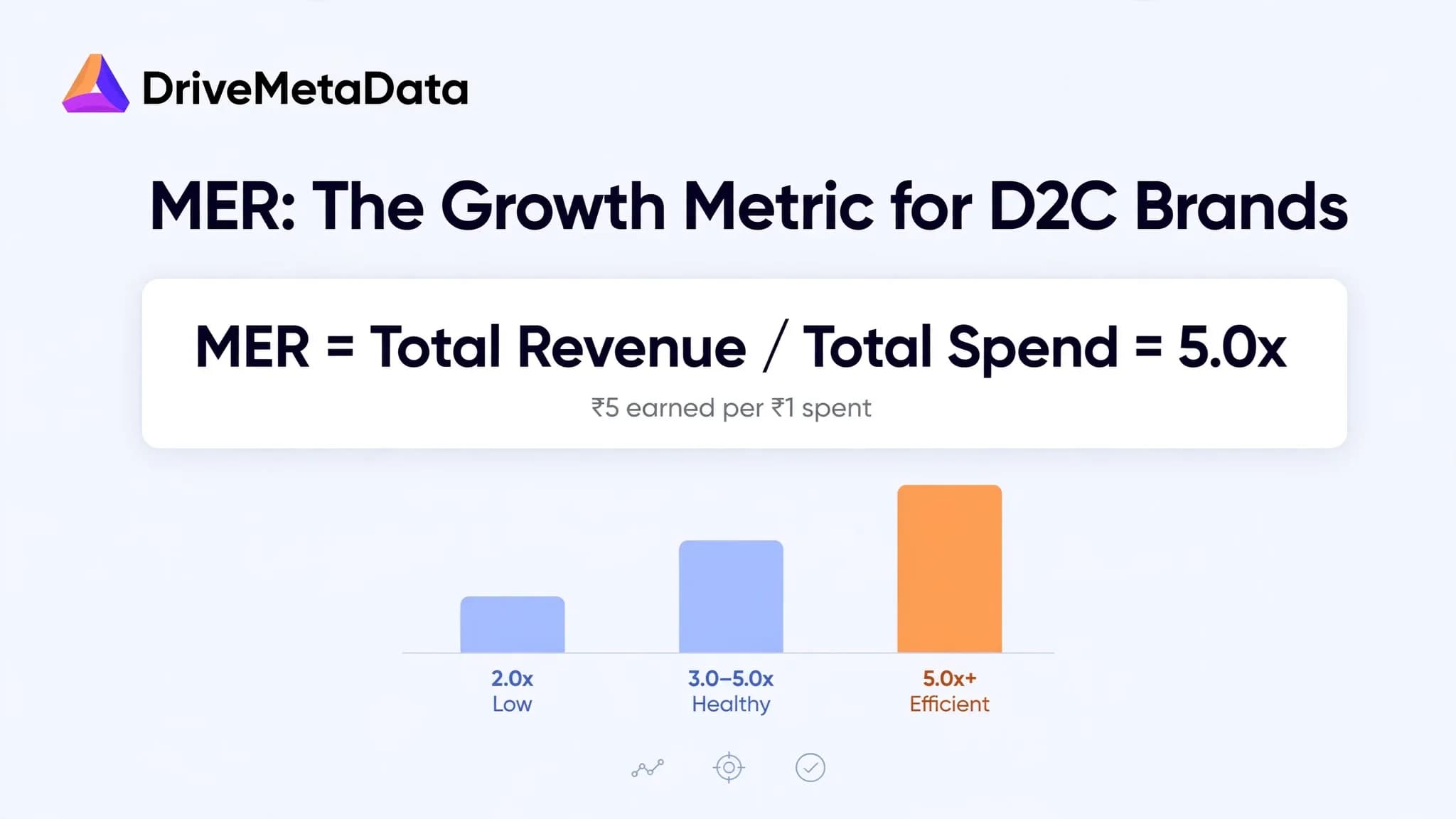
Marketing Efficiency Ratio (MER) Needs A Warning Label For D2C Growth
Customer Data Platform · 8 min read