
How deeper cohort analysis drives smarter marketing spend for Shopify stores
Ranjeet Ranjan
AI Executive Brief
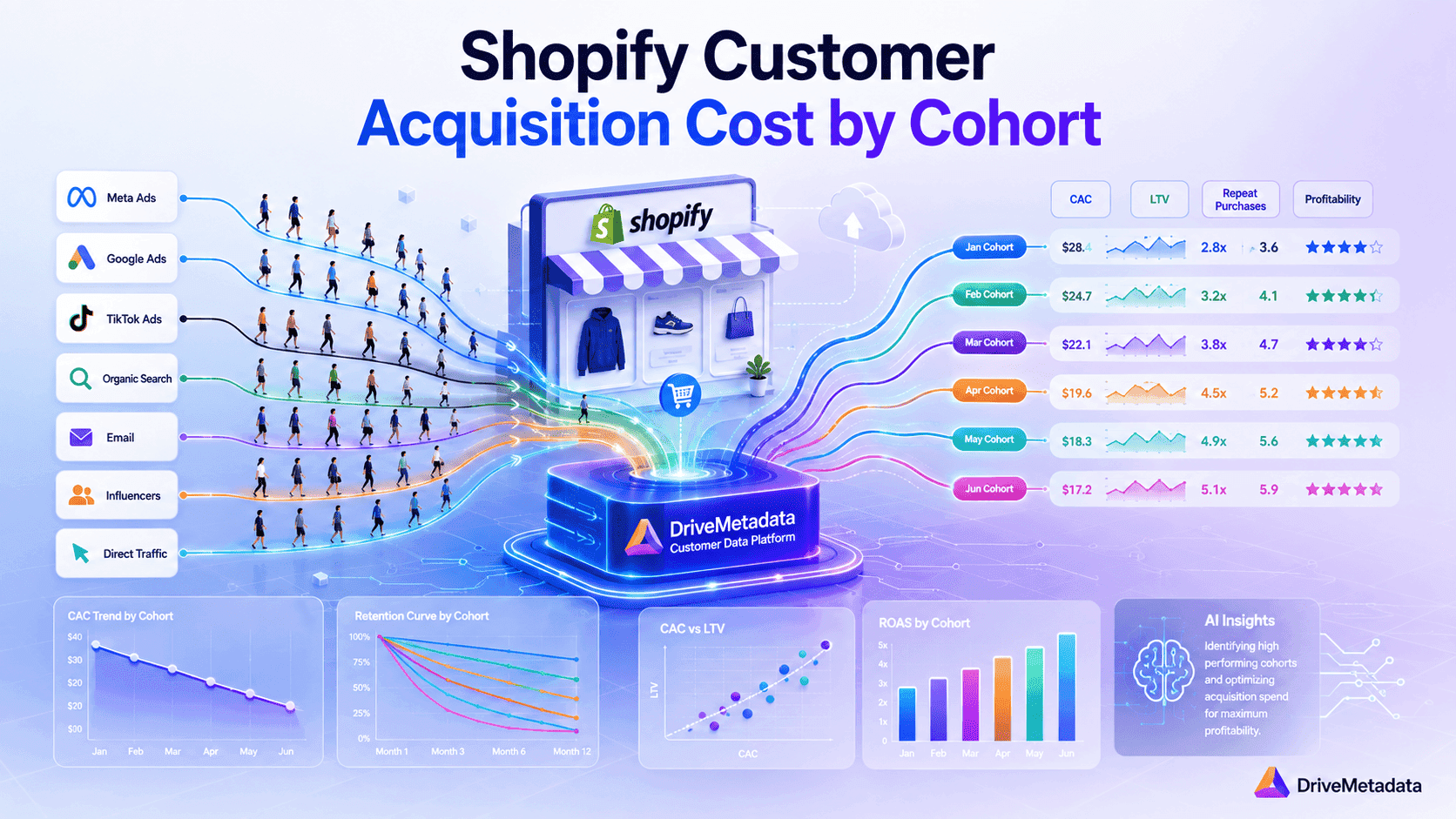
Analyzing Shopify customer acquisition cost by cohort uncovers differences in acquisition efficiency and customer lifetime value missed by blended CAC. Cohort segmentation combined with multi-touch attribution and AI-powered insights enables marketers to optimize budgets, improve forecasting, and maximize campaign performance.
Shopify marketers face a critical challenge when relying on blended Customer Acquisition Cost (CAC): it obscures key differences in acquisition efficiency and customer value across distinct segments. This lack of clarity can lead to inefficient marketing spend and flawed growth forecasts. By analyzing Shopify customer acquisition cost by cohort—segmenting customers by acquisition date, marketing channel, or behavior—marketers gain sharper insights. These insights empower better budget allocation, improved forecasting, and more effective campaign optimization.
Shopify marketers face a critical challenge when relying on blended Customer Acquisition Cost (CAC): it obscures key differences in acquisition efficiency and customer value across distinct segments. This lack of clarity can lead to inefficient marketing spend and flawed growth forecasts. By analyzing Shopify customer acquisition cost by cohort—segmenting customers by acquisition date, marketing channel, or behavior—marketers gain sharper insights. These insights empower better budget allocation, improved forecasting, and more effective campaign optimization. This article explores why blended CAC metrics fall short, how cohort analysis enhances precision, and provides a step-by-step framework to implement cohort CAC analysis using unified data sources, identity resolution, and multi-touch attribution.
Why Blended CAC Can Mislead Shopify Marketers and Store Owners
Common Pain Points with Blended CAC in Shopify Ecommerce
Blended CAC calculates total marketing costs divided by total customers acquired over a period. While straightforward, this approach masks substantial variation among different customer segments. Shopify stores often acquire customers through multiple channels—paid ads, organic search, social, and offline efforts. Aggregating all acquisition costs into one average conceals which channels deliver higher-value customers at efficient costs. As a result, marketers lack the clarity needed to prioritize spend, resulting in missed opportunities and wasted budget. Additionally, blended CAC often lags behind shifts due to seasonality or campaign changes, delaying critical marketing adjustments.
Business Risks of Relying on Blended CAC Metrics
Treating customer acquisition as a uniform process with blended CAC risks overspending on low-performing channels and underinvesting in high-yield segments. Since blended metrics ignore differences in lifetime value (LTV) by cohort, they limit accurate ROI forecasting. This obscurity can stall growth or misdirect budgets based on incomplete data. Furthermore, blended CAC data provides little insight for optimizing the customer journey or addressing underperforming acquisition segments. The challenge is compounded by privacy-driven limitations on granular multi-channel attribution, making reliance on blended CAC less reliable in today's data environment.
What Is Cohort Analysis and Why It Matters for Shopify CAC Measurement
Defining Customer Acquisition Cohorts by Time, Channel, and Behavior
Cohort analysis segments customers by shared acquisition attributes such as acquisition date (month, week), primary marketing channel, or first purchase behavior. This segmentation allows marketers to compare acquisition costs, engagement, and revenue generation across meaningful groups. For instance, customers acquired during a holiday promotion may differ substantially in value and cost from those acquired through ongoing paid search campaigns. By breaking down CAC by these cohorts, marketers identify which acquisition efforts yield the best returns.
How Cohort Analysis Reveals Customer Lifetime Value and Acquisition Efficiency Differences
Tracking acquisition costs and subsequent customer behavior over time by cohort reveals the true relationship between CAC and customer lifetime value (LTV). Some cohorts may be more expensive to acquire but generate substantially higher lifetime revenue through retention and repeat purchases. Understanding these variations enables more accurate forecasting and informed, dynamic marketing investment decisions that focus on customer quality over just immediate cost. Cohort analysis also reveals timing and channel-related trends where gains or losses in efficiency occur.
Step-by-Step Framework: Performing Shopify Customer Acquisition Cost Analysis by Cohort
1. Identify and Segment Acquisition Cohorts
Begin by defining cohort parameters aligned with your marketing goals. Common segmentation methods include grouping customers by acquisition date (e.g., month or week), primary marketing channel (paid social, search, email), campaign source, or first purchase behavior. Clear cohort definitions facilitate reliable tracking and comparison. For Shopify merchants, using first-touch attribution data—such as the first click or session linked to acquisition—helps assign customers accurately to cohorts.
2. Unite Data from Shopify, Advertising, CRM, and Offline Channels
Accurate cohort CAC measurement requires unifying data from fragmented sources including Shopify orders, advertising platforms’ spend and click data, CRM systems, and offline marketing channels. Consolidating these data into a single platform or data warehouse ensures consistent attribution of marketing costs to specific customer cohorts. Without unified data, important touchpoints risk being missed or double-counted, resulting in distorted CAC figures.
3. Apply Multi-Touch Attribution to Assign Marketing Costs
Single-touch attribution attributes customer acquisition cost to only the first or last touchpoint, oversimplifying complex ecommerce journeys. Multi-touch attribution distributes CAC across all marketing touches leading to a conversion, giving a more balanced and accurate cost allocation. Applying this model at the cohort level reveals the true spend influence across channels and campaigns, enabling detailed insights on where marketing dollars drive customer acquisitions most effectively.
4. Analyze Cohort CAC Trends to Optimize Marketing Budgets
After calculating cohorts' acquisition costs and revenue outcomes, monitor performance trends to identify efficiency shifts. Comparing recent cohorts with historical data and across channels allows marketers to reallocate budget toward the most efficient segments with attractive LTV profiles. Identifying costly cohorts for optimization or pause reduces wasteful spending. Consistent tracking supports robust scenario planning and growth forecasting based on cohort-level insights.
The Critical Role of Identity Resolution in Accurate Cohort CAC Measurement
Why Fragmented Customer Data Challenges Cohort Analysis
Ecommerce data fragmentation—across devices, channels, and platforms—creates duplicate or incomplete records that distort cohort attribution. Without effective identity resolution, acquisition costs and revenue may misalign with actual customers or cohorts, leading to unreliable CAC calculations. Challenges include anonymous browsing, customers switching devices, and siloed platform data. Overlooking these issues results in misleading cohort insights.
Benefits of Identity Resolution for Trustworthy Customer Cohorts
Identity resolution consolidates customer interactions across all data sources to form unified, persistent profiles. This accuracy ensures all marketing activity, conversions, and revenue are correctly attributed to individual customers and their cohorts. Reliable identity resolution improves attribution accuracy, avoids double counting, and enables dependable customer journey analytics essential for trustworthy cohort CAC measurement.
Common Mistakes and Pitfalls When Analyzing CAC by Cohort
1. Ignoring Data Fragmentation and Incomplete Attribution
Using siloed or incomplete data sources skews acquisition cost reporting. Omitting key touchpoints—such as offline channels, CRM-driven engagements, or retargeting interactions—distorts cohort CAC accuracy. Failing to apply multi-touch attribution or dismissing indirect ad spends also leads to misleading comparisons.
2. Overlooking Customer Lifetime Value Differences Across Cohorts
Treating all customers as equally valuable ignores the reality that lifetime value varies widely by cohort. Low-cost cohorts with low engagement might underperform compared to pricier cohorts with longer buying cycles. Neglecting LTV differences risks prioritizing low-cost but low-return segments, missing chances to invest in higher-value cohorts for sustainable growth.
3. Neglecting Fraud and Data Quality Issues
Invalid traffic such as fraudulent clicks, bots, or tracking errors inflates acquisition costs artificially. Poor data quality—missing tracking parameters, duplicate records—further distorts CAC. Integrating fraud detection and data validation safeguards ensures that cohort CAC reflects genuine customer acquisition and value.
Using Cohort CAC Insights to Optimize Shopify Marketing Spend and Forecast Growth
Targeted Budget Reallocation Based on Cohort Performance
Cohort CAC analysis highlights acquisition groups with low costs and high lifetime value. Marketers can then reallocate budgets away from underperforming cohorts toward those delivering superior returns. This focused approach maximizes marketing efficiency, reduces waste, and accelerates revenue growth. It also supports refined campaign testing and channel decisions leveraging segment-level CAC data rather than aggregated averages.
Enhancing Forecast Accuracy with Predictive AI on Cohort LTV
Pairing cohort CAC with predictive AI models enhances forecasting by projecting customer lifetime value based on cohort characteristics and early behavior patterns. These forecasts allow marketers to adjust budgets dynamically and plan growth more effectively. Predictive analytics also help identify which cohorts justify higher initial acquisition costs due to promising long-term returns.
| Metric | Blended CAC | Cohort CAC |
|---|---|---|
| Definition | Total marketing cost divided by total customers over a period | Marketing cost and customer data segmented by acquisition time, channel, or behavior |
| Granularity | Aggregate level | Segmented by meaningful customer groups |
| Insight Depth | Masks acquisition efficiency differences | Reveals variation in costs and value across cohorts |
| Lifetime Value Consideration | Typically ignores LTV differences | Links CAC to cohort-specific LTV |
| Budget Optimization | Limited support due to averaging | Enables precise budget reallocation |
| Forecasting Usefulness | Less precise due to averaging | Improved accuracy via cohort trends and predictive models |
How DriveMetaData’s AI-Powered Platform Supports Accurate Shopify Cohort CAC Analysis
Unified Data Integration Across Shopify, CRM, Advertising, and Offline Channels
DriveMetaData integrates fragmented data from Shopify stores, advertising platforms, CRM systems, and offline sources into a unified platform. This ensures marketers have comprehensive and consistent data to calculate accurate customer acquisition cost by cohort.
Multi-Touch Attribution and Customer Journey Analytics at Cohort Level
The platform applies multi-touch attribution across all marketing touches in the customer journey to precisely allocate spend at the cohort level. This reveals the acquisition efficiency and customer value differences that blended metrics conceal, enabling smarter marketing decisions.
Identity Resolution and Fraud Detection for Data Integrity
DriveMetaData’s identity resolution unifies customer profiles across channels to eliminate duplicates and data gaps, improving cohort analysis accuracy. Integrated fraud detection protects against invalid marketing costs, ensuring trustworthy CAC insights.
Predictive AI Models for Cohort Value Forecasting and Budget Optimization
AI-driven models forecast lifetime value and revenue potential for acquisition cohorts, guiding optimized budget allocation and growth forecasting. Marketers can confidently invest based on expected returns rather than historical cost averages.
Final Thoughts: Making Cohort-Based CAC Analysis Essential for Shopify Growth
FAQ
What is Shopify customer acquisition cost by cohort?
It is the calculation of customer acquisition cost segmented by specific groups of customers—called cohorts—defined by acquisition date, marketing channel, or customer behavior to reveal differences in acquisition efficiency and customer value.
Why is blended CAC insufficient for Shopify marketers?
Blended CAC averages all costs and customers, hiding variations by channel, time, or customer value. This limits insights into which segments perform best and can lead to inefficient marketing spend.
How does multi-touch attribution improve cohort CAC accuracy?
Multi-touch attribution distributes marketing costs across all touchpoints in the customer journey, providing a more precise allocation of spend to acquisition cohorts than single-touch methods.
What role does identity resolution play in CAC analysis?
Identity resolution unifies fragmented customer data into single profiles across devices and channels, improving the accuracy of cohort assignment and ensuring reliable CAC calculations.
How can predictive AI help with Shopify cohort CAC analysis?
Predictive AI models forecast future customer lifetime value based on cohort data and early behavior, enabling marketers to make informed budget decisions and growth plans.
Shopify marketers aiming to optimize acquisition and scale growth must move beyond blended CAC metrics that obscure critical cohort differences. Cohort-based CAC analysis uncovers variations in acquisition efficiency and customer lifetime value essential for smarter budget allocation and accurate forecasting. Success requires unifying customer and marketing data, applying multi-touch attribution, and resolving customer identities across channels. Incorporating predictive AI further enhances forecasting accuracy and dynamic budget optimization. Prioritizing cohort CAC analysis positions Shopify teams to maximize marketing ROI and sustainably grow revenue while managing evolving data privacy and measurement challenges.
Attribution Audit
Find the gaps hiding in your attribution data.
Get a focused audit of campaign tracking, ROAS signals, and conversion paths before media spend leaks into blind spots.
Related Blogs
More from our insights
Shopify Marketing Attribution Across Meta, Google Ads, and Email: A Revenue Truth Framework
Customer Data Platform · 11 min read
Shopify Customer Journey Attribution: Multi-Touch Models & Repeat Order Tracking
Customer Data Platform · 6 min read
Marketing Efficiency Ratio (MER) Needs A Warning Label For D2C Growth
Customer Data Platform · 8 min read