
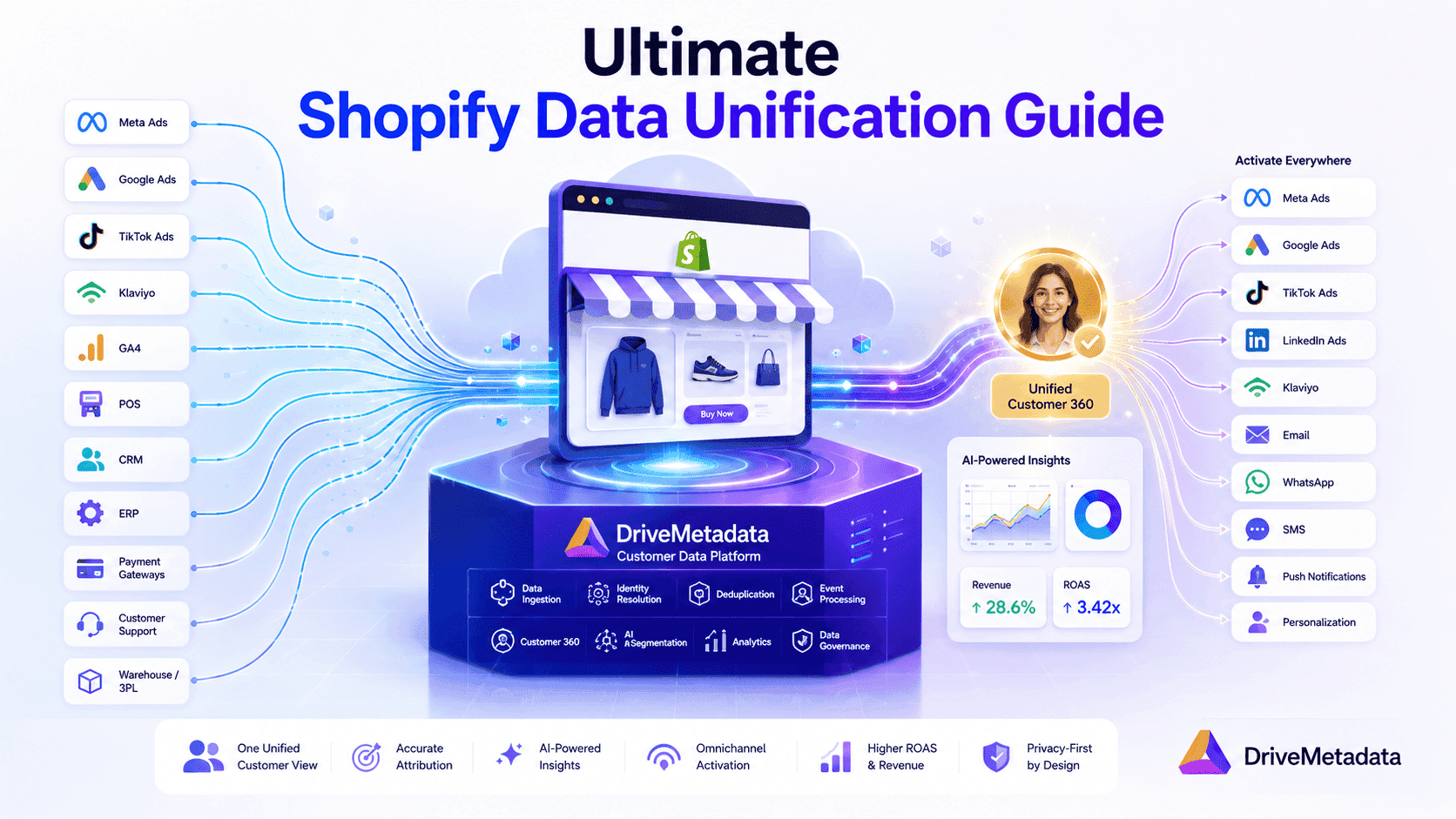
A comprehensive approach to unify Shopify customer data amid evolving privacy and analytics challenges in 2026.
Ranjeet Ranjan
AI Executive Brief
Shopify merchants face fragmented customer data and tighter privacy regulations in 2026, challenging marketing attribution and analytics. This guide presents strategies to unify data across channels, apply privacy-first governance, and leverage AI-powered segmentation and omnichannel automation to enhance marketing performance and customer lifetime value.
Shopify merchants face increasing challenges as customer data fragments across ecommerce platforms, CRM, ad channels, and offline sales. This disjointed data limits visibility into customer journeys, undermines marketing attribution accuracy, and leads to costly budget inefficiencies. In 2026, tighter privacy regulations and cookie restrictions further complicate tracking and analytics, increasing acquisition costs and operational risks. This comprehensive guide offers actionable strategies to unify Shopify data across touchpoints, address privacy-driven measurement gaps, choose effective attribution models, and harness AI-powered segmentation and omnichannel automation to optimize marketing performance.
The Growing Challenge: Fragmented Shopify Data and Privacy-Driven Constraints
Why Siloed Data Limits Shopify Store Growth and Marketing ROI
Shopify generates data from diverse sources: online storefront visits, checkout processes, email campaigns, paid advertising, social engagement, customer support, and offline sales. When this data remains isolated in separate systems, it creates an incomplete view of customer behavior. Marketers struggle to accurately attribute which channels drive conversions and often default to last-click models that misrepresent customer journeys. This fragmentation hinders effective personalization, reduces engagement, and depresses lifetime customer value—ultimately limiting store growth and marketing return on investment.
Impact of 2026 Privacy Changes on Shopify Data Integration and Analytics
Evolving privacy regulations and technology policies in 2026 have intensified restrictions on third-party data and tracking. Cookie limitations, browser privacy features, and platform-level changes reduce the reliability of third-party signals essential for campaign measurement and attribution. Shopify merchants must shift toward privacy-first data governance—prioritizing first-party, consented customer data, and protecting personal information rigorously. These constraints introduce measurement gaps and uncertainty that require advanced attribution methods and fraud detection approaches to maintain data completeness while complying with regulations.
What Shopify Data Unification Really Means for Your Business
Understanding Unified Customer Profiles Across Web, Mobile, CRM, Advertising, and Offline
Shopify data unification consolidates customer information from ecommerce platforms, CRM systems, advertising data, mobile apps, and offline sales into a single, unified customer profile. This comprehensive 360° view links browsing behavior, purchase history, advertising interactions, and offline transactions. Unified profiles empower marketers to build accurate audience segments, analyze full customer journeys, and orchestrate campaigns reflecting real, multichannel interactions rather than isolated touchpoints.
Key Benefits of Data Consolidation: Improved Personalization, Analytics, and Campaign Insights
Consolidating Shopify data breaks down silos that obstruct precise customer segmentation and targeting. This leads to personalized marketing at scale, improving engagement and customer lifetime value. Unified data enhances analytics accuracy, enabling multi-touch attribution that fairly credits all marketing interactions along the funnel, including offline conversions. As a result, marketers optimize campaign budgets and gain competitive advantage by understanding the real drivers of purchase behavior.
Step-by-Step Framework for Integrating Shopify Data Across All Channels
Gathering and Connecting Shopify Ecommerce Data with CRM, Advertising, and Offline Sales
Start by mapping all relevant data sources: Shopify ecommerce events, CRM records, advertising platforms such as Google Ads and Facebook Ads, mobile applications, and point-of-sale systems for offline sales. Integrate these using APIs, server-side tracking, or SDKs to ingest event and customer data in real-time or batches. Use consistent identifiers—email addresses, phone numbers, device IDs—to accurately link customer records while honoring privacy preferences.
Ingesting and Harmonizing Data: Real-Time Event Tracking and Data Quality Considerations
After sourcing data, standardize formats, timestamps, and event types to ensure consistency across datasets. Implement real-time event tracking to instantly capture customer actions, enabling timely personalized experiences and up-to-date analytics. Maintain high data quality by identifying and resolving missing values, duplicates, and conflicting information. Continuous monitoring of data health is essential to preserve attribution accuracy and reliable segmentation.
Ensuring Privacy-First Data Governance Throughout Integration
Privacy compliance is foundational to trustworthy data management. Collect data only with proper consent and lawful basis, applying data minimization to limit storage and sharing. Use encryption, anonymization, and strict access controls to safeguard personal information. Provide transparent customer preference management, allowing data-sharing opt-outs and deletion requests. Regularly update policies and ensure adherence to regulations like GDPR, CCPA, and other regional data laws to mitigate compliance risks and build customer trust.
Optimizing Marketing Attribution and Analytics for Shopify in a Privacy-First World
Challenges of Multi-Touch Attribution Amid Privacy-Driven Measurement Constraints
Multi-touch attribution assigns conversion credit across several customer interactions, improving understanding of campaign effectiveness. However, privacy-driven signal loss in 2026 reduces tracking completeness, leading to data gaps and potential bias. Marketers must balance attribution model complexity with available data, considering probabilistic or incremental attribution techniques that estimate the influence of untracked events while avoiding model overfitting.
Selecting Attribution Models Suitable for Shopify Customer Journeys in 2026
Choose an attribution model that aligns with the complexity of your Shopify customer journeys and level of data availability. Traditional models include first-touch, last-touch, linear, and time decay. Advanced options leverage machine learning for algorithmic attribution. Privacy-first marketing favors models able to use aggregated or partial data securely. Complementary methods like incrementality testing and media mix modeling can further refine credit assignment while adapting to data constraints.
Using Conversion Tracking and Campaign Analytics to Optimize Ad Spend
Conversion tracking links marketing interactions to business outcomes, such as online purchases, subscriptions, or offline visits, providing vital feedback on campaign performance. Combine conversion data with marketing spend and unified customer profiles to perform campaign analytics that identify ROI drivers. Focus on metrics like cost per acquisition, return on ad spend, and customer lifetime value to guide allocation of budgets toward channels and audience segments delivering the highest returns.
Leveraging AI-Powered Segmentation and Omnichannel Marketing Automation for Shopify Growth
How Predictive AI Models Enhance Customer Segmentation and Lifetime Value
AI-driven segmentation applies machine learning to identify behavioral and preference patterns beyond traditional rule-based approaches. Predictive models assign scores for churn risk, purchase likelihood, and lifetime value, enabling prioritization of high-potential customers and improved retention efforts. These dynamic segments update as new data arrives, ensuring marketing messages remain relevant and effective in real-time.
Activating Audiences Across Channels with Omnichannel Workflows and Automation
With unified customer data augmented by AI, marketers can automate omnichannel campaigns delivering consistent messaging via email, social media, web, mobile, and offline interactions. Automation workflows trigger timely communications based on customer actions or lifecycle stages, boosting engagement and operational efficiency. This coordinated approach prevents audience fatigue and duplication, strengthening brand relationships throughout the customer journey.
Common Pitfalls and Best Practices in Shopify Data Unification and Marketing Analytics
Typical Mistakes in Data Integration and Attribution Implementation to Avoid
- Ignoring data quality issues like duplicates, missing fields, or inconsistent identifiers
- Underestimating privacy and consent risks leading to compliance violations
- Relying exclusively on last-click attribution despite incomplete cross-channel data
- Failing to integrate offline sales data, missing key conversion signals
- Using overly complex attribution models unsupported by available data
- Neglecting ongoing monitoring and governance of data pipelines and analytics
Best Practices for Maintaining Data Privacy Compliance While Driving Personalization
- Collect and process only data necessary for defined marketing purposes
- Secure explicit customer consent and provide simple opt-out mechanisms
- Apply anonymization and encryption to protect data at rest and in transit
- Keep privacy policies and staff training up to date with regulatory changes
- Design segmentation and automation respecting user preferences and limits
- Conduct regular privacy audits and risk assessments to identify gaps
How to Measure Success: Metrics and KPIs for Unified Shopify Data and Marketing Impact
| Metric | Description | Why It Matters |
|---|---|---|
| Customer Lifetime Value (CLV) | Total predicted revenue from a customer over their relationship | Indicates effectiveness of personalization and retention strategies |
| Attribution Accuracy | Degree to which marketing touchpoints are fairly credited | Supports sound budget allocation and campaign optimization |
| Campaign ROI | Return on investment for specific marketing campaigns | Measures efficiency of spend and creative effectiveness |
| Data Completeness | Percentage of total customer interactions captured | Reflects quality of unified profiles and reliability of analytics |
| Segmentation Engagement Rates | Open, click, and conversion rates for audience segments | Tests relevance and precision of AI-driven segmentation |
| Privacy Compliance Score | Alignment with consent, data minimization, and governance standards | Mitigates regulatory risks and builds customer trust |
How DriveMetaData Supports Shopify Data Unification and Advanced Marketing Analytics
DriveMetaData provides an AI-powered Customer Data Platform designed to unify Shopify ecommerce data with CRM, advertising, mobile apps, and offline sources in real time. It creates comprehensive 360° customer profiles to support privacy-first marketing in 2026. Advanced multi-touch attribution and conversion tracking accommodate signal limitations and evolving compliance requirements. Predictive AI automates customer segmentation, while omnichannel marketing automation streamlines personalized campaign activation. DriveMetaData’s privacy-first governance framework ensures secure data practices and regulatory adherence, helping Shopify marketers optimize analytics and campaign effectiveness.
Final Thoughts and Next Steps to Master Shopify Data Unification in 2026
FAQ
What is Shopify data unification and why does it matter in 2026?
Shopify data unification is the process of consolidating customer data from ecommerce, CRM, advertising, mobile, and offline channels into a single profile. It matters in 2026 because privacy regulations and cookie restrictions limit tracking, requiring holistic, privacy-first strategies to ensure accurate marketing attribution and personalized customer engagement.
How can I integrate offline sales data with Shopify ecommerce data?
Integrate offline sales by connecting point-of-sale systems and offline transaction records with your Shopify and CRM data via APIs or data ingestion tools. Use consistent customer identifiers to link these records into unified customer profiles for complete journey analytics.
Which attribution models work best for Shopify marketing in a privacy-first world?
Models that handle partial or aggregated data are preferred, such as multi-touch attribution with probabilistic adjustments, media mix modeling, and incrementality testing. Transparency and adaptability to evolving privacy constraints should guide model selection.
How does AI improve customer segmentation for Shopify merchants?
AI identifies complex behavioral patterns and predicts metrics like churn risk and purchase propensity that traditional segmentation misses. This enables dynamic, data-driven audience segments that improve targeting precision and customer lifetime value.
What are common pitfalls to avoid when unifying Shopify data?
Avoid ignoring data quality issues, underestimating privacy compliance, relying solely on last-click attribution, failing to include offline data, overcomplicating attribution models, and neglecting ongoing monitoring of data pipelines and governance.
Fragmented Shopify data and privacy-driven constraints create challenges but also opportunities for ecommerce marketers ready to embrace a unified data strategy. Consolidating data across multiple channels, implementing privacy-first governance, selecting attribution models aligned with limited signal environments, and leveraging AI-powered segmentation and automation can unlock deeper customer insights and marketing efficiency. To get started, evaluate your existing data landscape, identify integration gaps, and invest in real-time, comprehensive customer intelligence solutions designed for the complex 2026 ecosystem.
Attribution Audit
Find the gaps hiding in your attribution data.
Get a focused audit of campaign tracking, ROAS signals, and conversion paths before media spend leaks into blind spots.
Related Blogs
More from our insights
Shopify Marketing Attribution Across Meta, Google Ads, and Email: A Revenue Truth Framework
Customer Data Platform · 11 min read
Shopify Customer Journey Attribution: Multi-Touch Models & Repeat Order Tracking
Customer Data Platform · 6 min read
Marketing Efficiency Ratio (MER) Needs A Warning Label For D2C Growth
Customer Data Platform · 8 min read