
A practical guide to proving whether ads created demand, captured demand, or took credit for sales that would have happened anyway.
Ranjeet Ranjan
AI Executive Brief
This article explains how to identify true ad-driven sales, reduce wasted ad spend, and prioritize campaigns that genuinely increase revenue using incrementality measurement methods, frameworks, and privacy-compliant analytics.
Paid media teams often scale campaigns because platform ROAS and attributed conversions look healthy. The problem is that those dashboards cannot prove whether ads created revenue or simply took credit for buyers who were already going to purchase. That is the incrementality problem. Ad incrementality measurement helps marketing and finance teams prove whether ads created demand, captured demand, or took credit for customers who were already going to buy.
Paid media teams often scale campaigns because platform ROAS and attributed conversions look healthy. The problem is that those dashboards cannot prove whether ads created revenue or simply took credit for buyers who were already going to purchase.
The dashboard says paid media is working. ROAS is up. Attributed conversions are up. The performance team wants more budget. Then finance asks the question that changes the meeting: "If the ads are creating so much revenue, why is contribution profit flat?"
That is the incrementality problem. Paid ads can create demand, capture existing demand, or take credit for customers who were already going to buy. Traditional attribution can help explain touchpoints, but it does not prove the sale would not have happened without the ad.
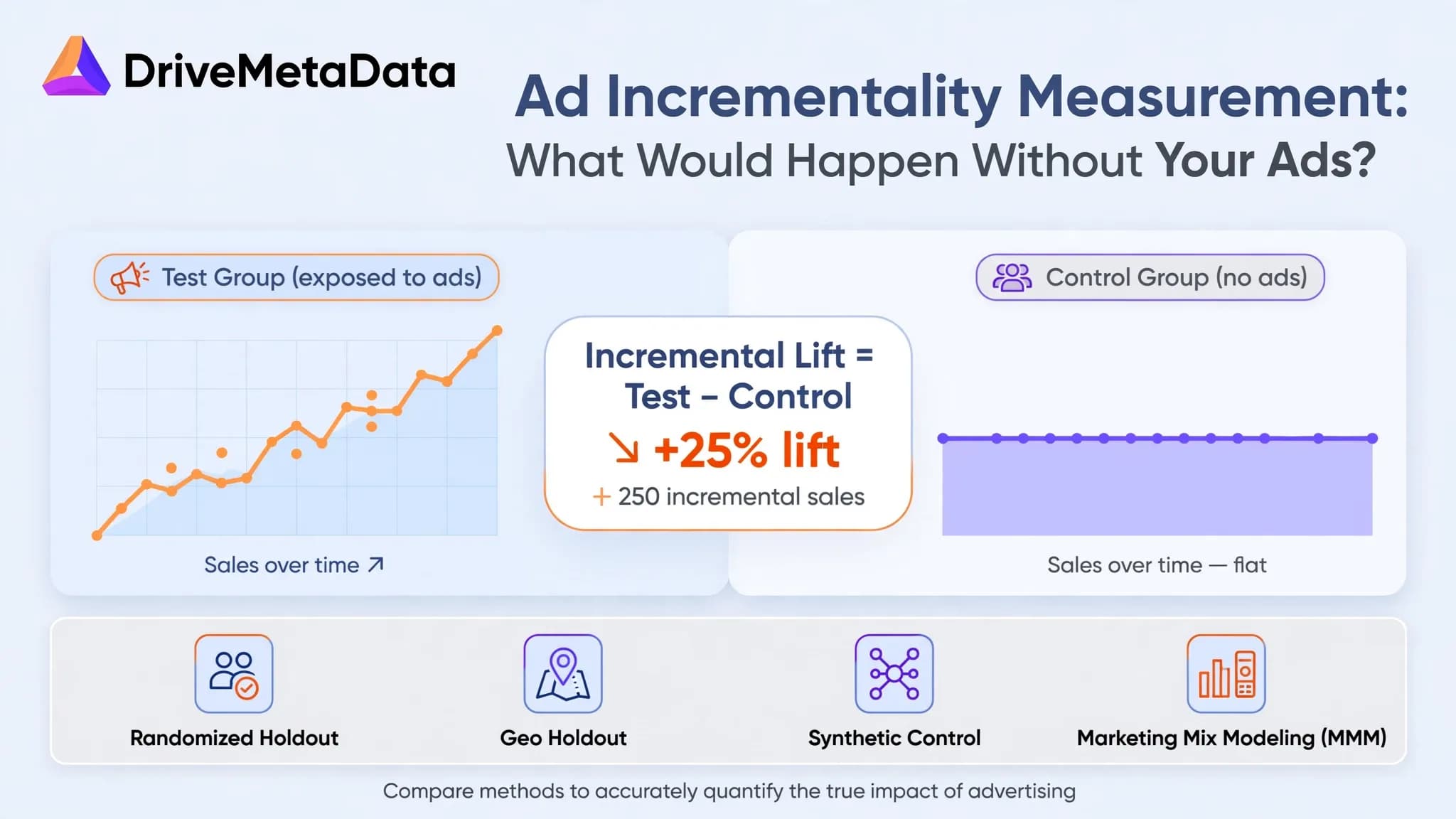
Ad incrementality measurement shows how many conversions, sales, or revenue dollars happened because advertising ran, not merely after advertising touched a buyer. The cleanest way to measure it is with a test and control design, then calculate incremental conversions, incremental revenue, iROAS, and the budget action that follows.
Ad incrementality measurement is the budget truth test. It helps CMOs, founders, growth leaders, and finance partners decide whether a campaign deserves more spend, needs a different audience, should be held steady, or should be cut.
The Credit Thief Problem
The most dangerous ad is not always the one that fails. Sometimes it is the one that looks successful while stealing credit from customers who would have converted anyway.
Retargeting is the common example. A high-intent buyer visits a product page, joins the email list, receives a lifecycle offer, searches the brand, then sees a paid ad before purchasing. The ad platform may claim the conversion. The business still needs to ask whether the ad created incremental revenue or simply intercepted an existing buyer.
Ad incrementality measurement means estimating the causal lift created by advertising. It compares exposed users, regions, or time periods against a credible control or counterfactual baseline. It matters because attributed conversions can include sales that would have happened without the campaign.
The goal is not to discredit attribution. The goal is to keep attribution in its lane. Attribution answers, "Which touchpoints received credit?" Incrementality answers, "What changed because the ad ran?" Those are different questions. Budget decisions get weaker when teams use one method to answer both. If your budget debate starts because the two methods disagree, use when attribution and incrementality disagree as the next diagnostic path.
Evidence Snapshot: What Official Sources Say About Lift Testing
| Source | Public data or official guidance | What it supports | Caveat |
|---|---|---|---|
| Google Ads Help: About lift studies | Google describes lift studies as controlled experiments that split audiences into treatment and control groups to measure outcomes beyond clicks and impressions. | Incrementality measurement needs a control design, not only attributed conversions. | Google Ads guidance is platform-specific and does not prove any individual advertiser outcome. |
| Google Ads Help: About Conversion Lift | Google says Conversion Lift measures incremental conversions driven by campaigns and can report incremental conversions, incremental conversion value, iCPA, and iROAS when eligible. | iCPA and iROAS are valid incrementality metrics when the study design and conversion data support them. | Conversion Lift is not available for every account and depends on eligibility, volume, and setup. |
| Google Ads Help: Conversion Lift based on geography | Google describes geo-based Conversion Lift as measuring causal, incremental campaign impact by aggregating conversions into non-overlapping geographic regions. | Geo experiments can support incrementality measurement when user-level holdouts are not practical. | Google notes geo-based studies typically require higher budget than user-based alternatives. |
| Meta Open Source: GeoLift | GeoLift is an open-source solution from Meta Open Source for calculating lift at a geo level; the project states it is not a Meta product and is for research purposes only. | Synthetic-control geo testing is a recognized approach for measuring lift with aggregated geography data. | Requires analytics skill and careful test design; it should not be treated as a plug-and-play platform guarantee. |
| IAB State of Data 2024 | IAB reports that privacy changes and signal loss have altered addressability, measurement, and digital advertising. Its 2024 report surveyed more than 500 advertising and data decision-makers. | Privacy-driven signal loss makes source reconciliation, first-party data, and experiment design more important. | Industry research is broad; use it as context, not as a company-specific benchmark. |
What Ad Incrementality Measurement Means
Ad incrementality measurement estimates the additional conversions, revenue, or profit caused by advertising compared with what would likely have happened without the advertising. The key phrase is "caused by."
A conversion can be attributed to an ad without being incremental. A buyer may have clicked a paid search ad because they were already planning to buy. A returning customer may have seen a retargeting ad after an email already did the work. A loyal customer may have converted during a campaign window even if the campaign had no effect.
For a CMO, founder, performance lead, growth analyst, or finance partner, ad incrementality measurement connects paid media exposure, a test group, a control group or counterfactual baseline, incremental conversions, incremental revenue, iROAS, data-quality risk, and budget action.
- Should this campaign scale?
- Should spend hold while the team improves targeting?
- Should the audience be suppressed or split?
- Should attribution rules be recalibrated?
- Should the team run a cleaner test before moving budget?
Incrementality vs Attribution vs MMM
| Method | Primary question | Best use | Weakness |
|---|---|---|---|
| Attribution | Which touchpoints should receive conversion credit? | Journey diagnostics, channel paths, campaign optimization, sales-cycle analysis | Does not prove causality by itself. |
| Incrementality | What changed because the ad ran? | Budget validation, lift testing, causal campaign evaluation | Requires test design, control groups, volume, and careful interpretation. |
| Marketing mix modeling | How do spend, seasonality, channel mix, pricing, and external factors relate to outcomes over time? | Broad budget allocation, executive planning, privacy-constrained environments | Less granular for user-level journey decisions and needs enough historical variation. |
Attribution is useful for understanding the path to conversion. Incrementality is useful for proving whether advertising created additional outcomes. MMM is useful for estimating broader channel contribution over time. A mature measurement system uses all three, then decides which method is fit for the specific budget question.
For a deeper method comparison, refer to attribution, MMM, and incrementality.
How To Calculate Incremental Lift, iROAS, And Cost Per Incremental Conversion
Start with the cleanest possible version of the question: "Compared with a credible baseline, how many extra conversions or revenue dollars did this campaign create?" Use normalized test and control groups when group sizes differ.
Incremental conversions = observed treatment conversions - expected control-baseline conversions. Relative lift (%) = incremental conversions / expected control-baseline conversions x 100. Incremental conversion value = observed treatment value - expected control-baseline value. iROAS = incremental conversion value / ad spend. Incremental cost per acquisition (iCPA) = ad spend / incremental conversions.
Platform ROAS uses attributed revenue. iROAS uses incremental conversion value. If a campaign reports strong platform ROAS but weak iROAS, the campaign may be capturing demand rather than creating it. If iROAS is strong but platform attribution is weak, the campaign may influence buyers in ways the platform report undercounts.
Illustrative Calculation
This example is illustrative, not a benchmark. A campaign spends $80,000. The experiment estimates $140,000 in incremental conversion value. iROAS = $140,000 / $80,000 = 1.75. If the finance-approved contribution margin is 45%, incremental contribution = $140,000 x 45% = $63,000, and contribution iROAS = $63,000 / $80,000 = 0.79.
The first number says the campaign created revenue. The second says the campaign may not clear the profit hurdle yet. That distinction is why incrementality should be tied to finance rules before the test starts.
The LIFT Decision Model
| Step | What to decide | What to document | Failure mode to avoid |
|---|---|---|---|
| L - Locate the business question | What decision will the test change? | Campaign, channel, audience, spend level, KPI, budget owner | Running a test with no decision attached. |
| I - Isolate treatment and control | Who or where sees the ads, and who or where does not? | Randomization logic, geo split, exclusions, campaign settings | Control contamination or unmatched regions. |
| F - Filter noise and invalid signals | What data should be excluded or adjusted? | Fraud rules, existing-customer logic, promo calendar, offline sales, delayed conversions | Counting bad events, duplicate identities, or unrelated promotions as lift. |
| T - Test for lift and uncertainty | What result is strong enough to act on? | Incremental conversions, incremental value, iROAS, confidence or credible interval, study power | Treating directional or inconclusive results as proof. |
| T - Translate to budget action | What happens if the result is positive, weak, negative, or inconclusive? | Scale, hold, suppress, retest, reallocate, or improve data quality | Ending with a report instead of a decision. |
Methodology For Using LIFT
Run LIFT before the campaign changes, not after the team already wants the answer. First, locate the exact budget decision. Second, isolate treatment and control. Third, filter noise. Fourth, test for lift with uncertainty. Fifth, translate the result into action.
The budget rule should be defined up front. For example: scale only when contribution-adjusted iROAS clears the finance hurdle; hold when lift is positive but uncertain; suppress when a retargeting segment shows weak incremental value; retest when contamination or data gaps weaken confidence.
Which Incrementality Test Should You Use?
There is no single best incrementality test. The right test depends on the decision, channel, audience size, conversion volume, privacy constraints, and operational risk.
| Test type | Best fit | Data required | Main risk | Budget decision it supports |
|---|---|---|---|---|
| Audience holdout | Owned audiences, retargeting, lifecycle, campaigns where users can be withheld | User or customer IDs, exposure logic, conversion events | Control users may still see ads through another channel or device | Whether a segment deserves spend or suppression. |
| Platform Conversion Lift | Eligible Google, Meta, or other platform campaigns | Platform setup, eligible conversion actions, enough volume, account access | Platform-specific eligibility and reporting boundaries | Whether platform spend created incremental conversions. |
| Geo experiment | Regional campaigns, offline sales, privacy-constrained measurement, cross-channel testing | Geo-level spend, revenue, conversion data, pre-period history | Regional mismatch, spillover, higher budget needs | Whether channel or campaign spend creates incremental business outcomes. |
| Synthetic-control geo test | Larger datasets with many regions and stable pre-period behavior | Time-series data by region, treatment dates, outcome metric | Poor pre-period fit can distort the counterfactual | Whether a broad campaign created lift when randomized user holdouts are not practical. |
| Ghost ads or PSA-style test | Advanced paid media experimentation where auction-level control is possible | Platform or ad-tech support, impression-level logic | Complexity and limited availability | Whether impressions, not just targeting, created incremental action. |
| MMM calibration | Executive budget planning across channels | Historical spend, outcomes, seasonality, pricing, macro factors | Less useful for fine-grained audience decisions | Whether experiment results should adjust longer-term planning models. |
Use audience holdouts when you can withhold users cleanly. Use geo experiments when user-level control is not practical or when offline outcomes matter. Use platform lift when eligibility and volume are available. Use MMM calibration when the question is about broader budget allocation rather than one campaign. Audience holdouts also depend on clean audience segmentation, because a control group is only useful when the business knows who was eligible, who was exposed, and who should have been excluded.
Warning Labels: What Makes Incrementality Tests Misleading
| Warning label | What it looks like | Why it matters | Fix before acting |
|---|---|---|---|
| Contaminated control | Control users or control regions still receive ads | The baseline is no longer clean | Audit exclusions, channel overlap, geo spillover, and audience syncs. |
| Weak pre-period fit | Test and control regions behaved differently before the campaign | The counterfactual may be unreliable | Re-match regions or use a different test design. |
| Underpowered test | The result is noisy or inconclusive | The team may overreact to random variation | Check feasibility, conversion volume, duration, and expected effect size. |
| Promotion collision | A discount, launch, influencer event, or inventory change happens during the test | Lift may be caused by something other than the ad | Freeze major commercial changes or document them before analysis. |
| Identity breakage | The same person appears as multiple customers or devices | Incremental customers and repeat buyers may be misclassified | Resolve identity rules and deduplicate before measurement. |
| Offline blind spot | Store, call-center, CRM, or sales data is missing | Incremental value may be undercounted | Reconcile offline and digital outcomes before the readout. |
| Margin blind spot | Revenue lift is positive but contribution is weak | The campaign can create sales while losing money | Report contribution-adjusted iROAS with finance-approved assumptions. |
The most common incrementality mistake is treating an inconclusive test as a failed campaign or a positive point estimate as proof. Incrementality results should be interpreted with uncertainty, data-quality checks, and a pre-agreed budget rule. If duplicate people, devices, or customer records are distorting test groups, fix identity resolution for attribution before trusting the readout.
Illustrative CMO/CFO Scenario: Platform ROAS Is Up, Incremental Revenue Is Flat
This scenario is illustrative and not a customer case study. A D2C subscription brand enters its monthly growth review with a familiar conflict. The paid social dashboard shows strong attributed conversions. The CMO sees a campaign that appears ready to scale. The CFO sees flat contribution profit and asks whether the campaign created new revenue or simply reached buyers who were already influenced by email, organic search, and previous brand exposure.
The team uses LIFT to structure the decision. Locate: decide whether to move more budget into retargeting or shift spend into prospecting and lifecycle activation. Isolate: set up a geo-based test because user-level suppression across every paid and owned channel is not clean enough. Filter: document promotions, exclude invalid activity, separate new and returning customers, reconcile ecommerce orders with CRM subscriptions, and check control-region exposure. Test: compare incremental conversion value with media spend, then calculate iROAS and contribution-adjusted iROAS. Translate: if retargeting shows weak incremental value, do not scale just because platform ROAS looks good.
The result to measure is not "did the dashboard look better?" The result to measure is whether paid media created incremental contribution that finance can defend.
Metrics & Evidence
| Metric | Formula / how to calculate | Source type | Freshness needed | What it proves | Caveat | Action trigger |
|---|---|---|---|---|---|---|
| Incremental conversions | Observed treatment conversions - expected control-baseline conversions | Experiment data, platform lift report, warehouse events | Per study period | How many conversions likely happened because ads ran | Requires clean treatment/control design | Scale only when incremental conversions clear the decision threshold. |
| Relative lift | Incremental conversions / expected control-baseline conversions x 100 | Experiment analysis | Per study period | Strength of lift relative to baseline demand | Can look large on a small baseline | Investigate when lift is positive but volume is too small to matter. |
| Incremental conversion value | Observed treatment value - expected control-baseline value | Revenue, ecommerce, CRM, offline sales | Per study period | Revenue value created beyond baseline | Depends on clean revenue definitions | Compare with media spend and contribution margin. |
| iROAS | Incremental conversion value / ad spend | Experiment plus finance spend | Per study and budget review | Revenue generated per ad dollar based on incremental value | Revenue iROAS is not contribution profit | Scale only when iROAS clears the finance-approved hurdle. |
| Contribution iROAS | Incremental contribution profit / ad spend | Finance margin, discounts, returns, fulfillment cost | Monthly or per test readout | Whether lift survives unit economics | Needs finance-approved margin logic | Hold or rework campaign when revenue lift exists but contribution is weak. |
| iCPA | Ad spend / incremental conversions | Experiment plus spend data | Per study period | Cost to acquire one incremental conversion | Not useful if conversion value varies widely | Compare with CAC, payback, and LTV quality. |
| Attribution-to-incrementality gap | Platform-attributed conversions / incremental conversions | Platform attribution and lift test data | Per campaign test | Whether attribution may be overstating or understating causal impact | Requires comparable conversion definitions | Recalibrate reporting when attribution and lift diverge materially. |
How To Turn Incrementality Results Into Budget Decisions
- Scale: lift is positive, uncertainty is acceptable, contribution-adjusted iROAS clears the finance hurdle, and data-quality checks pass.
- Hold: lift is positive but uncertainty, conversion lag, or contribution margin needs another read.
- Fix: the test shows contamination, weak identity matching, missing offline outcomes, or incompatible conversion definitions.
- Suppress or reallocate: lift is weak or negative, especially when platform attribution is high.
Incrementality should change budget only when the result is strong enough for the decision. A weak or inconclusive read does not automatically mean the campaign failed. It may mean the test was underpowered, contaminated, too short, or measuring the wrong outcome.
How DriveMetaData Fits
DriveMetaData helps marketing and finance teams turn incrementality from a one-off test into a repeatable measurement workflow.
The practical need is data trust. Incrementality analysis depends on consistent customer identity, clean conversion events, accurate spend, audience definitions, fraud filtering, offline and CRM reconciliation, and clear outcome metrics. If those inputs are messy, a lift test can produce a confident answer to the wrong question.
DriveMetaData is designed to support this workflow by helping teams unify customer and campaign data, resolve identities across source systems, detect invalid activity, compare attribution with incrementality reads, and activate cleaner audiences after the test. The platform fit is strongest when the business needs to know whether the next action is scale, hold, suppress, retest, or reallocate.
FAQ
What is ad incrementality measurement?
Ad incrementality measurement estimates the conversions, revenue, or profit caused by advertising compared with a credible control or baseline. It helps marketers separate sales created by ads from sales that likely would have happened anyway through brand demand, organic traffic, email, direct traffic, or returning-customer behavior.
How is incrementality different from attribution?
Attribution assigns credit to touchpoints in a customer journey. Incrementality estimates causal lift by comparing exposed buyers with a control group or counterfactual baseline. Attribution is useful for journey diagnostics. Incrementality is stronger for budget validation because it asks what changed because the advertising ran.
What is iROAS?
iROAS means incremental return on ad spend. It is usually calculated as incremental conversion value divided by ad spend. It differs from platform ROAS because it uses estimated incremental value, not all platform-attributed revenue. For finance decisions, teams should also review contribution-adjusted iROAS.
Which incrementality test should a marketing team use?
Use an audience holdout when users can be withheld cleanly. Use a geo experiment when user-level suppression is not practical, offline outcomes matter, or cross-channel measurement is needed. Use a platform Conversion Lift study when the account, campaign, and conversion volume are eligible. Use MMM calibration for broader planning.
How long should an incrementality test run?
The test should run long enough to capture the normal conversion cycle, enough volume for a useful read, and enough stability to avoid reacting to noise. There is no universal duration. Teams should check feasibility, study power, conversion lag, seasonality, and campaign learning behavior before setting the test window.
Can incrementality measurement work without third-party cookies?
Yes, but the design matters. Geo experiments, aggregated conversion data, first-party customer data, clean CRM records, and modeled counterfactuals can support incrementality measurement when user-level tracking is limited. The article should still avoid claiming that any method automatically solves privacy or compliance requirements.
What makes an incrementality test unreliable?
Common failure points include contaminated controls, weak pre-period fit, small samples, overlapping promotions, missing offline sales, duplicate identities, invalid conversions, delayed purchase cycles, and unclear budget rules. A test should document these risks before launch and qualify the result when they appear.
Ad incrementality measurement should end with a budget decision, not just a lift chart. The strongest read combines a clear business question, credible treatment and control design, noise filtering, iROAS and contribution analysis, and a pre-agreed action rule. Use attribution to understand journeys, use incrementality to test causal lift, and use clean customer and revenue data to decide whether to scale, hold, fix, suppress, or reallocate spend.
Attribution Audit
Find the gaps hiding in your attribution data.
Get a focused audit of campaign tracking, ROAS signals, and conversion paths before media spend leaks into blind spots.
Related Blogs
More from our insights
Shopify Customer Journey Attribution: Multi-Touch Models & Repeat Order Tracking
Customer Data Platform · 6 min read
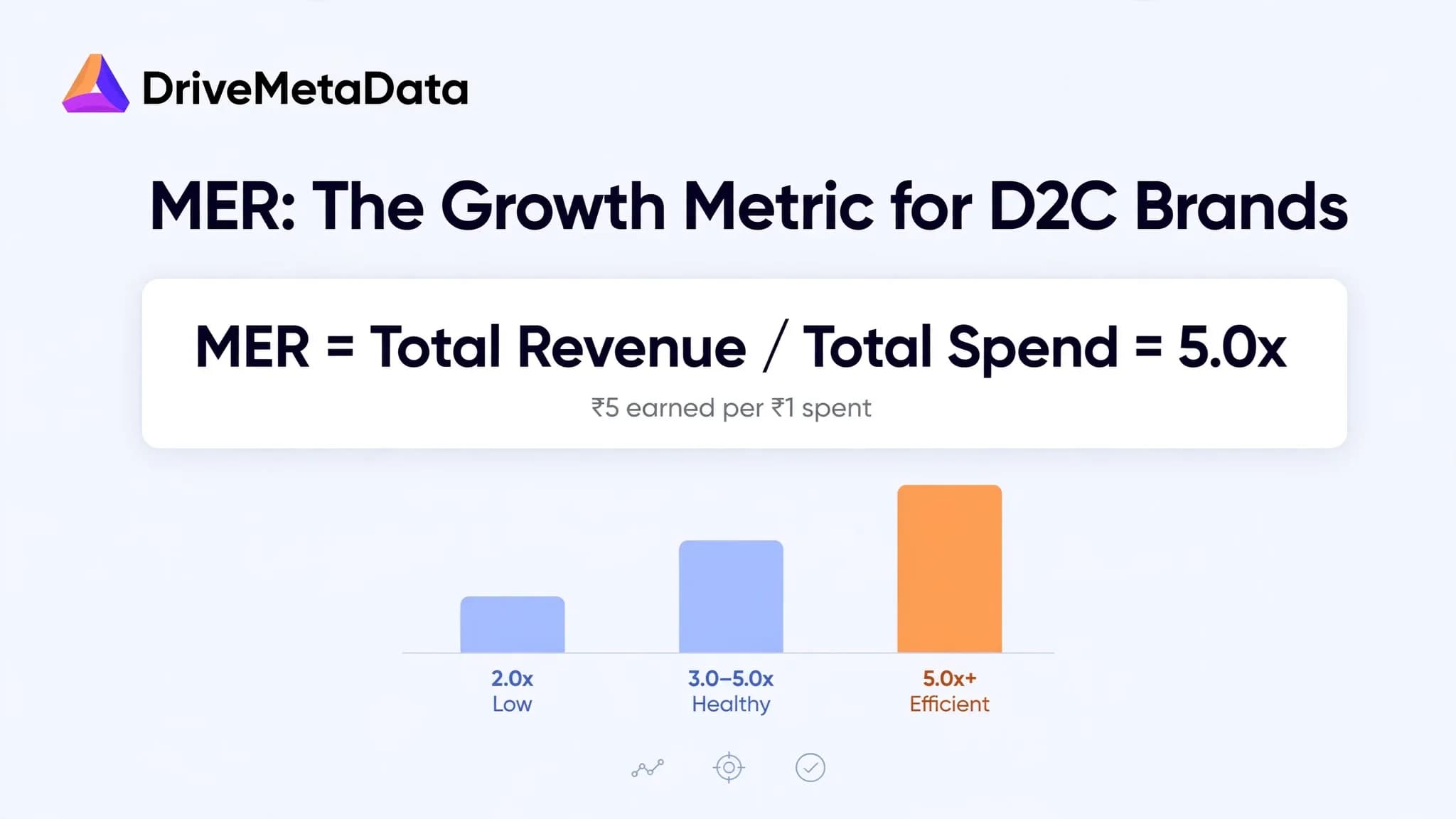
Marketing Efficiency Ratio (MER) Needs A Warning Label For D2C Growth
Customer Data Platform · 8 min read
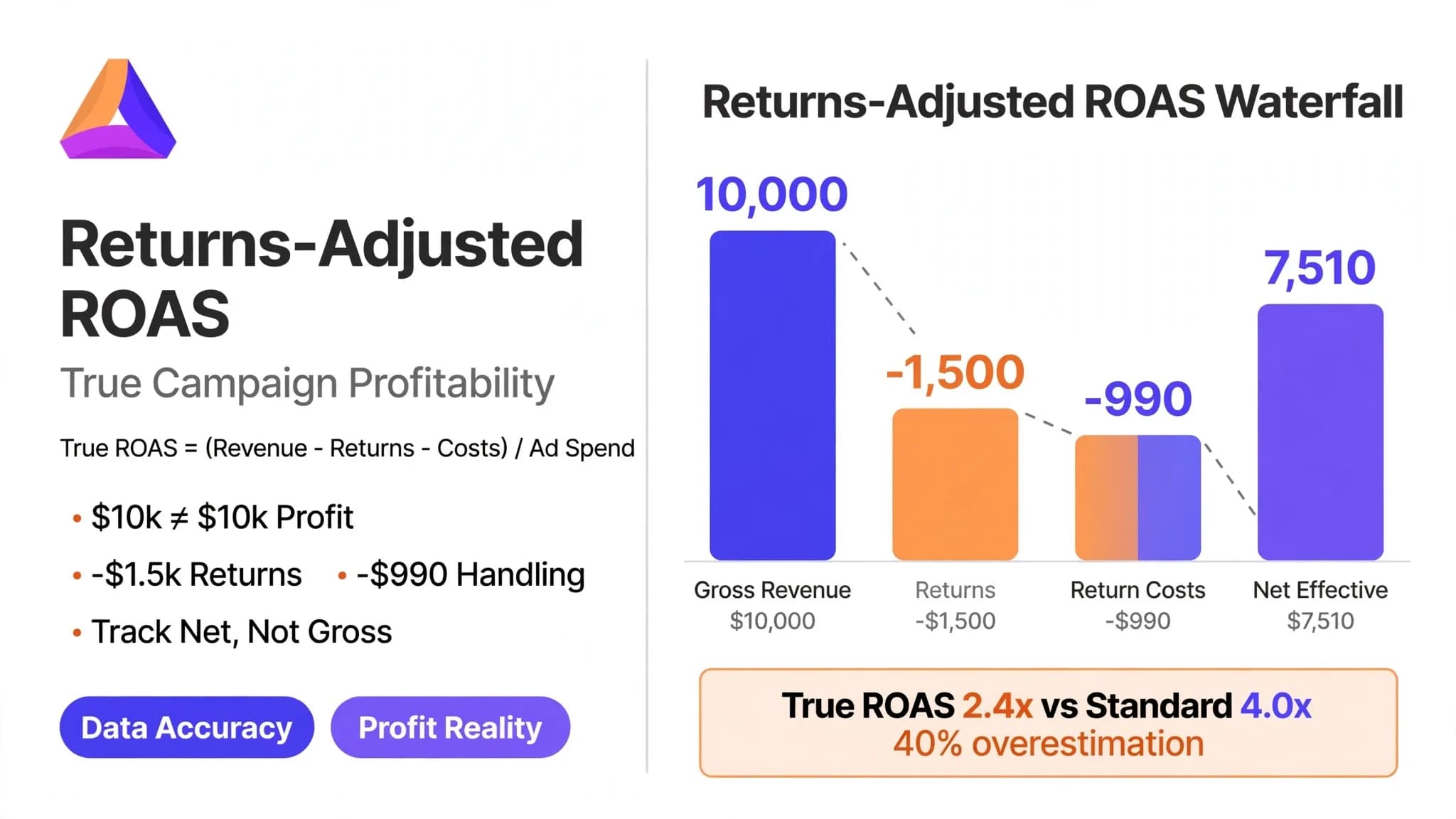
Returns-Adjusted ROAS: Formula, Calculation & How to Measure True Ecommerce Profitability
Customer Data Platform · 11 min read