
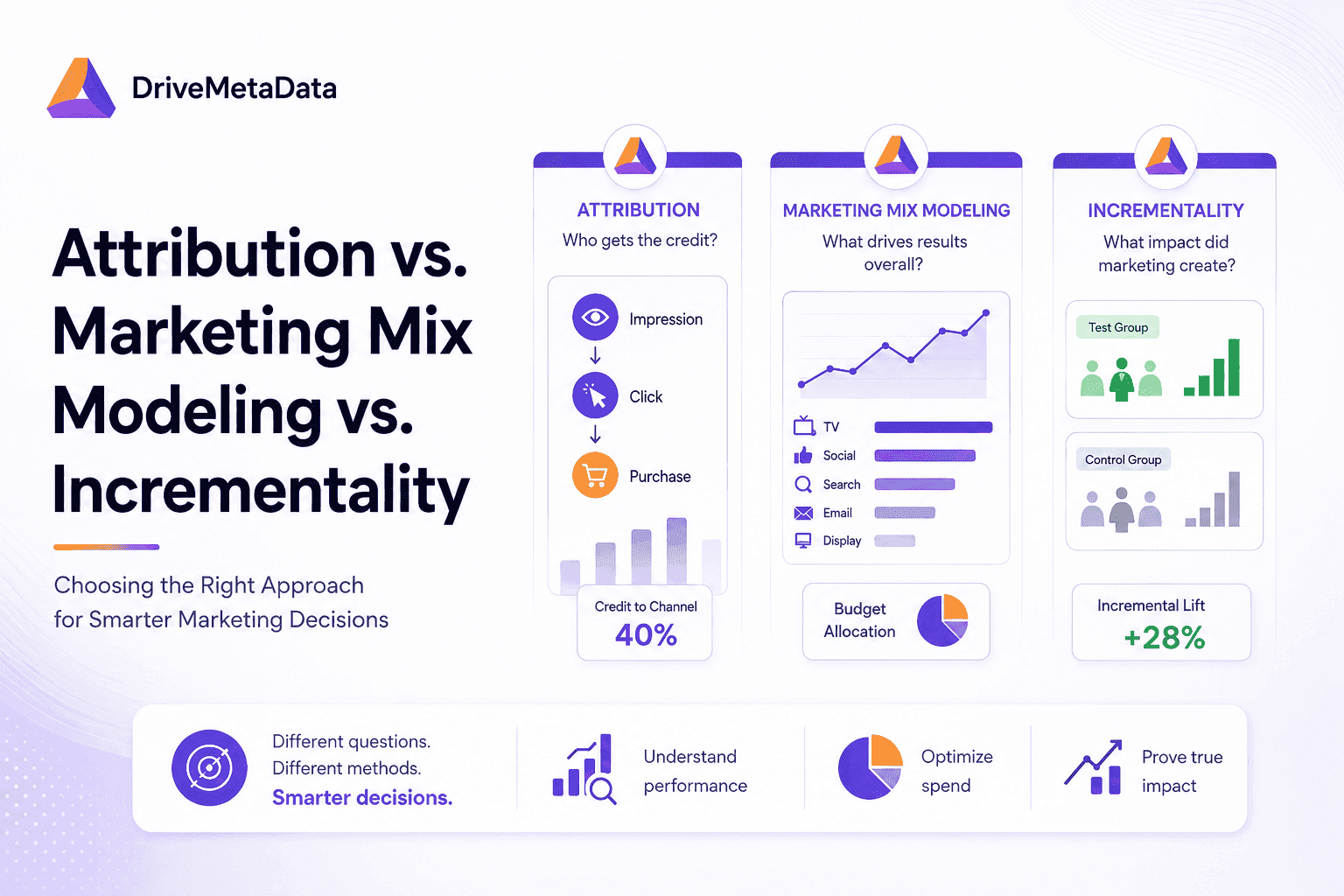
A practical decision framework for choosing attribution, marketing mix modeling, or incrementality by question, data quality, and budget risk.
Ranjeet Ranjan
AI Executive Brief
Attribution, marketing mix modeling, and incrementality testing are not interchangeable measurement methods. They answer different business questions at different levels of proof, speed, and granularity. This article gives growth, analytics, and finance teams a practical framework for deciding when to trust each method, how to reconcile conflicting results, and how to avoid budget decisions based on a single incomplete dashboard.
Your attribution dashboard says paid social is profitable. Your marketing mix model says the channel is close to saturation. Your incrementality test says only part of the reported revenue would disappear if the ads stopped. None of those numbers is automatically wrong. They are answering different questions.
The Short Version
Attribution, marketing mix modeling, and incrementality are three different marketing measurement methods. Use attribution to assign conversion credit across digital touchpoints, MMM to estimate channel contribution across the full media mix, and incrementality testing to prove causal lift. The right method depends on the business decision, data quality, time horizon, and budget risk.
Attribution assigns credit, MMM estimates contribution, and incrementality tests causality.
The practical question is not "which model is best?" The better question is "which model should lead this decision?"
Entity map: marketing measurement connects growth leaders, analytics teams, and finance teams with source systems such as ad platforms, web analytics, CRM, ecommerce, subscription, and offline revenue data. The relevant product pillars are marketing analytics, customer data quality, identity resolution, and attribution. The core risk is moving budget from incomplete or mismatched evidence.
Attribution, MMM, And Incrementality Answer Different Questions
Attribution means assigning credit for a conversion, purchase, lead, booking, or other key action across marketing touchpoints. It matters because growth teams need fast feedback on campaigns, audiences, keywords, creative, email, and journeys.
Marketing mix modeling, or MMM, means estimating how media spend, non-media factors, seasonality, pricing, promotions, and external conditions contribute to business outcomes over time. It matters because leaders need budget guidance across channels, including channels that do not create clean click paths.
Incrementality testing means measuring what changed because marketing happened. It compares a treatment group against a control group, a test geography against control geographies, or an observed result against a credible counterfactual. It matters because finance teams need to know whether spend created outcomes that would not have happened anyway.
| Method | Primary question | Best use | Data grain | Main risk |
|---|---|---|---|---|
| Attribution | Which touchpoints should receive credit? | Tactical optimization across ads, email, web, and lifecycle journeys | User, session, event, click, impression, order, lead, or account path | It can over-credit touchpoints near conversion and confuse credit with causality. |
| Marketing mix modeling | How much did each channel contribute over time? | Budget planning, channel mix, offline media, saturation, and forecasting | Aggregate time-series data such as spend, impressions, revenue, promotions, seasonality, pricing, and market variables | It can hide campaign-level issues and depends on model design, controls, and data history. |
| Incrementality testing | What happened because marketing ran? | Causal validation for major spend decisions, new channels, retargeting, and suspicious attribution | Treatment/control groups, geo tests, holdouts, or experiment cells | It can be narrow, expensive, time-bound, or inconclusive when test design is weak. |
This comparison is the core distinction: attribution assigns credit, MMM estimates contribution, and incrementality tests causality.
What The Evidence Says
This topic is evidence-heavy because it affects ROAS, CAC, attribution, revenue reporting, privacy-sensitive measurement, and budget allocation. Use source-backed guidance for definitions and claims, then keep operating examples clearly labeled as illustrative.
| Source | Public data or official guidance | What it supports | Caveat |
|---|---|---|---|
| Google Analytics developer docs for GA4 collection | Google documents GA4 event collection for websites and apps. | Measurement quality depends on implemented events, source-system setup, and the data captured before reporting. | Event collection documentation supports data-quality requirements, not a guarantee that attribution is complete. |
| Google Meridian documentation | Google describes Meridian as an open-source MMM framework with Bayesian modeling and causal inference capabilities. | MMM can support channel contribution, ROI, response curves, and budget allocation questions. | MMM quality depends on data completeness, controls, priors, assumptions, and calibration. |
| Meta Robyn documentation | Meta Marketing Science describes Robyn as an experimental, open-source, AI/ML-powered MMM package. | Modern MMM workflows can use open-source tooling, saturation logic, calibration, and budget allocation support. | Robyn is a modeling framework, not an automatic source of business truth. |
| Meta Open Source GeoLift | Meta Open Source describes GeoLift as a tool for measuring geo-level lift with synthetic-control methods. | Incrementality can be measured with geo experiments when user-level holdouts are not practical or are not desired. | Geo experiments require sound market selection, enough signal, and careful interpretation. |
| IAB State of Data 2024 | IAB reports that privacy change and signal loss have changed addressability, measurement, and digital advertising practices. | Privacy-driven signal loss makes first-party data, aggregate modeling, and experiment design more important. | Industry research is broad context, not a benchmark for any one advertiser. |
The Measurement Authority Matrix
The Measurement Authority Matrix gives each method a job. It prevents teams from treating platform ROAS, attribution ROAS, MMM contribution, and lift-test results as interchangeable numbers.
| Decision | Primary method | Secondary check | Why this method should lead | Action if evidence conflicts |
|---|---|---|---|---|
| Adjust bids, creative, keywords, audiences, or email journeys this week | Attribution | Conversion lag, CRM match rate, incrementality history | The decision is granular and needs speed. | Optimize tactically, but do not move major budget from attribution alone. |
| Set quarterly channel budgets | MMM | Incrementality tests for high-spend channels and attribution trend checks | The decision is about total channel contribution, saturation, and portfolio allocation. | Calibrate the largest or most uncertain channel with a lift test. |
| Prove whether a campaign created new revenue | Incrementality testing | Attribution for operational diagnosis and MMM for portfolio context | The decision requires a causal answer. | Wait for the test readout or document uncertainty before scaling. |
| Evaluate retargeting, branded search, affiliates, or lower-funnel media | Incrementality testing | New-vs-returning revenue, audience overlap, attribution paths | These channels can capture demand that already existed. | Cap scale until lift, audience quality, and overlap are understood. |
| Measure TV, CTV, OOH, retail media, or offline influence | MMM or geo experiment | Branded search, store sales, CRM revenue, and market-level trends | These channels often lack reliable user-level click paths. | Avoid cutting channels only because digital attribution is low. |
| Explain marketing performance to finance | Incrementality plus MMM | Attribution as supporting operational detail | Finance needs contribution and causal evidence, not only touchpoint credit. | Present a confidence-weighted recommendation and caveats. |
The matrix does not make one method the permanent winner. It makes the decision explicit before the team argues about dashboards.
Methodology: Choose By Question, Grain, Speed, And Proof
Use this four-step method before you choose attribution, MMM, or incrementality.
- Name the decision. Are you changing a bid, moving a channel budget, defending a board plan, or testing a new campaign?
- Name the unit of decision. Is the decision about a keyword, ad set, journey, channel, geography, customer segment, or full portfolio?
- Name the evidence standard. Is directional evidence enough, or does the decision require finance-grade causal proof?
- Name the data risk. Check identity match quality, event completeness, CRM revenue joins, offline sales, conversion lag, refunds, privacy constraints, and campaign naming.
Attribution should lead when the team needs fast, granular optimization and the user-level data path is reliable. MMM should lead when the team needs portfolio allocation across channels and time. Incrementality should lead when the question is whether marketing caused the outcome.
When To Use Attribution
Use attribution when the decision is tactical. Attribution is useful for deciding which campaigns, audiences, keywords, offers, touchpoints, or lifecycle journeys deserve more attention now.
Attribution is strongest when events are captured reliably, customer IDs are deduplicated, conversion windows are understood, and the channel creates measurable digital interactions. A strong identity resolution for attribution process helps reduce duplicate customers, fragmented paths, and channel-credit errors.
Attribution is weaker when the path is incomplete, the buying cycle is long, offline influence matters, privacy restrictions limit signal, or a channel captures demand that would have converted anyway. Attribution can support budget decisions, but it should not be the only proof for major spend increases.
When To Use Marketing Mix Modeling
Use MMM when the decision is strategic. MMM is useful for quarterly planning, annual budget setting, scenario planning, offline media evaluation, saturation analysis, and channel-level contribution.
MMM is especially useful when the channel mix includes TV, CTV, OOH, retail media, direct mail, stores, call centers, partners, or other touchpoints that do not produce reliable person-level click paths. It can also help when privacy-driven measurement constraints make user-level tracking less complete.
MMM is not a shortcut around poor data. It still needs consistent spend, impressions, revenue, promotions, seasonality, pricing, and control variables. It also needs plain-language assumptions so executives understand where the model is confident and where the model is estimating.
When To Use Incrementality Testing
Use incrementality testing when the decision requires causal proof. It is the strongest fit when a channel looks too good in attribution, when finance questions the revenue impact, when a new channel needs validation, or when a major budget increase depends on proving lift.
Common approaches include user holdouts, conversion lift studies, geo experiments, matched-market tests, and synthetic controls. Each approach has tradeoffs. User holdouts can be precise but may be limited by platform eligibility and privacy constraints. Geo experiments can support offline and aggregate data, but they often require more planning, budget, and statistical review.
For a deeper testing workflow, use ad incrementality measurement as the next step after this comparison.
Metrics And Evidence
Marketing measurement gets clearer when each metric is tied to a decision and a source type. Do not compare metrics unless the time window, revenue definition, conversion lag, and customer definition are aligned.
| Metric | Formula / how to calculate | Source type | Freshness needed | What it proves | Caveat | Action trigger |
|---|---|---|---|---|---|---|
| Attribution ROAS | Attributed revenue divided by ad spend | Ad platform, analytics, or multi-touch attribution model | Daily or weekly, with attribution-window awareness | Which campaigns or touchpoints received conversion credit | It does not prove the conversion would not have happened without the touchpoint | Use for bids, creative, audiences, and tactical optimization. |
| Incremental revenue | Treatment revenue minus control or expected baseline revenue | Lift test, holdout, geo experiment, synthetic control, or calibrated model | Same test window plus conversion lag | Revenue estimated to have happened because marketing ran | Baseline quality and test design determine usefulness | Use before scaling spend when causality matters. |
| iROAS | Incremental conversion value divided by total ad spend | Conversion lift, geo lift, holdout, or incrementality model | Same spend and revenue period | Incremental value per dollar spent | Requires reliable incremental value, not attributed value | Scale only when iROAS clears the finance-approved margin and payback hurdle. |
| MMM contribution | Modeled contribution by channel over a defined period | MMM model using aggregate spend, revenue, controls, and external variables | Monthly or quarterly refresh, depending on planning cadence | Estimated channel contribution and response curve | Depends on model assumptions, input quality, priors, and controls | Use for channel mix, saturation, and budget allocation. |
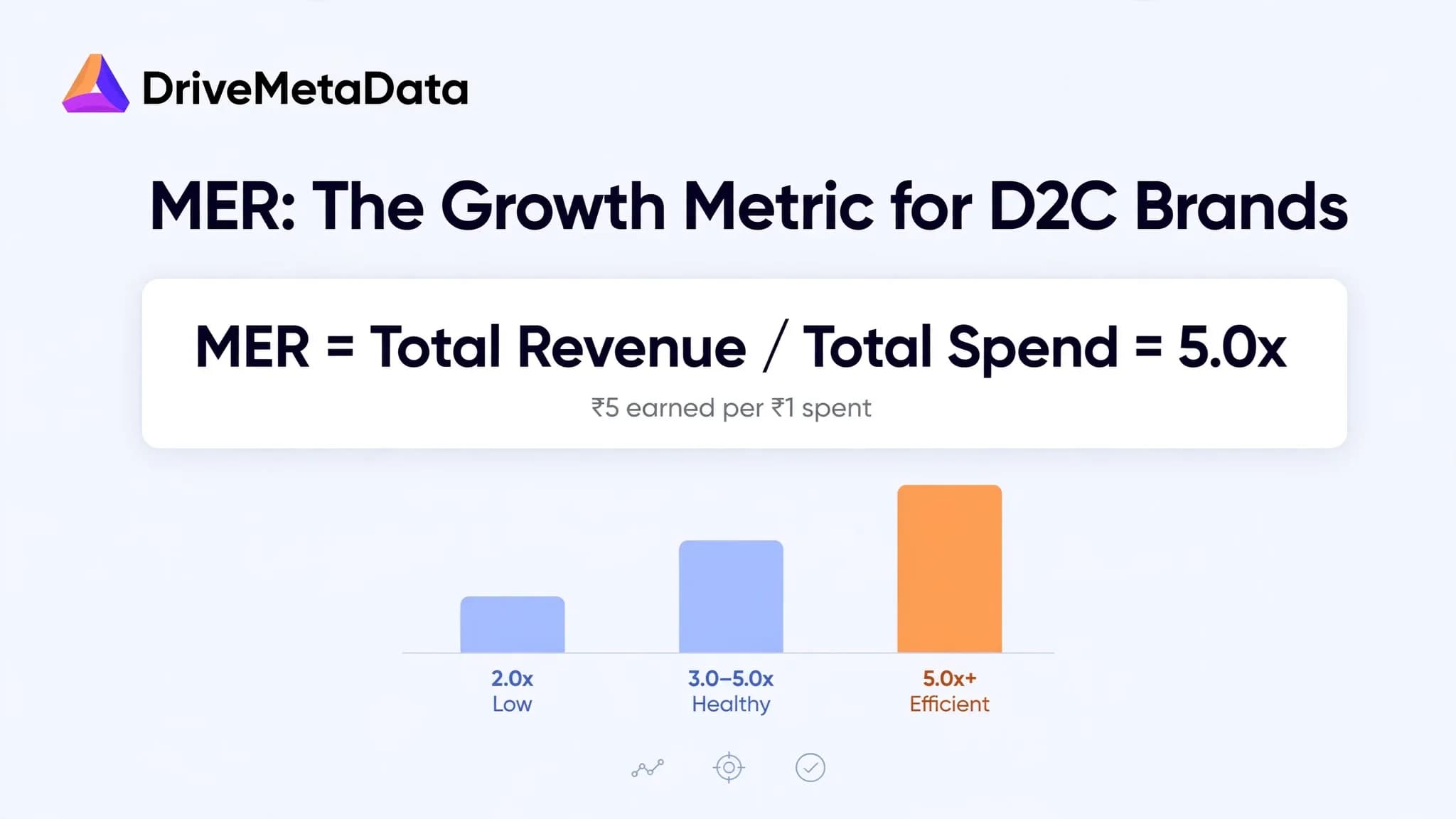
| MER | Total revenue divided by total marketing spend | Finance, ecommerce, CRM, subscription, or revenue system | Weekly, monthly, and quarterly | Blended business efficiency | MER does not explain which channel caused revenue | Use as a guardrail when channel dashboards look healthy but total efficiency weakens. |
| Model disagreement delta | Difference between two method estimates divided by the average of both estimates | Attribution, MMM, lift test, and finance actuals | Same time window and revenue definition | Size of the conflict between methods | Diagnostic only; not a performance benchmark | Investigate when the gap changes the budget recommendation. |
For example, if a lift test reports USD 180,000 in incremental conversion value on USD 100,000 in spend, the illustrative iROAS is 1.8. That is not a benchmark. Whether 1.8 is good depends on gross margin, payback period, retention, cash timing, and the campaign's role in the portfolio.
Scenario: The Retargeting Budget Conflict
Consider an illustrative ecommerce team preparing a monthly budget review.
The paid social dashboard shows strong attributed revenue from retargeting. The growth team wants to increase budget. Finance sees blended efficiency flattening and asks why total revenue is not rising at the same pace as attributed revenue. The analytics team checks audience overlap and sees that many buyers were already active in email, search, and onsite journeys before retargeting exposure.
The right move is not to ignore attribution. Attribution still helps the team clean up creative, frequency, audience windows, and journey sequencing. The right move is to stop using attribution as the primary evidence for a budget increase.
The team should use incrementality as the lead method for the spend decision, attribution as the diagnostic method for campaign cleanup, and MMM as the planning context for total channel contribution. If the lift test shows weak incremental value, the team can cap retargeting, suppress recent high-intent buyers, move test budget into prospecting or lifecycle offers, and retest after the audience strategy changes.
The caveat: the result applies to the tested audience, period, offer, and media conditions. It should feed future MMM calibration and attribution QA, but it should not become a permanent rule without revalidation.
What To Do When The Methods Disagree
Disagreement is normal. It becomes dangerous only when the team has no rule for resolving it.
| Pattern | What it may mean | Next action |
|---|---|---|
| Attribution high, MMM low, incrementality low | The channel may be taking credit for demand that already existed. | Inspect retargeting, branded demand, returning customers, audience overlap, and attribution windows before scaling. |
| Attribution low, MMM high, incrementality unknown | The channel may influence demand before or outside the click path. | Check lagged revenue, branded search movement, geo-level response, and CRM outcomes before cutting. |
| MMM positive, incrementality weak | MMM may be absorbing seasonality, pricing, promo, or baseline demand. | Review controls and calibrate the model with experiment results. |
| Incrementality positive, attribution weak | Tracking loss, long sales cycles, offline revenue, or identity gaps may hide impact from attribution. | Protect the tested channel while fixing event capture and revenue joins. |
| All three conflict with finance revenue | The measurement foundation may be unstable. | Pause large reallocations, reconcile definitions, and audit source systems before deciding. |
If the disagreement itself is the problem, read when measurement methods disagree before presenting three conflicting dashboards to finance.
Common Mistakes
- Treating attributed revenue as incremental revenue. Credit assignment is not the same as causality.
- Using MMM for ad-level optimization. MMM is usually too aggregate for creative, keyword, or journey decisions.
- Using a short lift test to make a permanent budget rule. Experiments have time, audience, and market boundaries.
- Comparing mismatched windows. A weekly attribution dashboard should not be casually compared with a quarterly MMM readout.
- Ignoring conversion lag. Pipeline, subscription, offline, and B2B revenue can mature after the reporting window.
- Skipping source-system QA. Bad event capture, duplicate IDs, stale CRM stages, or missing refund data can distort every method.
- Letting platform incentives define the evidence standard. Platform reports are useful, but finance should not treat them as the only proof for scale.
How DriveMetaData Supports Integrated Measurement
DriveMetaData helps marketing, growth, and analytics teams connect event data, CRM outcomes, channel spend, journey behavior, and revenue context in one measurement workflow. The goal is not to force attribution, MMM, and incrementality to report the same number. The goal is to show why the numbers differ and what action is reasonable.
For teams evaluating marketing attribution software, this distinction matters. A useful platform should help teams separate credit, contribution, and causal lift instead of turning every dashboard into a sales claim.
DriveMetaData is designed to support measurement decisions across first-party data, identity quality, multi-touch attribution, journey analysis, audience quality, and revenue reporting. That makes the platform most useful when the buyer needs revenue-trusted growth intelligence, not another isolated channel report.
FAQ
What is the difference between attribution, MMM, and incrementality?
Attribution assigns credit to marketing touchpoints. Marketing mix modeling estimates channel contribution over time using aggregate data. Incrementality testing measures causal lift by comparing exposed and unexposed groups, test and control markets, or observed outcomes against a credible baseline.
Is incrementality better than attribution?
Incrementality is better for causal proof. Attribution is better for fast tactical optimization when the data path is reliable. A strong marketing measurement system uses both: attribution to improve campaigns and incrementality to validate whether major spend decisions create outcomes that would not have happened anyway.
Is MMM better than attribution?
MMM is better for budget planning, offline media, saturation, and channel-level contribution. Attribution is better for campaign, audience, keyword, and journey optimization. MMM and attribution answer different questions, so one should not permanently replace the other.
When should a business use all three methods?
Use all three when spend is material, the channel mix is broad, finance needs budget confidence, privacy-driven signal loss affects user-level tracking, or attribution and revenue outcomes disagree. Attribution can guide daily optimization, MMM can guide planning, and incrementality can validate high-stakes assumptions.
What is iROAS?
iROAS means incremental return on ad spend. It is calculated as incremental conversion value divided by total ad spend. Unlike attribution ROAS, iROAS tries to estimate value caused by ads beyond what would have happened without the ads. It should be interpreted with margin, payback, and test-design caveats.
What should teams do before trusting any measurement model?
Teams should verify event capture, customer identity, campaign naming, spend imports, CRM revenue joins, offline sales, refunds, conversion lag, attribution windows, model assumptions, and test design. Measurement quality depends on source-system quality before it depends on dashboard polish.
Attribution Audit
Find the gaps hiding in your attribution data.
Get a focused audit of campaign tracking, ROAS signals, and conversion paths before media spend leaks into blind spots.
Related Blogs
More from our insights

Shopify Marketing Attribution Across Meta, Google Ads, and Email: A Revenue Truth Framework
Customer Data Platform · 11 min read
Shopify Customer Journey Attribution: Multi-Touch Models & Repeat Order Tracking
Customer Data Platform · 6 min read
Marketing Efficiency Ratio (MER) Needs A Warning Label For D2C Growth
Customer Data Platform · 8 min read